


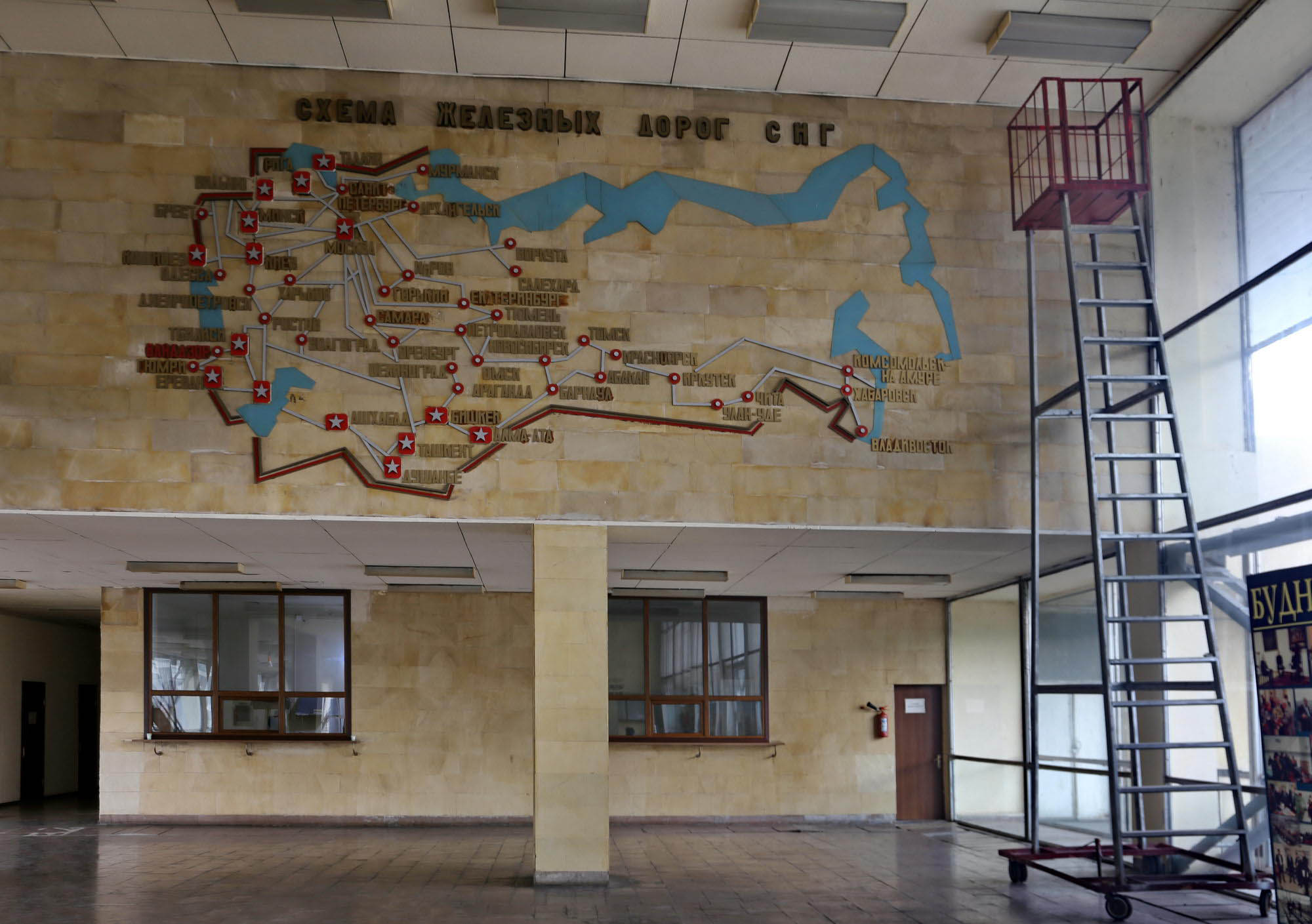
In Vanadzor, time has not stood still! Here they keep pace with the pulsing rhythm of the present, dynamically adapting to the rapidly changing challenges of our age. At the railway station, someone has replaced the inscription “Railway Network of the Soviet Union” above a map of the Soviet railway system with “Railway Network of the CIS.” Yet the map unmistakably depicts the Soviet Union: the Baltic states are still there, even though they never joined the CIS when it was founded in December 1991, and so is Georgia, which withdrew from it after the Russian invasion of 2008. You can even see that the СНГ (Содружество Независимых Государств, Commonwealth of Independent States) was added later, with the letters spaced more widely so as to fill the gap left by the former СССР.
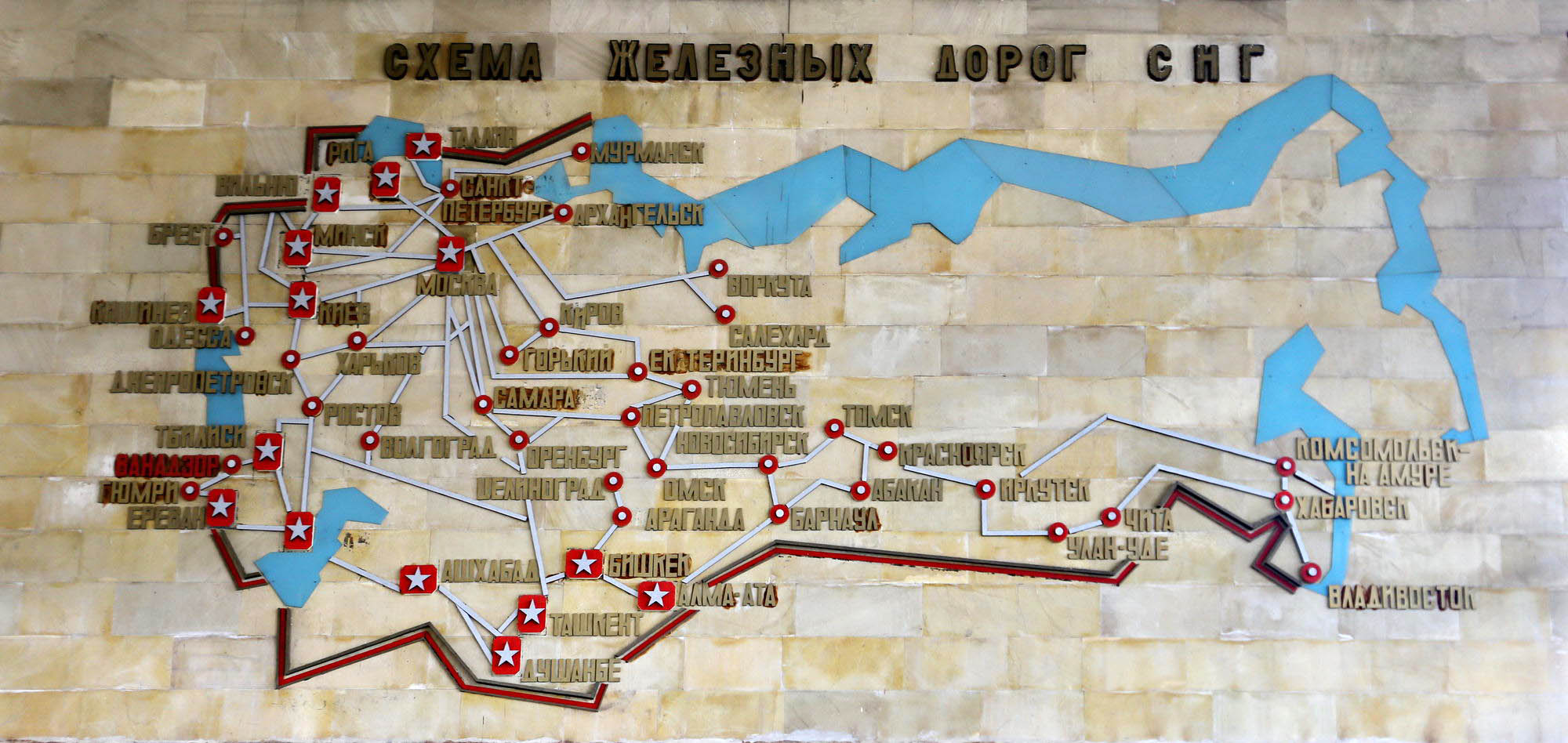
A few further alterations make it unmistakable that what we have here is a Botoxed map of the Soviet Union. Yekaterinburg, Saint Petersburg, Samara, Bishkek and Vanadzor itself have evidently been added later, replacing the names in use until 1991: Sverdlovsk, Leningrad, Kuybyshev, Frunze and Kirovakan. And then there is one city whose red dot is still there, but whose name has mysteriously disappeared. It, too, asserted its right to appear on an Armenian map in 1991. That city is Baku.
Stepping out onto the platforms, I am keen to document this pulsating present as well. But after the first couple of clicks, an elderly man and woman sitting on a bench call out to me: “No photography!” “Why?” I ask, with an innocence I do not quite possess. “Strategic facility,” the man replies, using the official Soviet formula. “You know,” I say, trying to defuse the situation, “I come from Hungary. I grew up under communism, and back then our railway stations looked just like this. I would like to document it.” “It is still communism here,” the woman says, nodding in agreement.
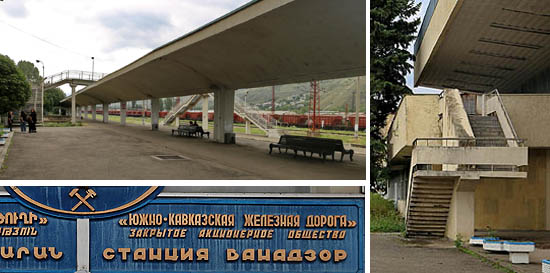
At the time the map was made, the city was called Kirovakan — literally “Kirov City” — after Sergei Kirov, the Leningrad party boss who was shot dead by a young party member in 1934. The motive for the assassination is still disputed. The most plausible version is that Kirov, who had backed Stalin against the party’s internal opposition, had become too popular, and Stalin decided it would be safer to get rid of him. Kirov was subsequently transformed into a party martyr and lent his name to countless cities and streets, while Stalin invoked his avenging as a pretext for setting out to destroy the so-called great conspiracy, a campaign that culminated in the Great Terror of 1937–38.
The era of Kirovakan meant industrialization for the city that had previously been known as Qarakilisa, “Black Church.” The Soviet leadership chose this well-situated valley as one of the country’s major industrial centers: it had abundant water and a railway, stood close to the great Soviet Caucasian hubs, and lay safely distant from the Turkish and Iranian borders. The chemical industry came first, followed by machine building, textiles, food processing and building materials. It was almost as if all this had depended on Kirov’s benevolent patronage: when the city exchanged his name for the newly invented Vanadzor — “valley of churches,” since the original Azerbaijani name was no longer considered desirable — Soviet industry, too, was left to decay.
The Soviet system often gave its material objectives a spiritual, even transcendent dimension through monumental public works, providing its citizens not only with work, but with a higher meaning attached to it. And while the work itself and the places where it was carried out have vanished, these monuments — statues, mosaic panels and striking buildings — have often survived, bearing witness to the faith of a vanished world.
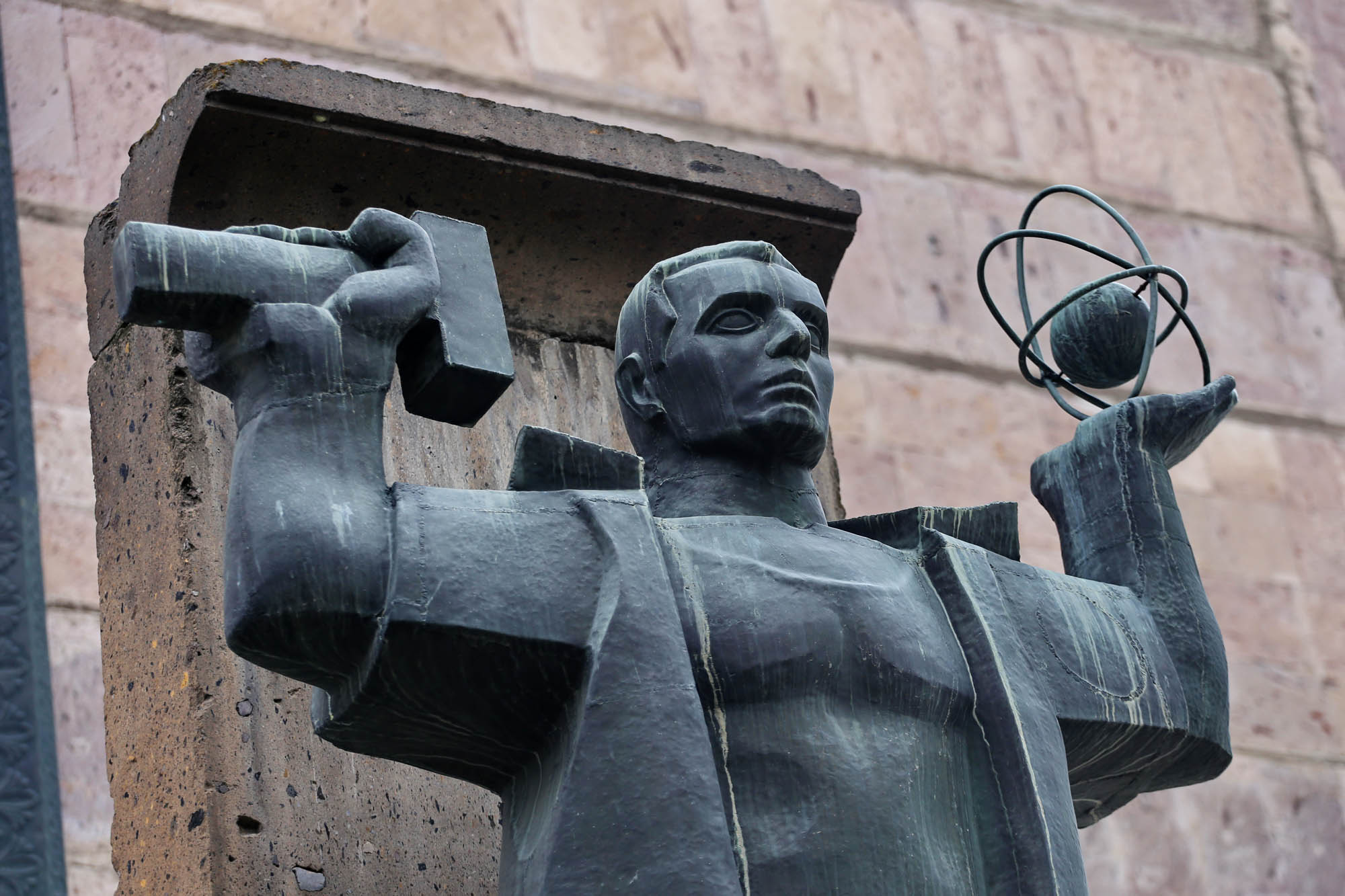
The central figure of Kirovakan’s most significant Soviet monument, the Worker — the central figure of this belief system and the priest of its symbolic liturgy — stands before a great red khachkar, raising high with both hands the two supreme sacraments of this faith, the Hammer and the Atom, symbols of Labour and Science, much as a Christian priest raises before God the body and blood of Christ. Yet there is no God in this religion; his place in the liturgy is occupied by the society called the Working People, before whom the Worker performs his ritual. They are represented in the light-coloured tufa panels beneath the black-basalt statue, each scene presenting one of the ideal functions of society.
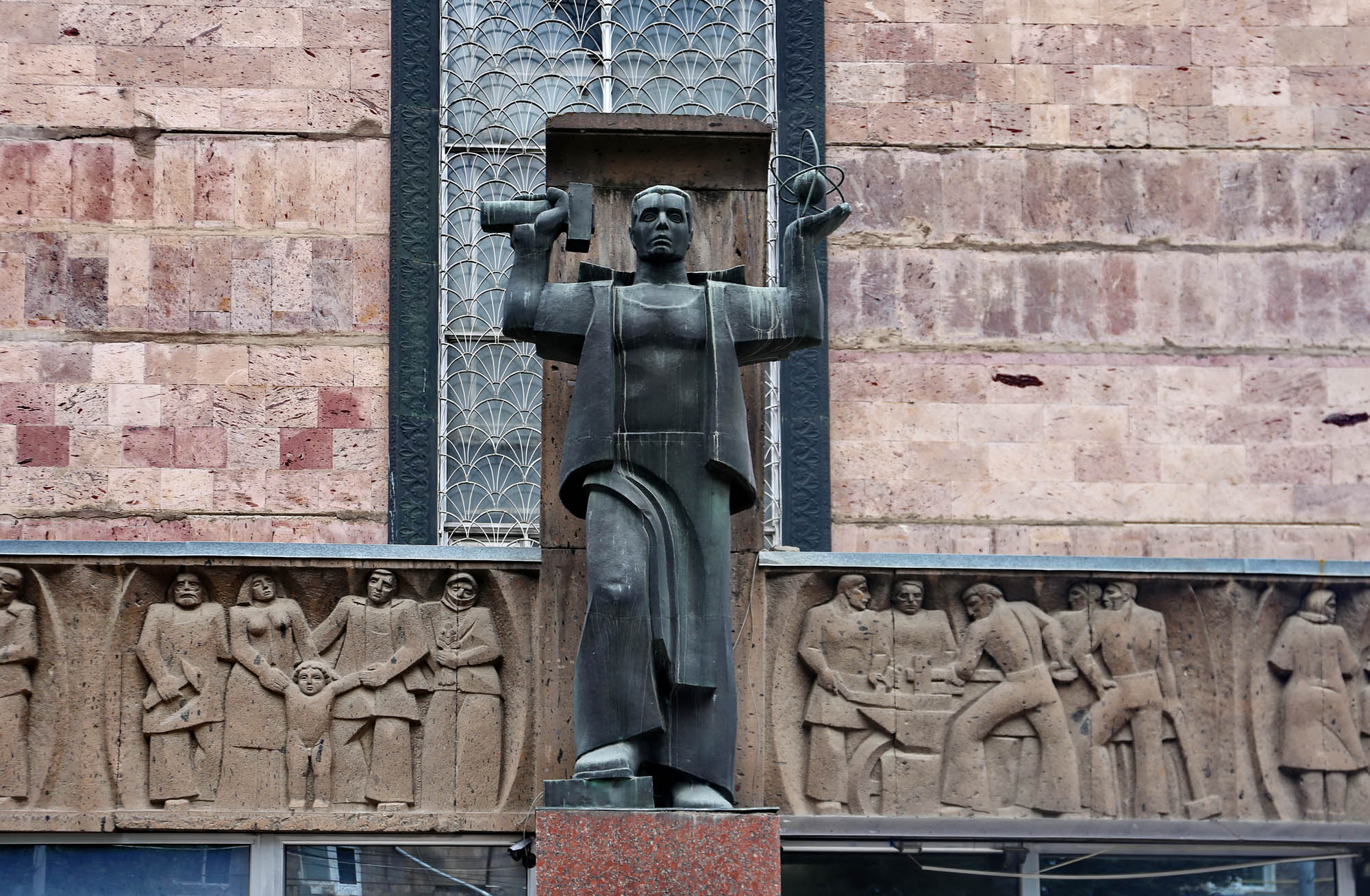
By the 1960s, Soviet public sculpture had left behind the anatomically detailed academic style of the Stalin era, in which the heroes of the people were portrayed as athletes. In its place came the so-called “severe style” (суровый стиль), characterised by stylised, geometrically reduced forms.
The Worker himself is austere and almost Cubist, composed of severe geometric planes. The folds of his coat, his shoulders and the planes of his face are shaped almost like architectural blocks. His body functions as a single massive pillar.
The scenes in the background are built up from layers of varying depth. Figures, heads and arms projecting more forcefully into space from the two-dimensional background create both tension and a distinctly cinematic sense of narrative.
Neither the Worker nor the figures in the reliefs display individual emotion. Their faces are stern, resolute and directed forward. They do not portray particular individuals, but the abstract Homo Sovieticus, cleansed of individual frailties and deviations and wholly devoted to the service of society.
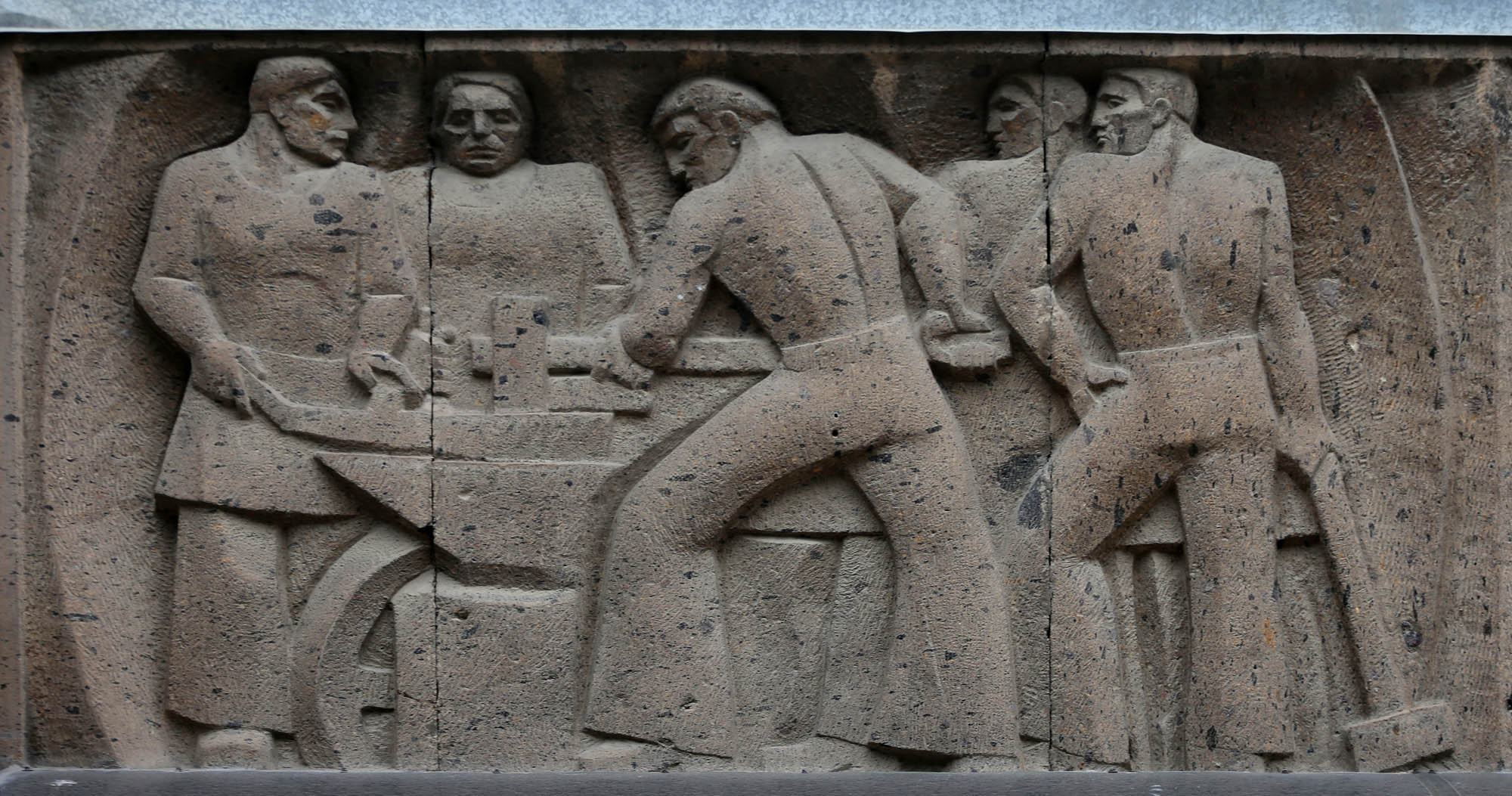
Flanking the central statue, like the principal scenes of a winged altarpiece, are the panels devoted to Labour and the Family.
Labour:
• The strength of collective effort: Five figures concentrate on a single shared task: working a metal component. There is no singled-out hero. The composition embodies the ideological conviction that the success of socialist society rests upon coordinated collective labour.
• The heroisation of physical strength and dynamism: The central worker, seen from behind, embodies physical exertion. His broad shoulders, bent legs and posture leaning into the workpiece celebrate the raw, creative power of the proletariat. In socialist art, physical labour is not a burden but a proud instrument of social advancement.
• The myth of heavy industry: The anvil and tongs on the left, together with the sledgehammer resting at the far right, symbolise heavy industry and the building of the nation. In the Soviet Union, metallurgy, machine-building and forging were regarded as the principal pillars of modernisation and economic independence.
• Mentorship and continuity between generations: The interaction between the older, bearded master in an apron on the left and the younger workers in the centre symbolises the transmission of knowledge and the continuity of the working class. The motif emphasises the educational role of the experienced factory collective.
• Discipline and stability carved in stone: The porous yet robust texture of the local Armenian tufa, combined with the angular, monumental forms of the figures, conveys the steadfastness and discipline of the working class and the stability of the system itself.
The scene is not simply a snapshot of factory life, but a visual manifestation of the socialist value system: here labour represents the highest form of social usefulness, in which individual will is entirely dissolved into the sacred purposes of the collective and of production.
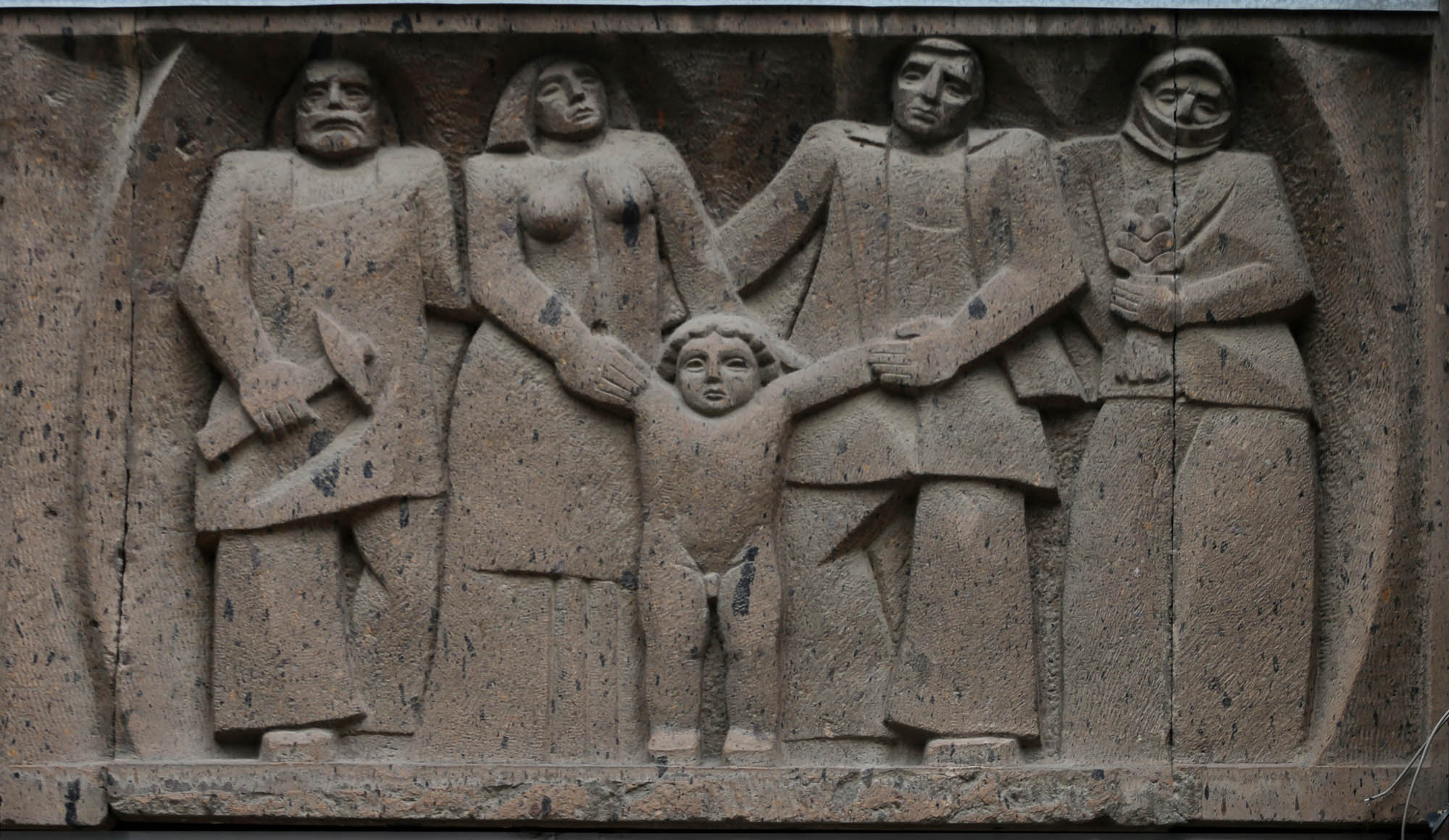
The Family:
Whereas the previous panel celebrated hard physical labour and production, this relief depicts their fruits: peace, family stability, and the alliance between generations, rendered in the visual language of the “Severe Style.”
• The Child as the Socialist Future: At the absolute centre of the composition stands a naked infant, whose hands are held by his parents. The child’s frontal pose and central position symbolise the pure, radiant future of socialism. His reaching out towards both parents evokes social equilibrium and the protective network of family and state.
• Mother and Father (the Socialist Basic Cell): The parents standing on either side of the child embody the harmonious partnership and equality of man and woman. The father bends towards the family in a protective gesture, while the mother embodies fertility, the giving of life, and the security of the family hearth. The simplicity of their clothing reflects their proletarian identity.
• The Unity of Generations and Society: At the two edges stand an older man and woman, representing at once the generation of grandparents and the wider society embracing the socialist family as its basic cell. The bearded man on the left, holding a hammer, represents heavy industry; the headscarfed woman on the right, with an ear of wheat, represents agriculture. Together they form a reinterpretation of the Hammer and Sickle, the alliance of workers and peasants.
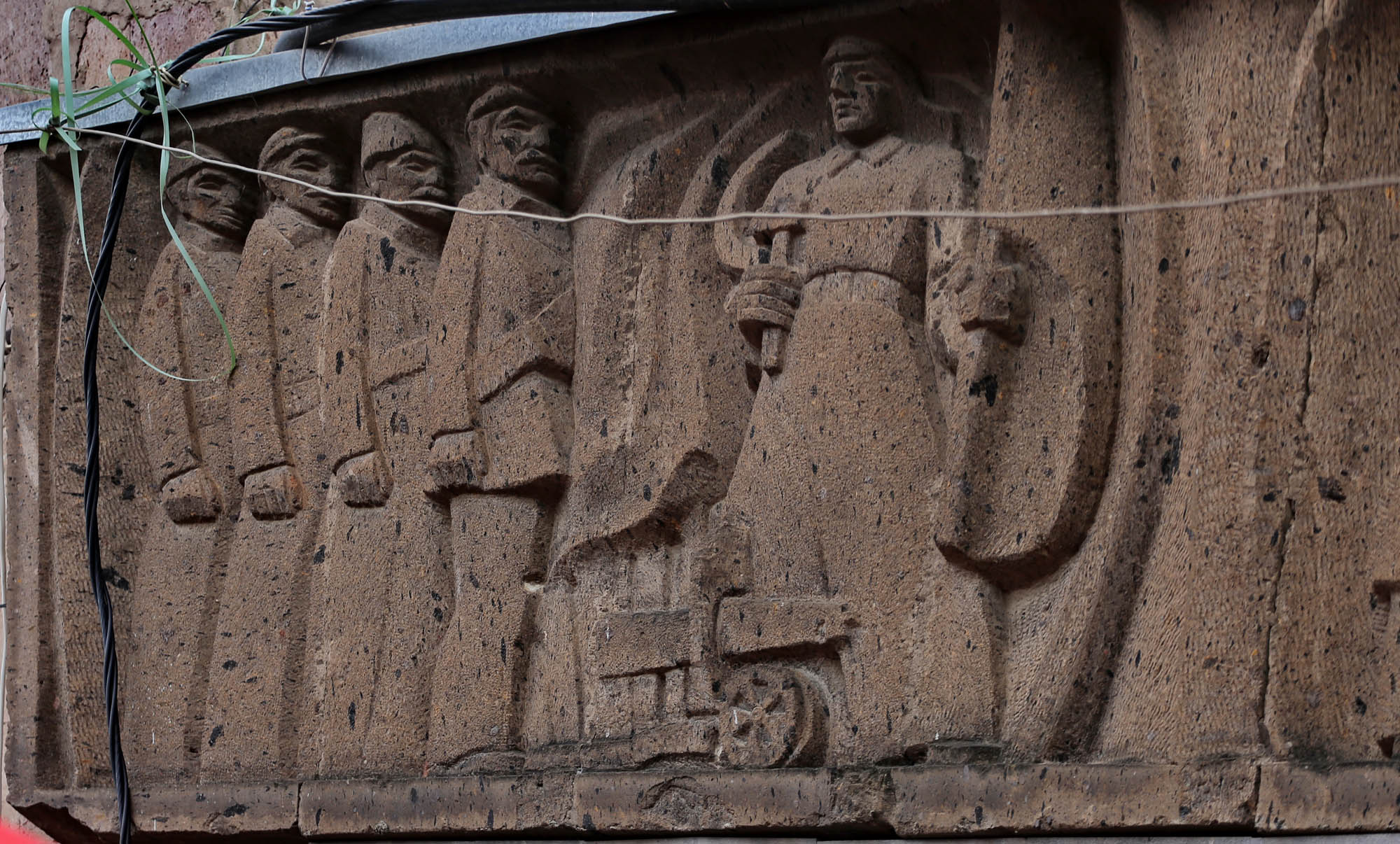
Alongside the central values — the statue of the Worker and the panels of Labour and Family — stand two further panels on either side. The frieze also turns from the left side of the building onto the main façade, where two additional opening scenes appear. Read from left to right, these six scenes trace the ascent of matter towards the stars, unfolding in detail the arc between the two cultic objects held by the Worker: the Hammer and the Atom.
The Myth of Foundation:
The opening scene (sadly, it can only be photographed from the side, and at a slight angle) depicts the historical genesis: the creation of the political legitimacy and security upon which the industrial and social development unfolding in the subsequent panels rests.
• The Historical Milestone: According to the Soviet view of history, the foundation of all social progress, prosperity, and modernisation was the abolition of exploitation. This panel records as the foundational event the victory of the Great October Socialist Revolution or, in the case of Armenia, the establishment of Soviet power in 1920.
• The Red Army as a Protective Shield: The marching soldiers — members of the Red Army or local Red Guards — proclaim that armed force guarantees peace and stability. Without this military power, external and internal enemies would have crushed the fragile new order.
• The Worker as Bearer of the Future: The central worker-soldier, holding the sickle and hammer and a red flag, foreshadows the subjects of the panels that follow. His triumphant figure sets in motion the economic and cultural chain reaction that the rest of the sequence unfolds.
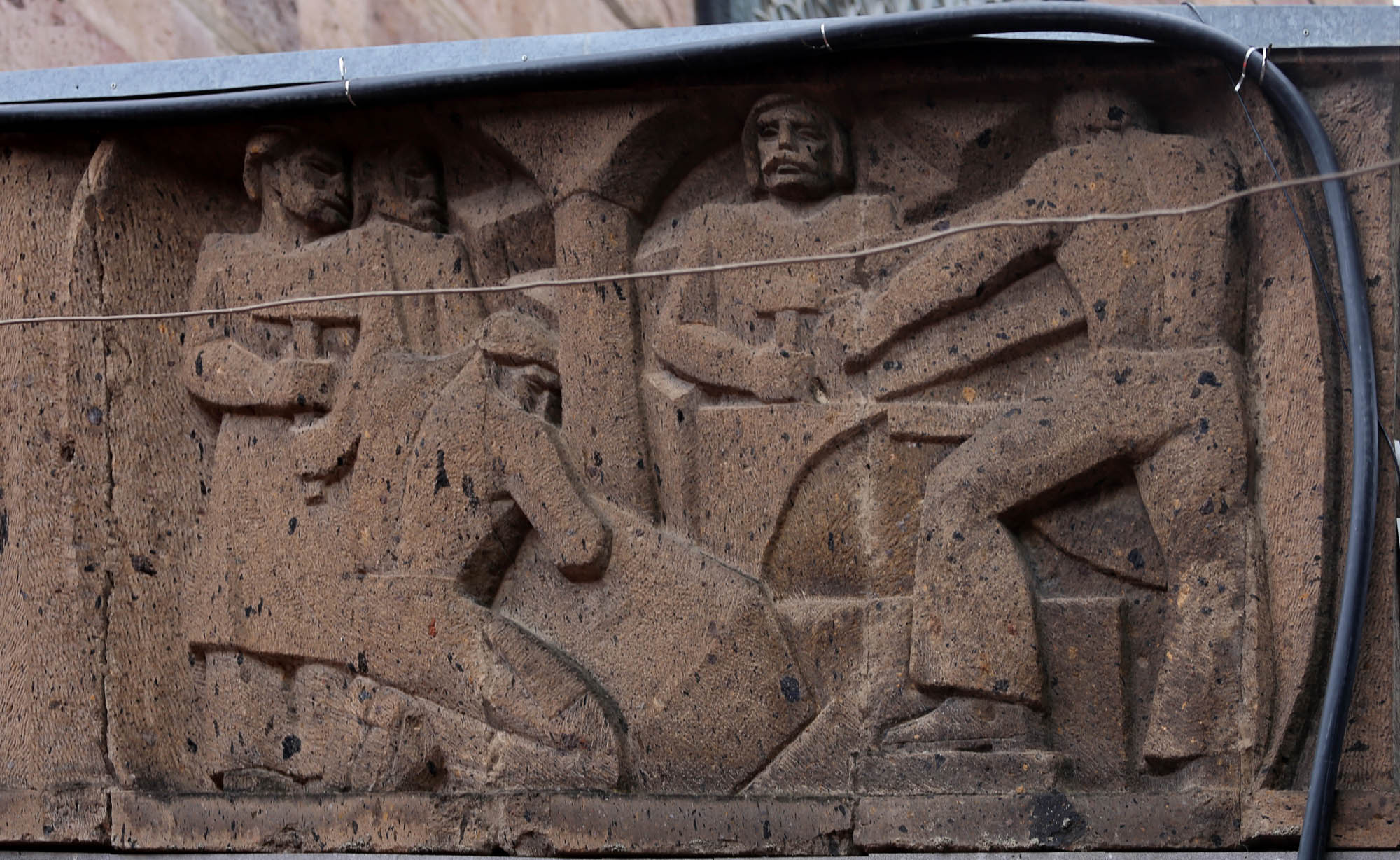
The Primordial Creative Force:
• The Origin of Creative Labour: Another panel devoted to Labour. How does it differ from the cultic panel beside the Worker on the main façade? Here we see an archaic, communal form of craftsmanship: the prototype of man's physical mastery over matter, from which the narrative must eventually lead us, through socialist heavy industry, to the conquest of outer space.
• The Ancient Community: In the panels celebrating modernization, bodies are often stretched diagonally and thrust forward, expressing the unstoppable advance of socialism. Here, by contrast, the figures are almost static, organized around vertical axes and forming a closed, rhythmic circle around the anvil. This symbolic arrangement emphasizes stability, the continuity of tradition across generations, and the deliberate precision of skilled labour, set against the headlong rush of modernization.
The faces of the figures, with their pronounced, angular features and distinctive hairstyles, emphatically bear the marks of Armenian national character. The artist thus presents Soviet ideology, somewhat obliquely, as the historical heir to a millennia-old local Armenian identity of stone carving and metalworking — a sign of the revival of Armenian national consciousness in the 1970s.
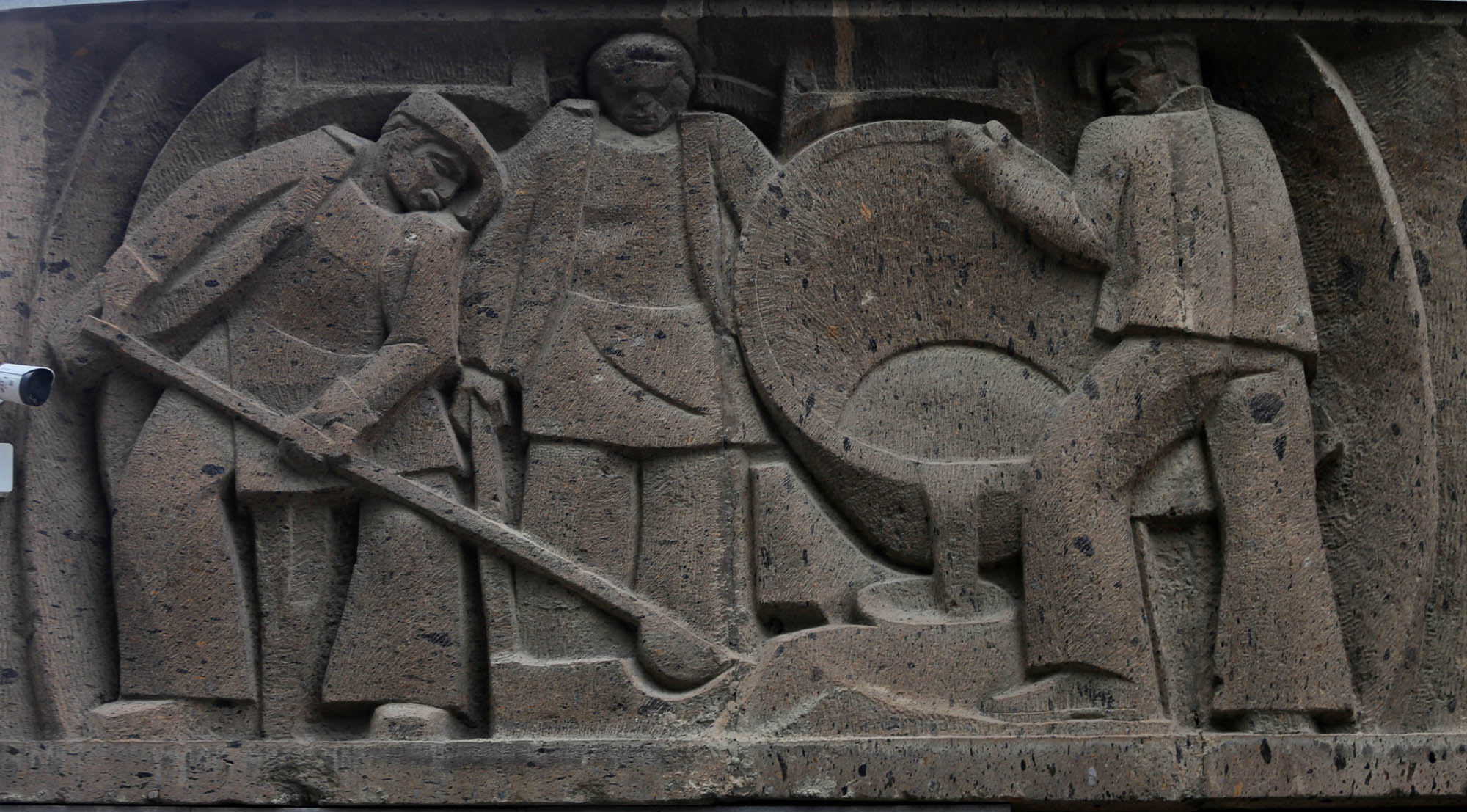
The panels on the main façade now turn to socialist labour and its achievements, tracing the arc from smelting all the way to the conquest of space.
Smelting:
• Remaking the World: Smelting was not merely a depiction of an industrial process, but a universal allegory of ideology and creation. According to Marxist-Leninist thought, socialism does not merely transform society; it places it on entirely new foundations. Smelting represents the radical moment when the petrified structures of the past — the cold, inert iron ore — are rendered fluid in the revolutionary fire, so that human beings may give them entirely new, useful and perfected forms according to their own will. This is why the smelter became such a central figure in Soviet sculpture.
• Forging the New Man (Homo Sovieticus): The smelting furnace was also a metaphor for society itself. Just as ore is purified of slag in the furnace, so the working class is purified of the remnants of the capitalist past — selfishness, religion, individual interests. The tempering of steel — famously evoked in Nikolai Ostrovsky's How the Steel Was Tempered (1936) — became a symbol of the strengthening of human character and communist consciousness.
• Triumph over Nature: Soviet man refuses to accept the limits imposed by nature. Molten metal represents the victory of human intellect and physical strength over matter. The man holding the tool is not merely serving the machine: he is the modern Prometheus, master of fire and shaper of the future.
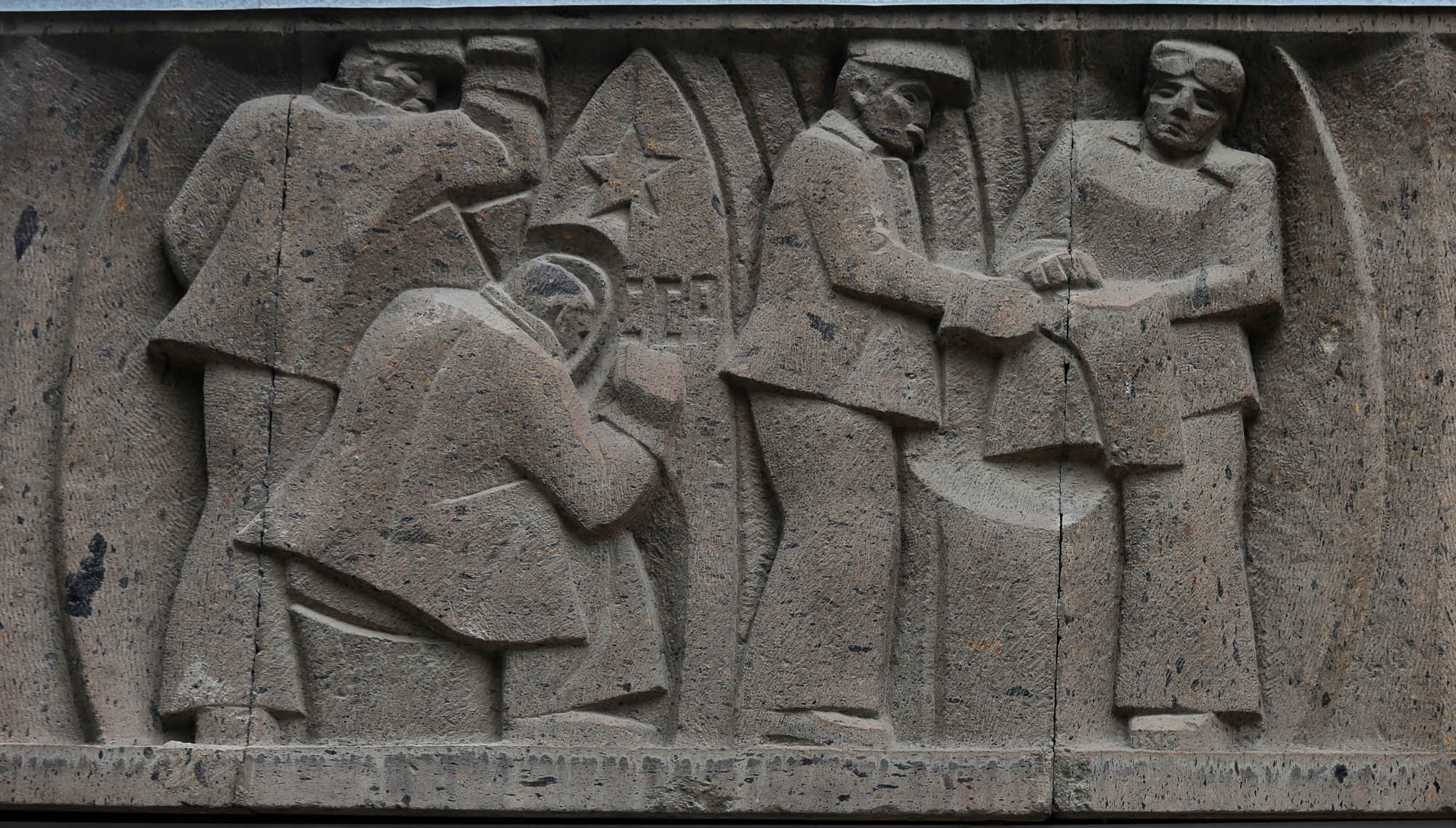
Welding:
• Indissoluble unity: In Soviet iconography, welding was elevated into the highest form of industrial activity and became a powerful political metaphor. Its very essence is that, along the weld seam, two pieces of material become one at the molecular level, with the resulting bond stronger than either of the original elements. It was thus a perfect visual metaphor for proletarian international solidarity and the monolithic unity of the Stalinist ideal: different people, classes, and republics fused together in the crucible of communism.
• The spark as Promethean force and symbol of revolution: Man stole the lightning of heaven and harnessed it to his own purposes, using it to create a new world. At the same time, the motto of Lenin’s newspaper Искра (Iskra, “The Spark”) was: “From the spark, a flame will flare up.” The shower of sparks flying from the welding process thus became a symbol of revolutionary energy, renewal, and the technological optimism directed towards the future.
• Welding and the conquest of space: The workers are not merely welding ordinary factory components; they are fabricating and preparing the hull of the spacecraft that will carry humanity to the stars. (The fact that the Soviet Union was the first to carry out welding in outer space, aboard Soyuz 6 in 1969, gave this image an especially powerful symbolic resonance.)
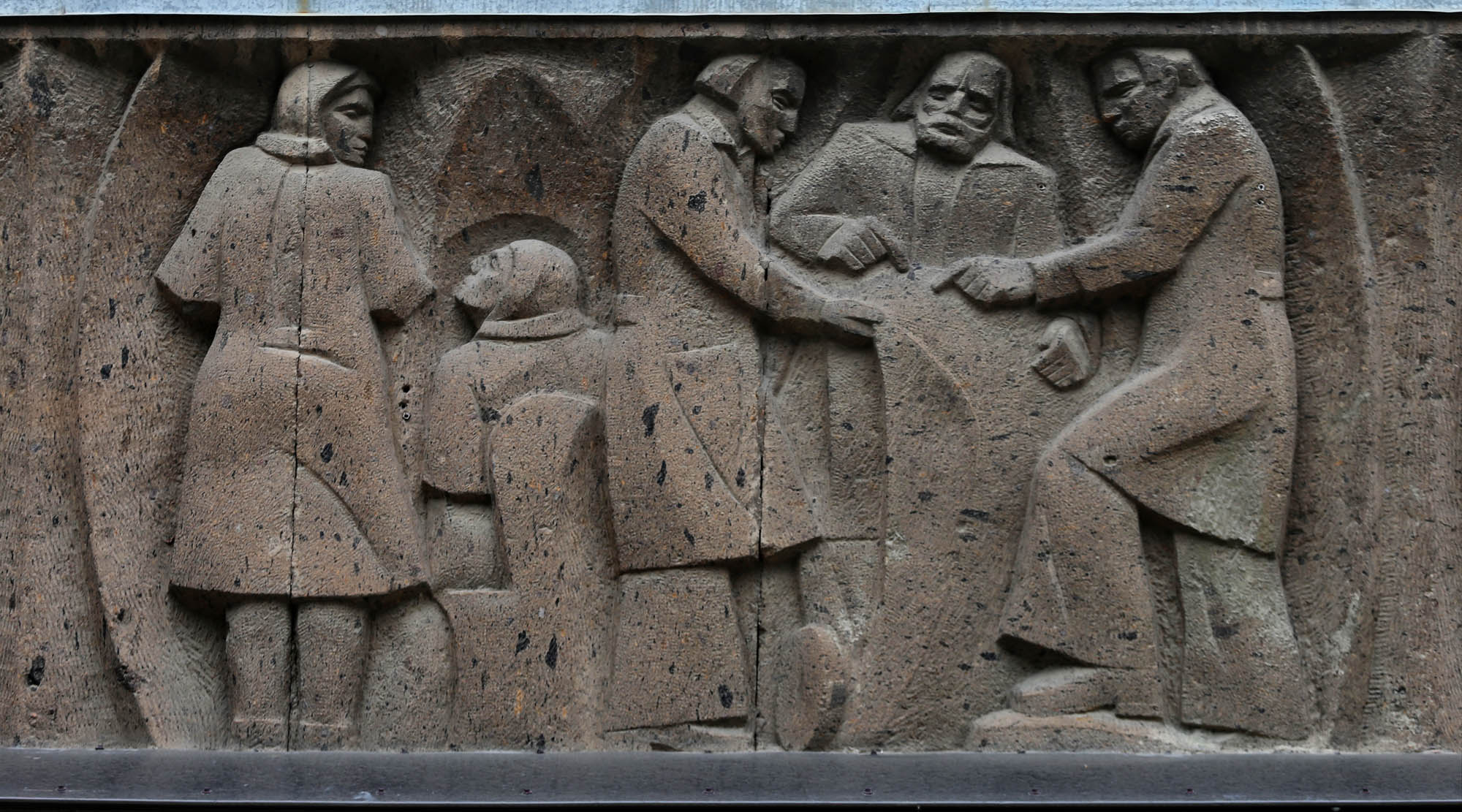
Planning:
The figures in the scene are gathered around a large document, blueprint, or map. Their gestures — pointing towards one another, jointly holding the plan — symbolize organization and the deliberate engineering and social planning of the world.
In the Soviet-socialist system, Planning was not merely an economic or engineering process, but one of the principal sacred pillars of state mythology and ideology.
• Victory over Chaos and the myth of creation: According to Marxist-Leninist ideology, the essence of capitalism lay in the “anarchy” of the market and the chaotic pursuit of self-interest. Socialist Planning, by contrast, represented the triumph of Order over Chaos. The Party and the planners appear almost as modern gods or demiurges, reshaping raw reality through the power of intellect and science alone.
• The blueprint as the appropriation of the future: Possessing the blueprint symbolized the idea that humanity was no longer the plaything of blind fate or market forces, but the absolute master of its own history. In socialist bureaucracy and art, the Plan — most famously the Five-Year Plan — was accorded an almost religious reverence.
• The icon of the future: The blueprint does not depict the present, but the utopian future yet to be born: new factories, cities, and power stations. In the composition, the figures’ gazes are often directed not at the paper itself, but into the distance, towards the radiant future.
• The collective will: Artistic representations of the Planning process are almost invariably collective. Socialist Realism rarely depicts a solitary planner. The group gathered around a table or sheet of paper — often bringing together a soldier, worker, peasant, and intellectual — symbolizes the complete fusion of social classes and the alliance between the intelligentsia and the working class. Even when no Party secretary is present, the dynamics of collective consultation serve as a visual metaphor for the Party’s democratic centralism and collective wisdom.
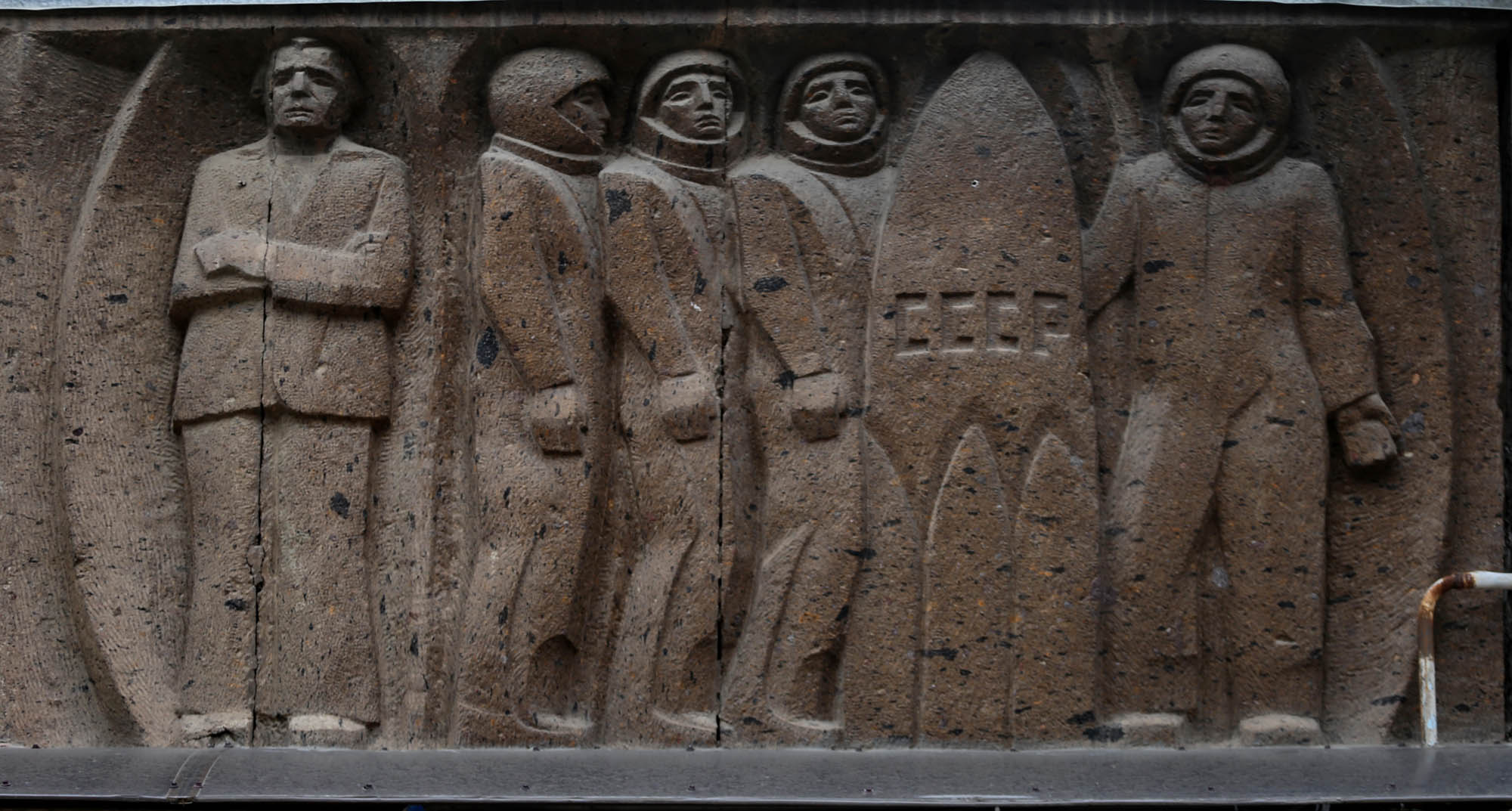
The Conquest of Outer Space:
Space exploration was not merely a technological project for the Soviet Union, but the ultimate vindication of socialist ideology. The conquest of outer space became the pinnacle of socialist development because it seemed to provide tangible proof of the truth of Marxist-Leninist historical materialism.
• The superiority of socialism: A fundamental tenet of Soviet ideology was that socialism represented a higher form of socio-economic organization that would inevitably overtake capitalism. The fact that the Soviet Union launched the first artificial satellite (Sputnik 1, 1957) and sent the first human into space (Yuri Gagarin, 1961) was presented by propaganda as proof that the planned economy and socialist system were more efficient than the Western market economy. Faced with the West’s economic superiority, the Soviet Union demonstrated through its victory in the space race that it could set the pace even in the most complex fields of science and technology.
• The secularization of the heavens: Marxism replaced religion with reason and science. Reaching the cosmos became the ultimate symbol of this scientific atheism. Soviet propaganda openly used cosmonauts as a weapon against religion. A phrase attributed to Nikita Khrushchev (or circulated in Gagarin’s name) became famous: “Gagarin flew into space, but he saw no God there.” The place of heaven was taken by physical reality, governed not by divine will but by Soviet man and science.
• The mission of the New Man: The ultimate goal of socialism was to transform society and human nature itself, creating the Homo Sovieticus. The cosmonaut became the most perfect embodiment of the New Man: courageous, disciplined, ideologically trained, and ready to sacrifice himself for the success of the collective. This is what the figures on the panel convey. The figure on the left — presumably a chief designer, engineer, or political leader — watches the proceedings with a serious, determined expression and arms folded across his chest. He embodies the rational, directing spirit. The cosmonauts’ posture and the way their figures stand tightly packed together radiate military discipline and unity. Their faces are monumental, stripped of individual emotion; they appear not as individuals, but as symbols of Soviet heroism. Their almost Egyptian-like alignment and the repetition of forms suggest that, in the service of a common goal, the individual dissolves into the collective.
• A cosmic scale: The promise of communism had originally been global in scope — world revolution — but with the conquest of outer space, this mission acquired a universal, cosmic dimension. The liberation of humanity from earthly exploitation was presented as logically continuing with victory over the laws of nature and physics themselves.
• Instead of the promise of prosperity: By the 1950s and 1960s, the Soviet Union, emerging from the Stalinist terror, needed a new, positive vision of the future with which to mobilize its population. Although everyday life was marked by shortages of goods and a housing crisis, the successes of the space programme conveyed to Soviet citizens the message that their deprivation was not in vain. The sacrifices of the present were preparing the way for a fantastic, almost science-fictional future. While rocket technology in reality also served nuclear deterrence, through the development of launch vehicles, it was presented to the outside world in the guise of peace, international solidarity, and the common progress of humanity.
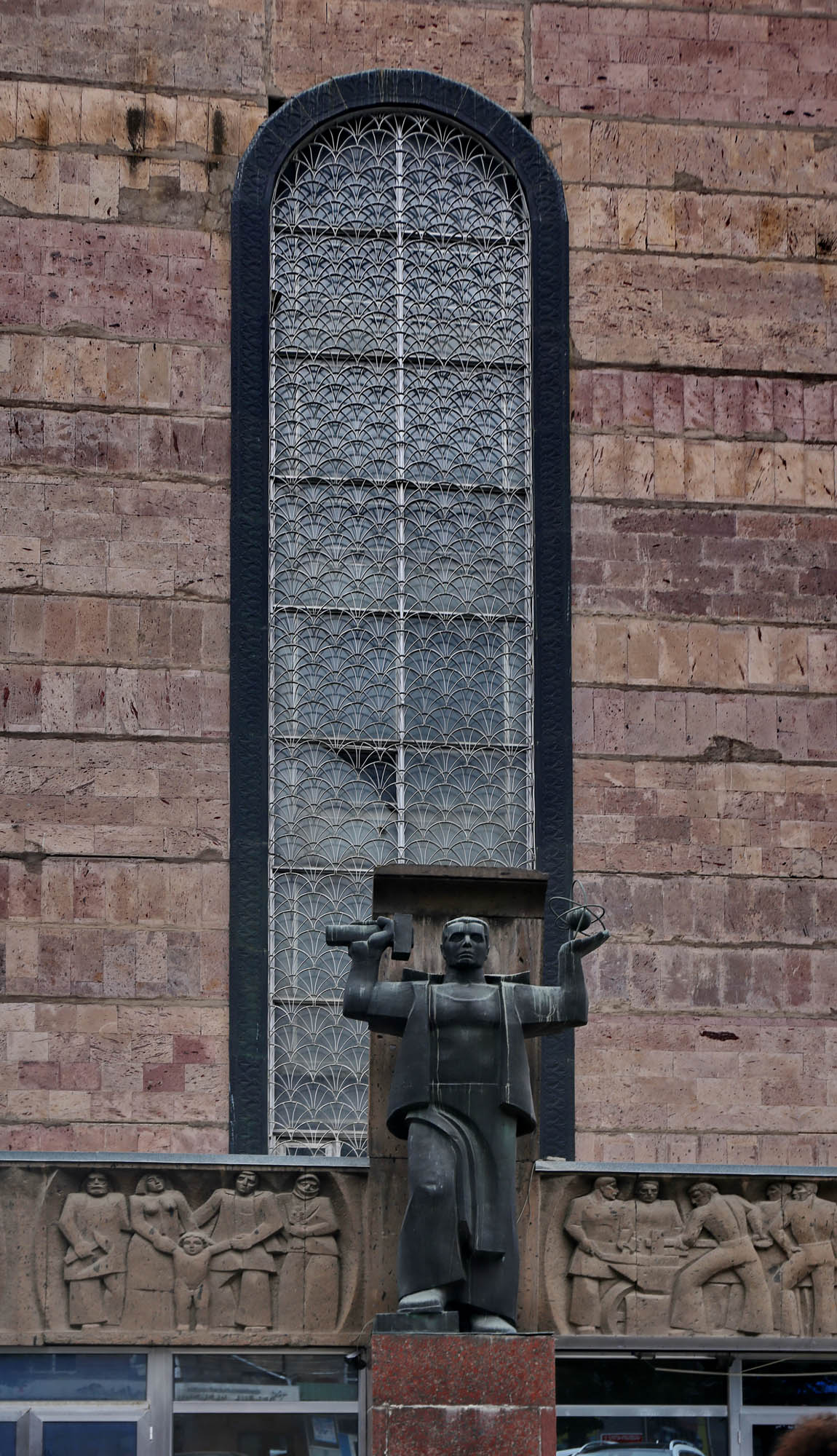
Such a grandiose liturgical-mythological altarpiece also called for a cathedral worthy of it. The sculptural ensemble stands in front of the entrance façade of the administrative headquarters of the Avtogenmash factory. The building was designed in the 1970s by Nver Ohanyan in a Soviet modernist style enriched with Armenian national elements. Ohanyan was also responsible for most of Kirovakan’s factories and housing estates.
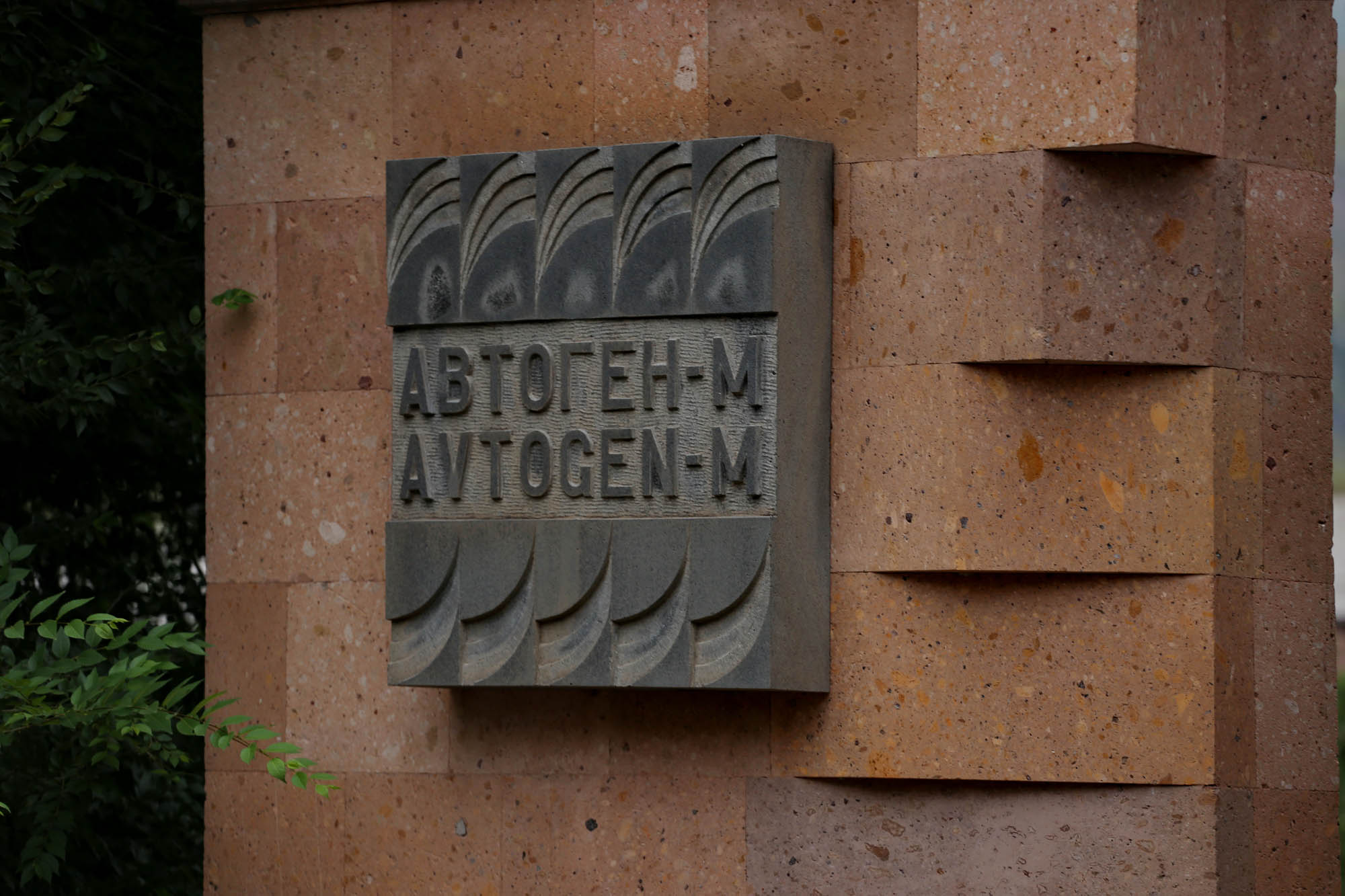
Founded in 1966, Avtogenmash was primarily engaged in the design and mass production of gas-welding, gas-cutting, and industrial automation equipment, later including laser technology. It was one of the Soviet Union’s key high-tech suppliers to the military and heavy-industrial sectors, and a source of pride for Armenian industry. Its products received numerous international awards and gold medals within the socialist bloc. It was almost proverbial that when people from Kirovakan travelled to Moscow and proudly brought home sophisticated technical equipment, they would sometimes discover upon unpacking it that it had actually been manufactured in Kirovakan.
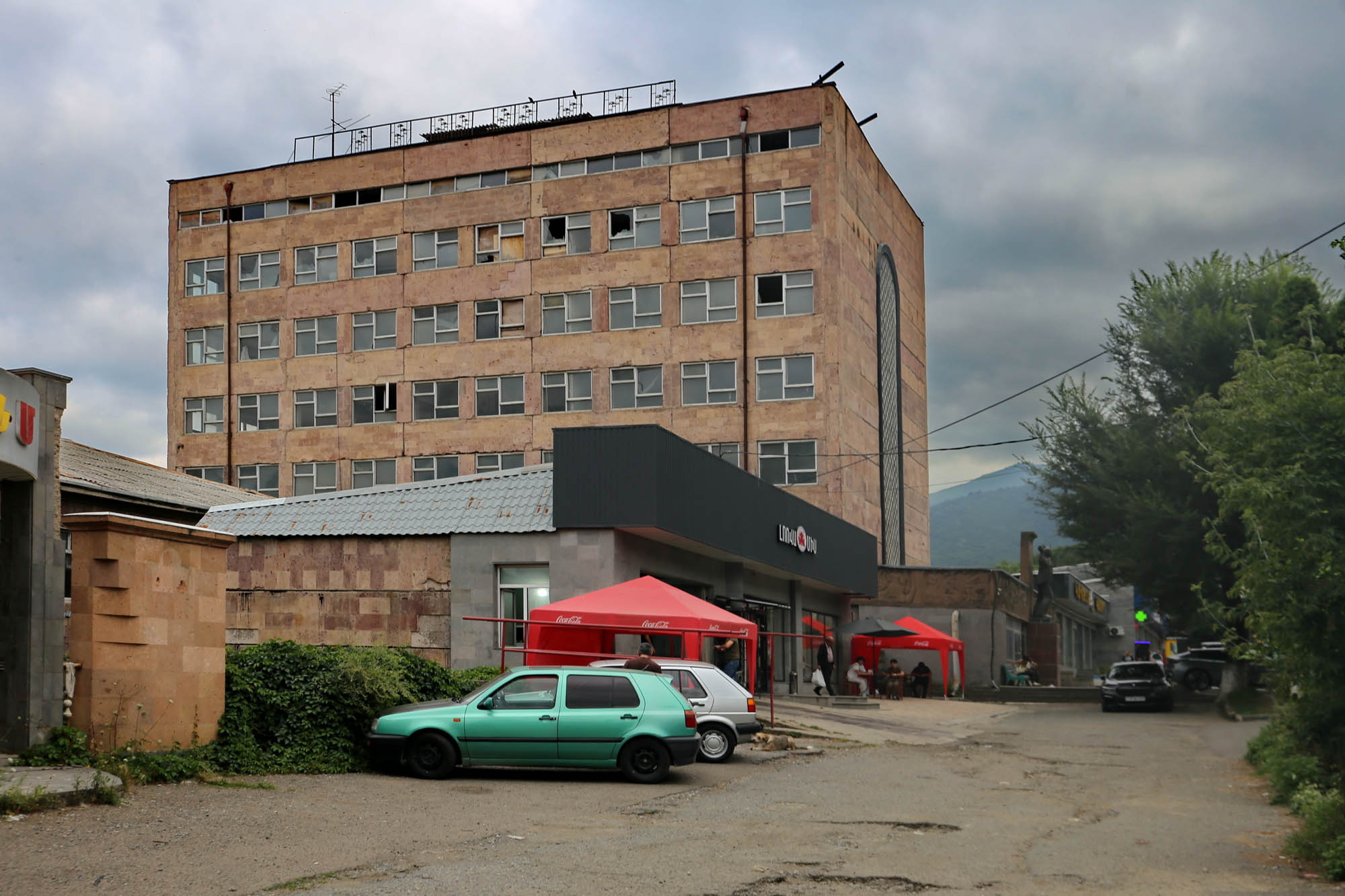
The factory was not destroyed merely by the collapse of the Soviet Union and the disappearance of its market. Shortly beforehand, in 1988, an earthquake whose epicentre was near Spitak devastated much of the surrounding region, including Kirovakan’s factories, killing many workers. Reconstruction of Avtogenmash was begun, but the collapse of the system brought the effort to a halt. Today the factory survives as a vast industrial ruin covering a large part of Vanadzor. Its best-preserved element is precisely this administrative headquarters, together with the sculptural ensemble.
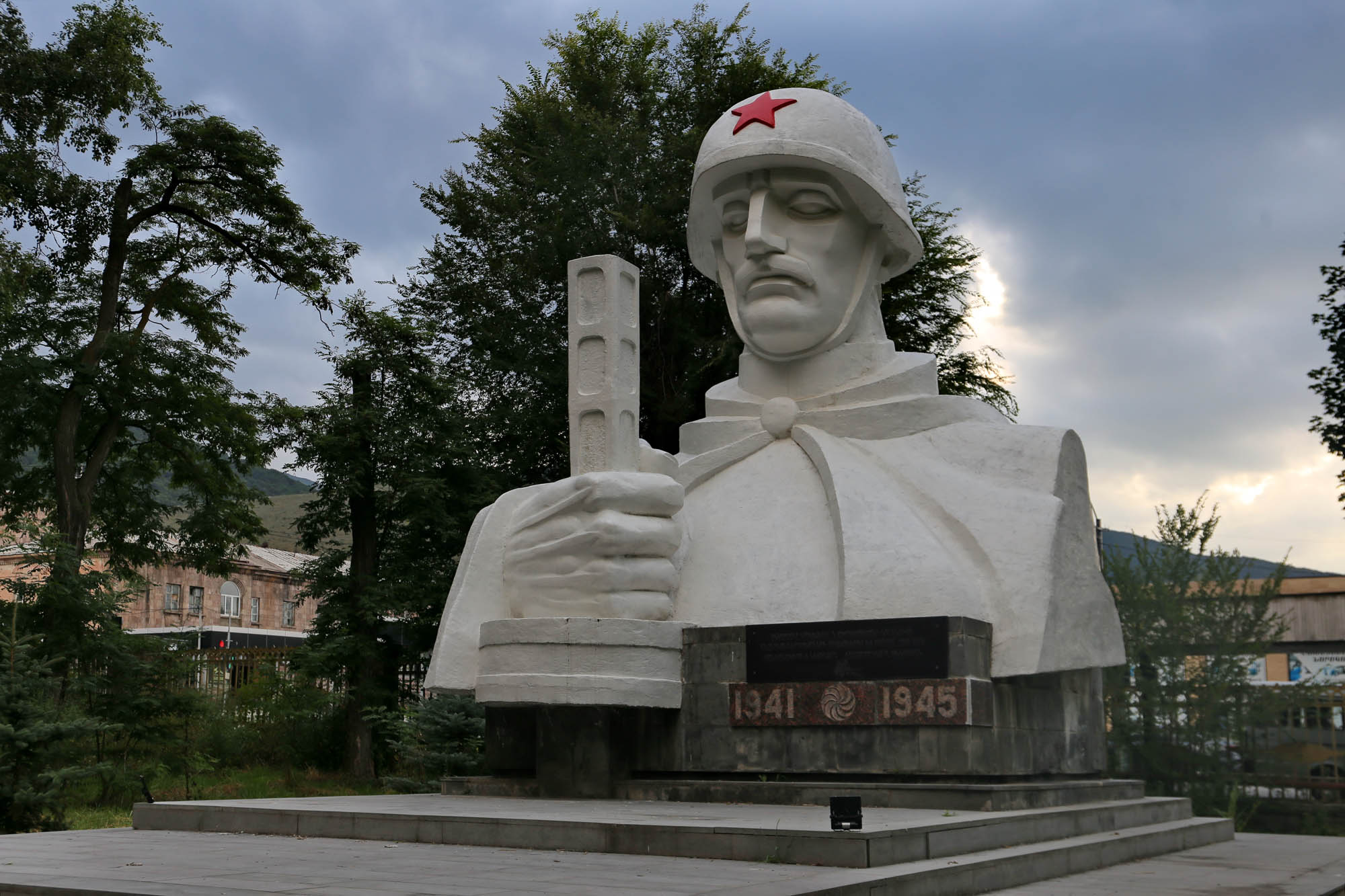
The sculptural ensemble was created by the Yerevan sculptor Zhirayr Ketikyan (1930–1997), who came to teach at the Kirovakan art school in 1959 and later became its director and then the city’s chief architect. Under his direction, the same group also created, between 1969 and 1973 and in the same “severe style,” the Monument to the Unknown Soldier in the park of the House of Culture. Alongside representations of workers, it represents another canonical genre of public sculpture of the period.


Add comment