


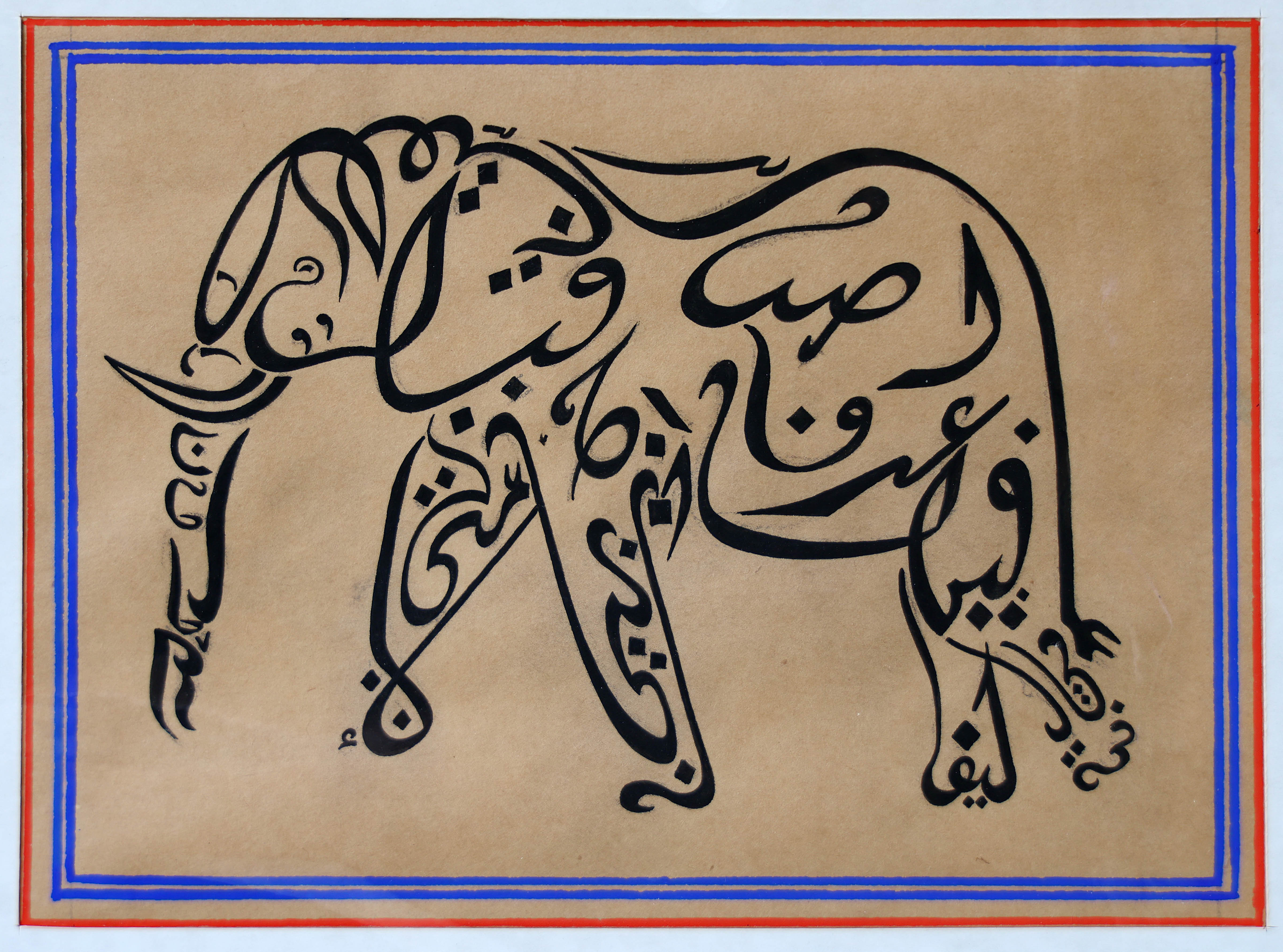
Soma bought this calligraphy in the bazaar in Bukhara. “What does it say?” she asked the seller. “A good story,” he replied with a twinkle in his eye. But since they no longer had enough of a common language to tell it, Soma brought it to me, hoping that I might be able to.
I only had to glance at it, and I immediately thought I knew what it was. Such elephant-shaped calligrams – musawwar, painted writing – most often render the Sura of the Elephant in this form.
|
Alam tara kayfa fa'ala rabbuka bi-asḥābil-fīl |
أَلَمْ تَرَ كَيْفَ فَعَلَ رَبُّكَ بِأَصْحَابِ الْفِيلِ |
Have you not seen how your Lord dealt with the companions of the Elephant?
Did He not turn their scheme into delusion?
And He sent against them flocks of birds,
which pelted them with stones of baked clay,
and made them like eaten straw.
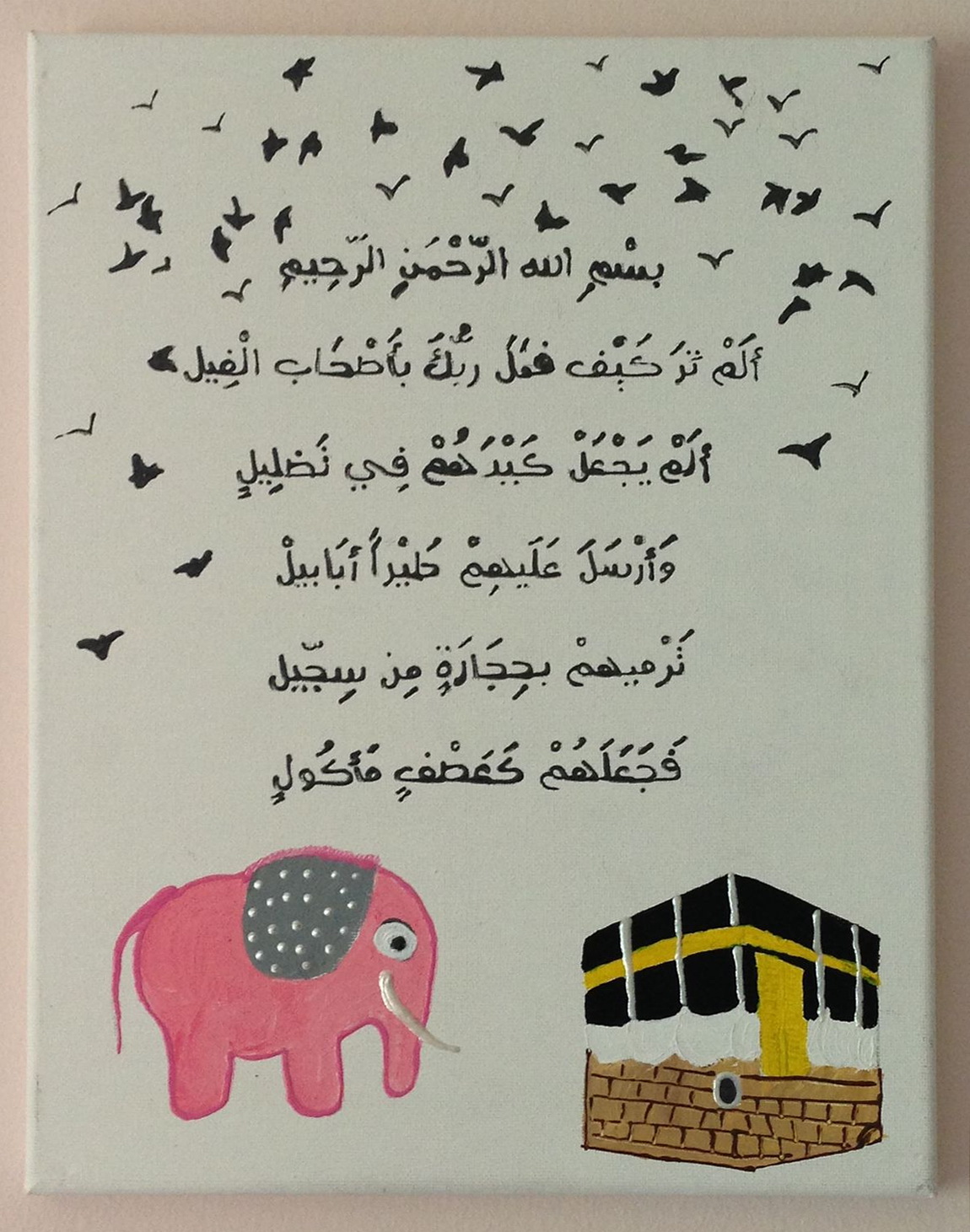
The story has a historical basis. Abraha, the Christian king of Yemen, sent an army in 570 to destroy Mecca and the Kaaba sanctuary, which rivalled the cathedral he had built in Sana'a as a centre of pilgrimage. He brought elephants with him, and the Arabs defending the Kaaba fled in terror into the mountains. But when the elephants reached Mecca, the lead elephant, Mahmoud, knelt down and refused to go any farther, no matter how much he was urged on. Allah then sent flocks of birds, which rained lumps of baked clay down upon the army, destroying it. Because of this miracle, the Arabs called 570 “the Year of the Elephant”, and according to tradition, Muhammad was born that same year.
This is one of the shortest suras of the Qur'an, which makes it possible for the entire text, together with the opening Bismillah verse, to fit onto the body of an elephant – or, more precisely, to form one.
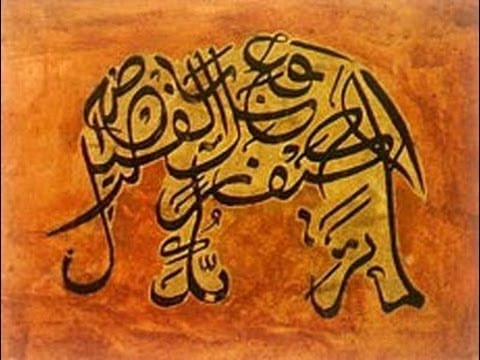 In traditional dîvânî celî calligraphy
In modern grotesque calligraphy
The musawwar is executed in the traditional dîvânî celî script, which developed in the 16th century in the Ottoman dîvân, that is, the highest state council, for the drafting of official documents, since its complexity made them difficult to forge.
And difficult to read, too. I look up the Sura of the Elephant and start comparing it with the strokes of Soma's elephant. But they do not match. This elephant has been shaped by a different text. I pick out a few words that I can decipher and search for them. And sure enough, the search brings up the line:
ذات صباح أطلقت النار على فيل في بيجامة. لن أعرف أبدًا كيف ارتدت بيجاما
Dhāt ṣabāḥ aṭlaqtu an-nār ʻalā fīl fī bījāmā. Lan aʻrifa abadan kayfa irtadat bījāmā.
And this line is none other than the famous Groucho Marx quotation:
One morning I shot an elephant in my pajamas. How he got into my pajamas, I’ll never know.
The line is spoken in the 1930 film Animal Crackers by Groucho Marx, playing Captain Spaulding, an African big-game hunter (at 2:04).
This film, and this poker-faced delivery, helped lay the foundations of modern absurdist and surreal comedy in America. Later geniuses such as Monty Python and Woody Allen drew inspiration from it.
The sentence itself became a textbook example of syntactic ambiguity. At first, one understands it to mean that the hunter was wearing pajamas, only to realize in the second half that it was the elephant who was wearing them. Indeed, in the original English, it was the hunter’s pajamas.
This is difficult to translate into Hungarian with the same punch. Fortunately, we have an old example sentence that takes the same ambiguity one step further: Látta Sámson az oroszlánt mentében. “Samson saw the lion, as he went.” Which of the two was going? But since mentében can mean both “as he went” and “in a coat”, we can also ask: which of them was wearing the coat?
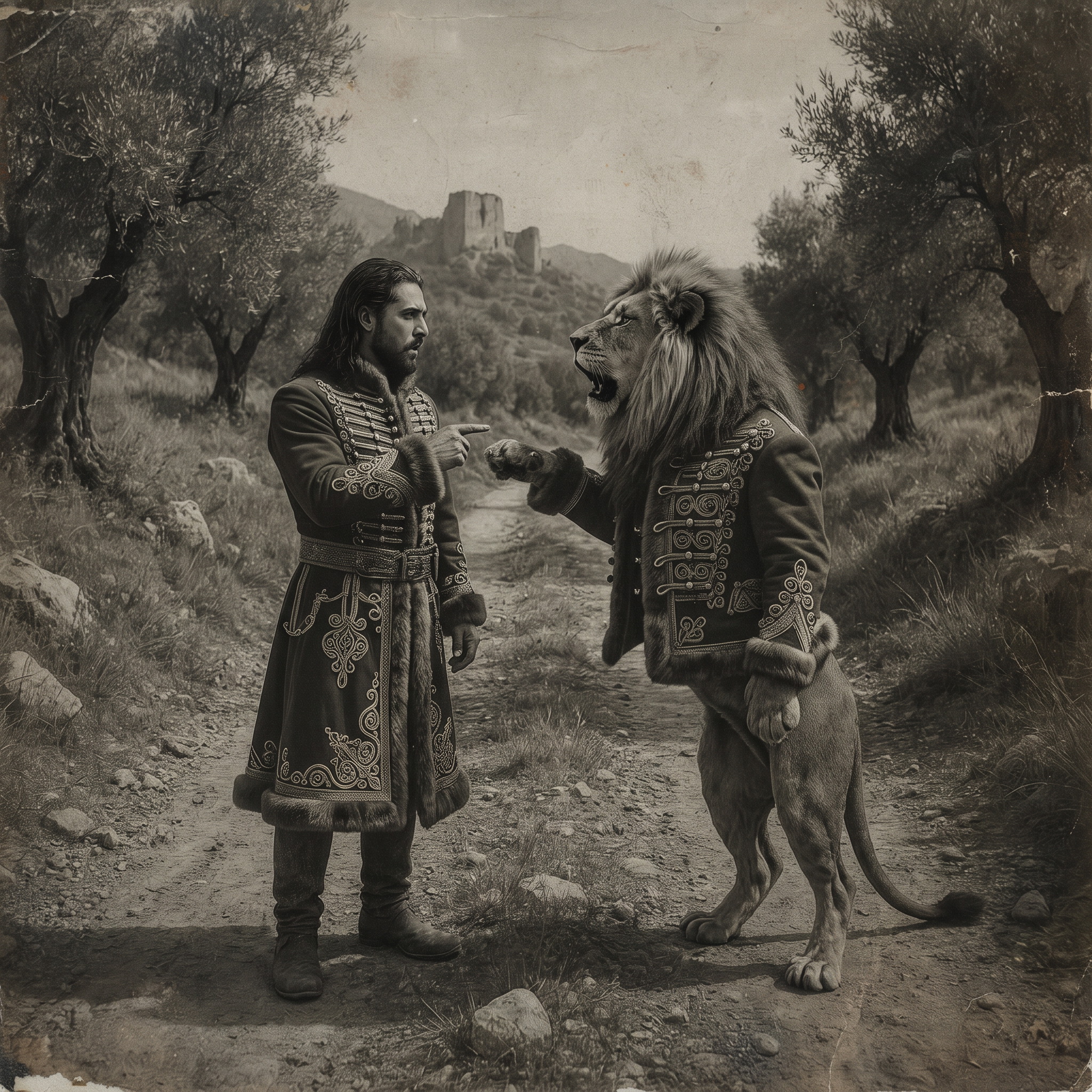 I shot this archival photograph with AI this morning, in my pajamas
Ferenc Móra quotes the sentence in his short story Birkózás Sámsonnal (Wrestling with Samson) as a Latin translation exercise, adding that “already in the days of Jan Amos Comenius, this exercise was a whetstone for the sharpness of the child’s mind”. I would be curious to know how Comenius rendered this distinctly Hungarian joke in Latin or Czech.
This absurd sentence is thus transformed by the calligrapher into an elephant, visually reproducing its absurdity: expecting to find Mahmoud, sanctified by the Qur'an, dressed in the Sura of the Elephant, we instead encounter, in his majestic form, Groucho Marx’s trophy, meticulously clad in pajamas (the word بيجامة, “pajamas”, fills precisely the lower half of his ample rear).
Who was the calligrapher versed both in dîvânî celî and in American absurdist humor, who committed this magnificent act of blasphemy? It is no longer difficult to find out: a boy from Nashville named Everitte Barbee, who studied international business and Arabic in Edinburgh and fell in love with Arabic calligraphy. He moved to Beirut, where he studied under the greatest local masters, and now makes his living turning pop-cultural texts into animals and symbols. He has become so popular that his calligrams are now sold alongside classical musawwar calligraphies throughout the Islamic world.
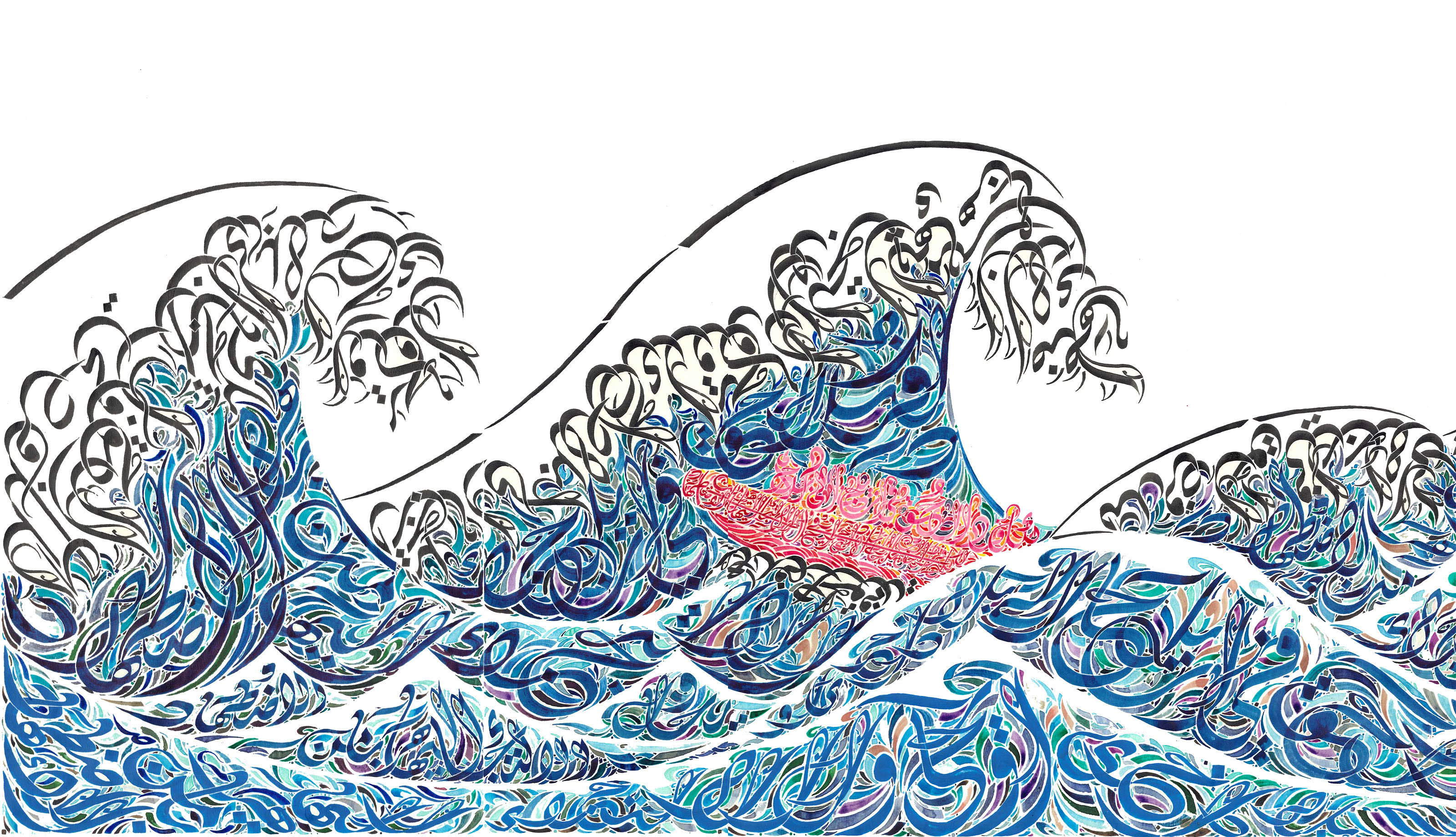 Everitte Barbee: Article 17 of the Universal Declaration of Human Rights: “Everyone has the right to seek and to enjoy in other countries asylum from persecution.”


Recent comments