


Priverno is today a charming little hilltop town south of Rome. It is difficult to photograph, however, because there is nowhere to stop along the motorway. It remains in the memory of those travelling towards Anagni, with its 11th-century crypt, the “Sistine Chapel of the Middle Ages”, or towards the magnificent 12th-century Cistercian abbey of Fossanova, where St Thomas Aquinas died on his way to the Council of Lyon, as a fleeting vision glimpsed in passing.
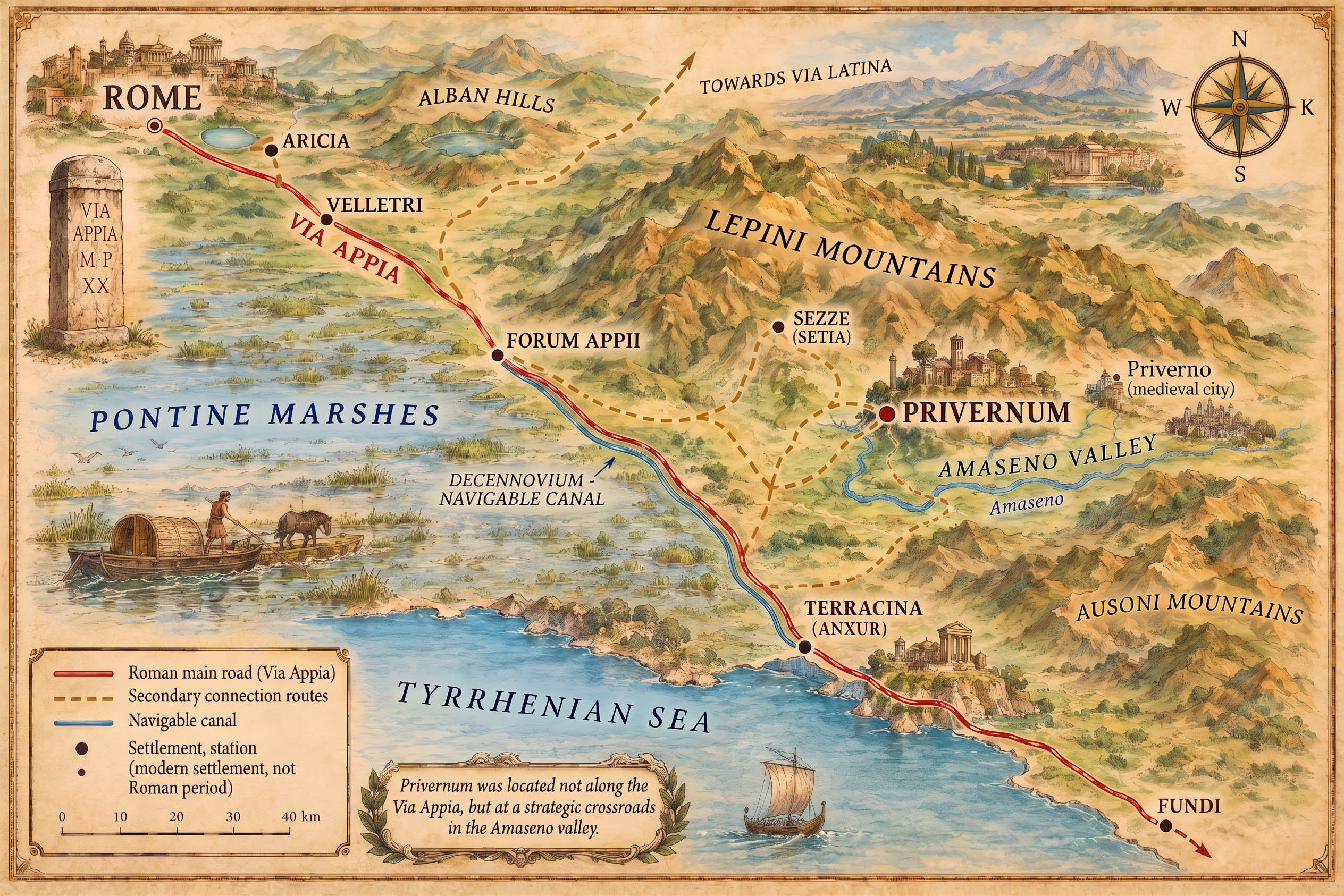
Yet ancient Privernum was a considerable Roman city along the Via Appia, in the valley of the River Amasenus. It was originally inhabited by the warlike Volscian tribes, against whom Rome fought many bloody wars, as Shakespeare also immortalised in his Coriolanus. In the 2nd century BC, however, the Romans finally granted them citizenship, opening the way to assimilation, McDonald’s and the iPhone.
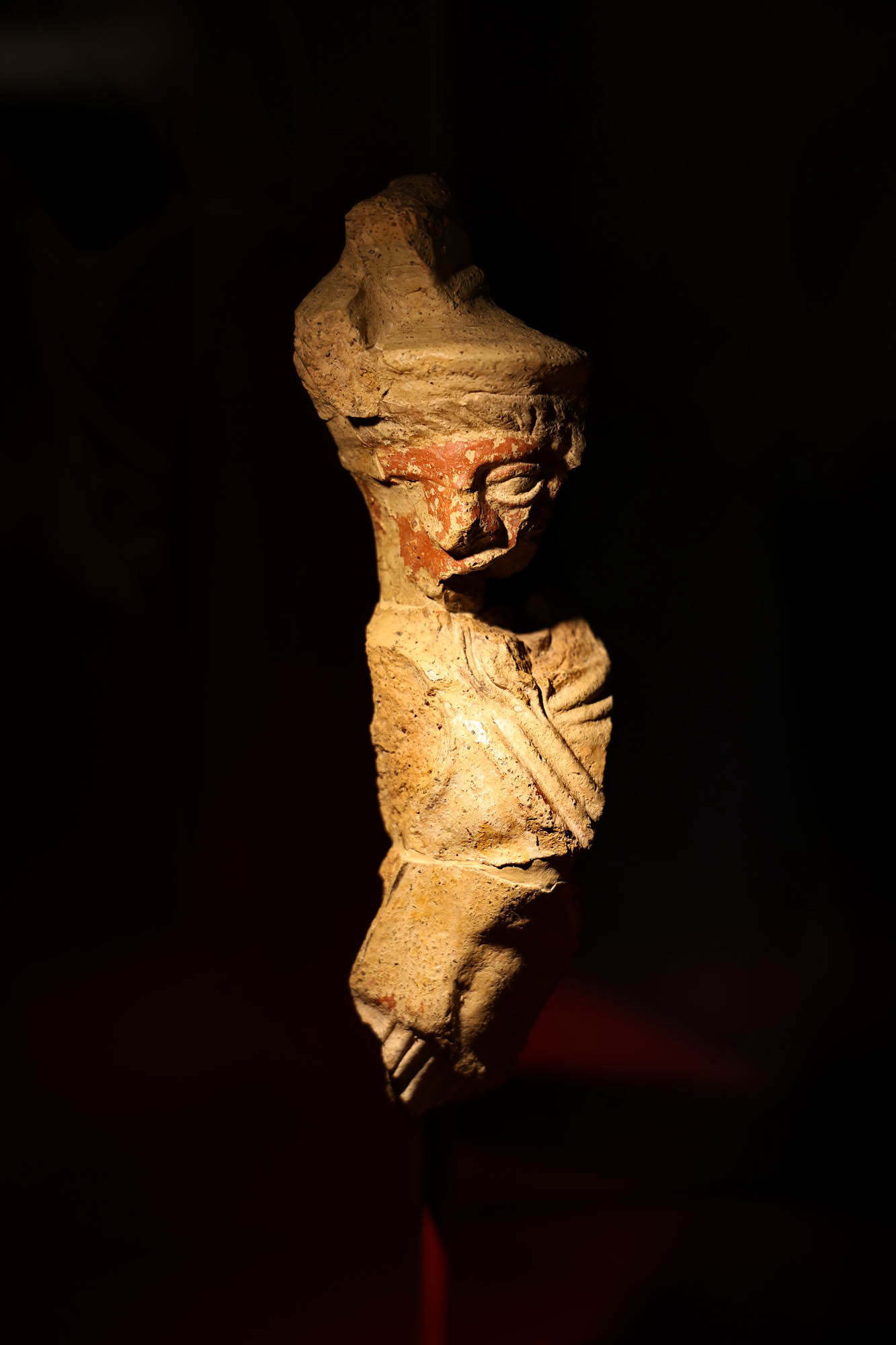 A Volscian warrior, votive statuette in the archaeological museum of Priverno
The wealth of Roman Privernum came from the fertility of the Amasenus valley and the nearby Via Appia, which ran all the way from Rome to Brundisium, the empire’s most important port, where goods from Asia Minor and Egypt arrived. One stretch of the road crossed the Pontine Marshes, which Mussolini would later have drained (and whose reclamation is commemorated on the façade of the Lilies Café in Cefalù, as I have written about here). On the AI-generated map, I have paid tribute to Horace with a mule-drawn barge: this is how he travelled the stretch from Forum Appii to Anxur, as he describes in Satire 1.5 (“Journey to Brundisium”):
|
„(...) Forum Appi, |
“...From Forum Appii, teeming with sailors |
Privernum, however, was sheltered from the brazen mosquitoes and marsh frogs, and so it grew into a flourishing town. The Roman elite built country villas here, and statues of all the emperors were erected in the city forum, as the Emperor Room in the Priverno Museum attests.
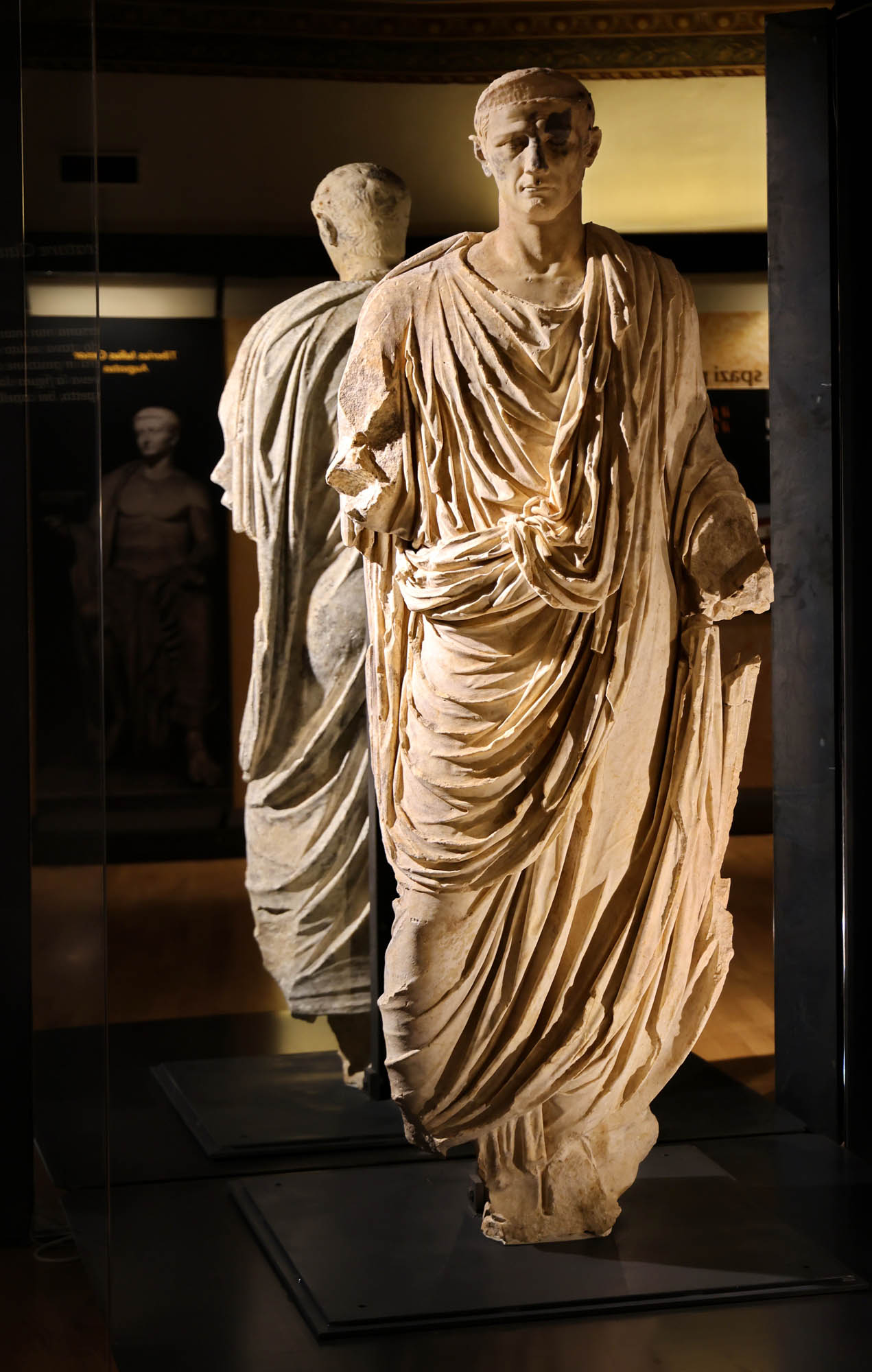 Emperor Claudius
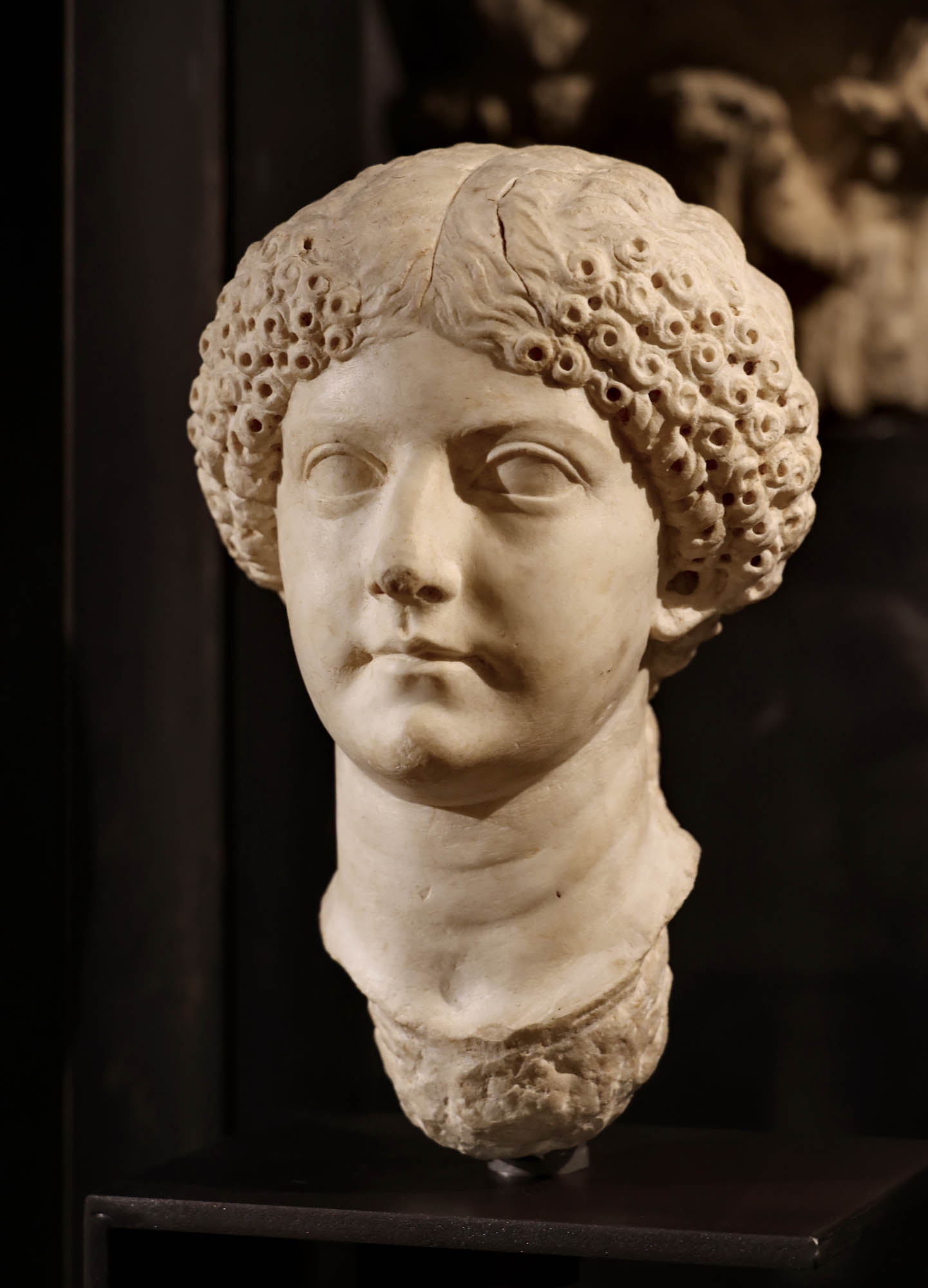 Julia Agrippina, daughter of Germanicus, sister of Caligula, wife of Claudius, mother of Nero
Then prosperity came to an end. Barbarian armies sweeping through the river valleys and Saracen pirates attacking from the sea nearly destroyed the entire city. In the tenth century, the survivors decided to abandon their town and move up to the top of a nearby hill, from which the Volsci had once descended, fortifying it with walls.
The ancient city, buried beneath the deposits of the Amaseno, thus lay peacefully undisturbed until 1989. The archaeological excavations that began that year confirmed its former reputation for wealth, bringing to light a great many villas with beautiful mosaic floors. The best-preserved floors are now displayed in the archaeological museum of Priverno. Among them is the geometrically patterned floor of a reception room (tablinum), whose threshold is decorated with a five-metre-long frieze depicting the Nile.
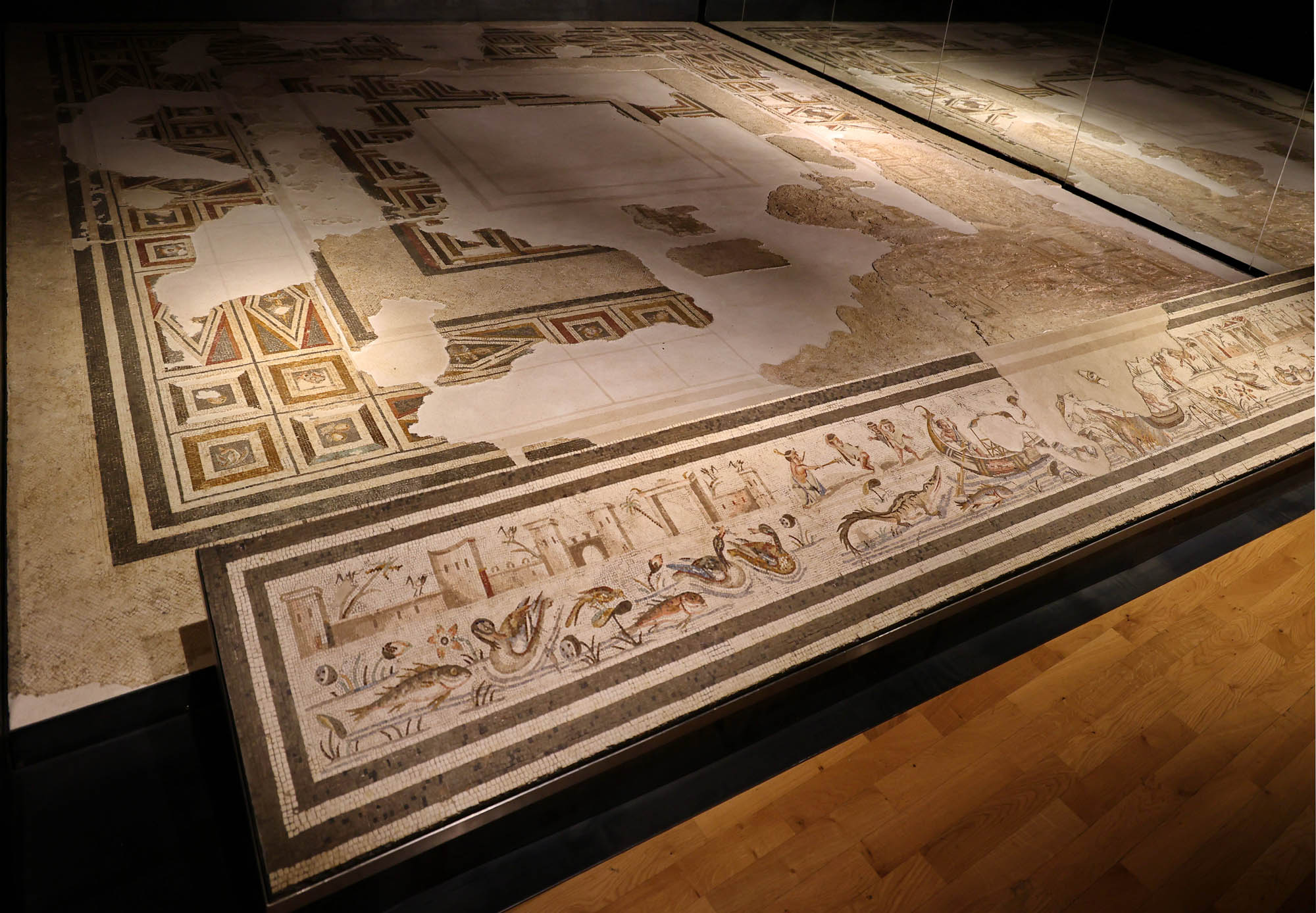
The culture of first-century BC Rome was swept up in a wave of Egyptomania. Egypt embodied mystery, the popular mystery cults of Isis and Serapis, abundance and exotic luxury; after its conquest in 31 BC, it also became a symbol of Rome’s global dominion. In those days, only the most powerful could afford a journey to Egypt, but the wealthiest could bring the Nile into their own living rooms. And they could do so without having to bother with cheeky mosquitoes and marsh frogs, profiteering innkeepers or incomprehensible hieroglyphs. Instead, they could see exactly what they wanted to see, and what they were able to take in—just like tourists today: comic genre scenes, natives fighting wild beasts, crocodiles, hippopotamuses and exotic birds. In other words, the Egypt they had imagined for themselves.
The mosaic—which gave the entire villa its name, the House of the Nile Threshold Mosaic (Domus del Mosaico della Soglia Nilotica)—was made using the opus vermiculatum technique, with lines laid out in tiny, delicate tesserae and subtle shading. The milky-white background is palombino (a marble-like limestone); its brightest details are in white marble; the black and dark-grey tones are made from slate and volcanic tufa; the greenish and yellowish hues from Latian clayey limestone and luxurious Numidian marble; and the reds and oranges from pieces of Peloponnesian marble and terracotta.
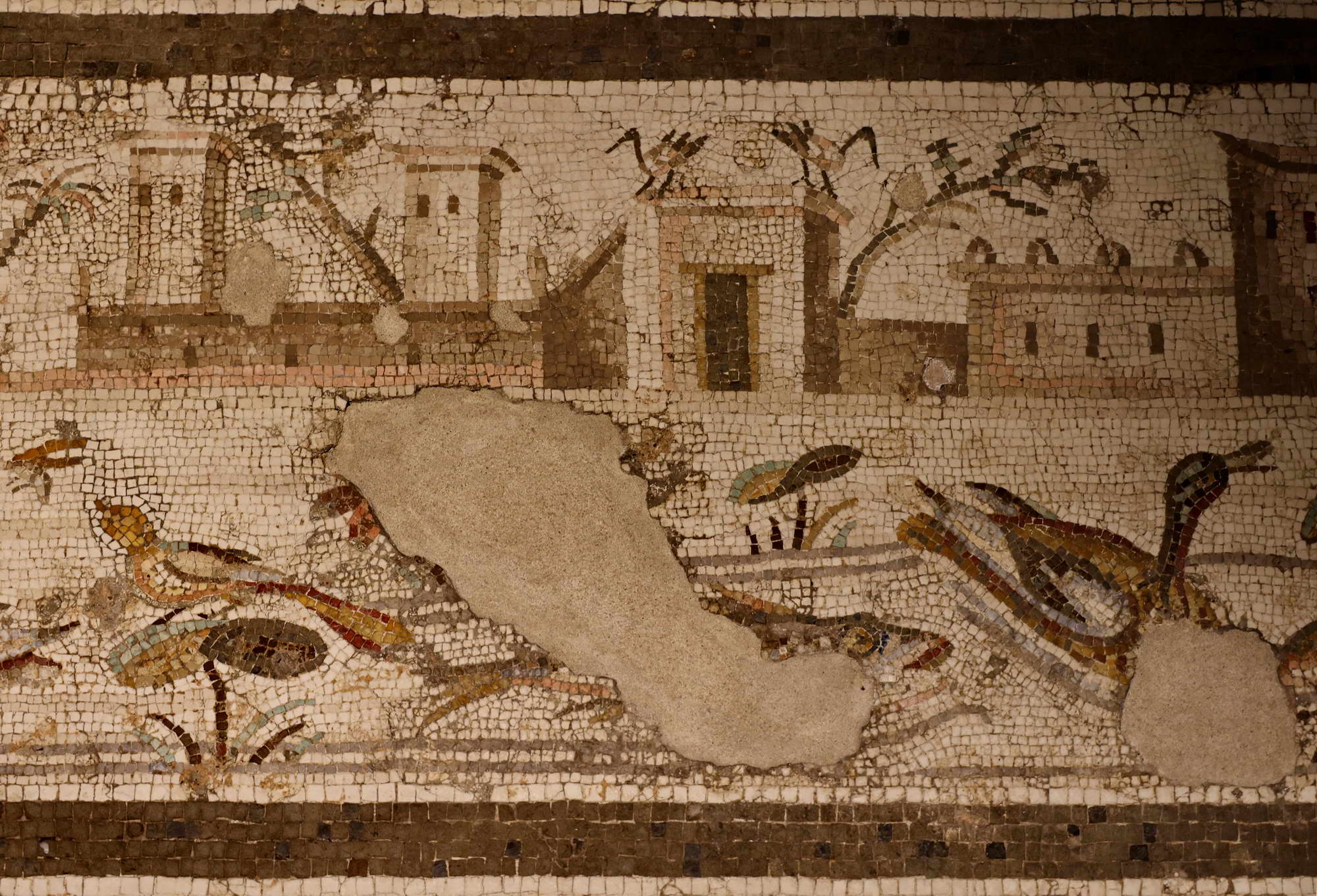
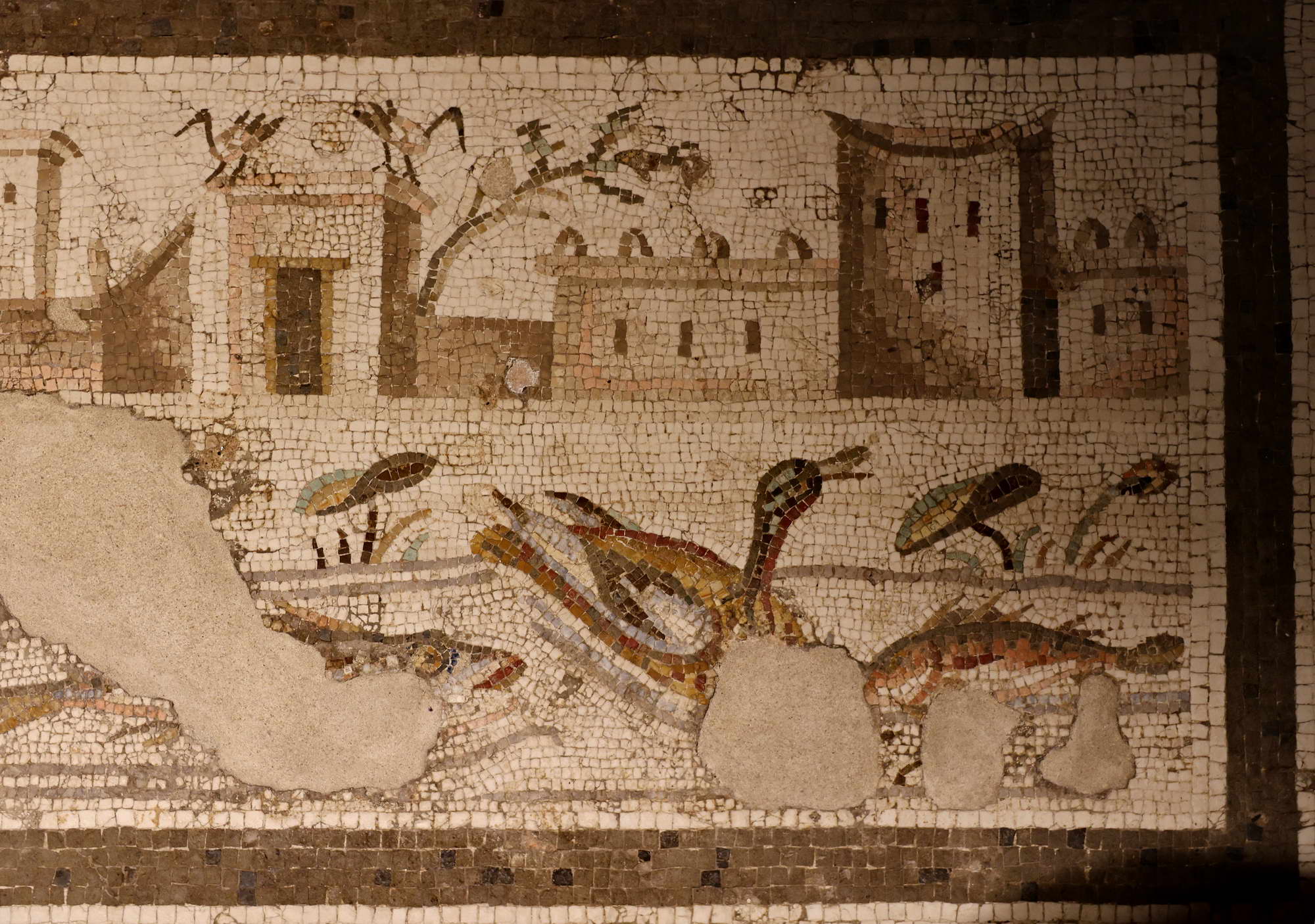
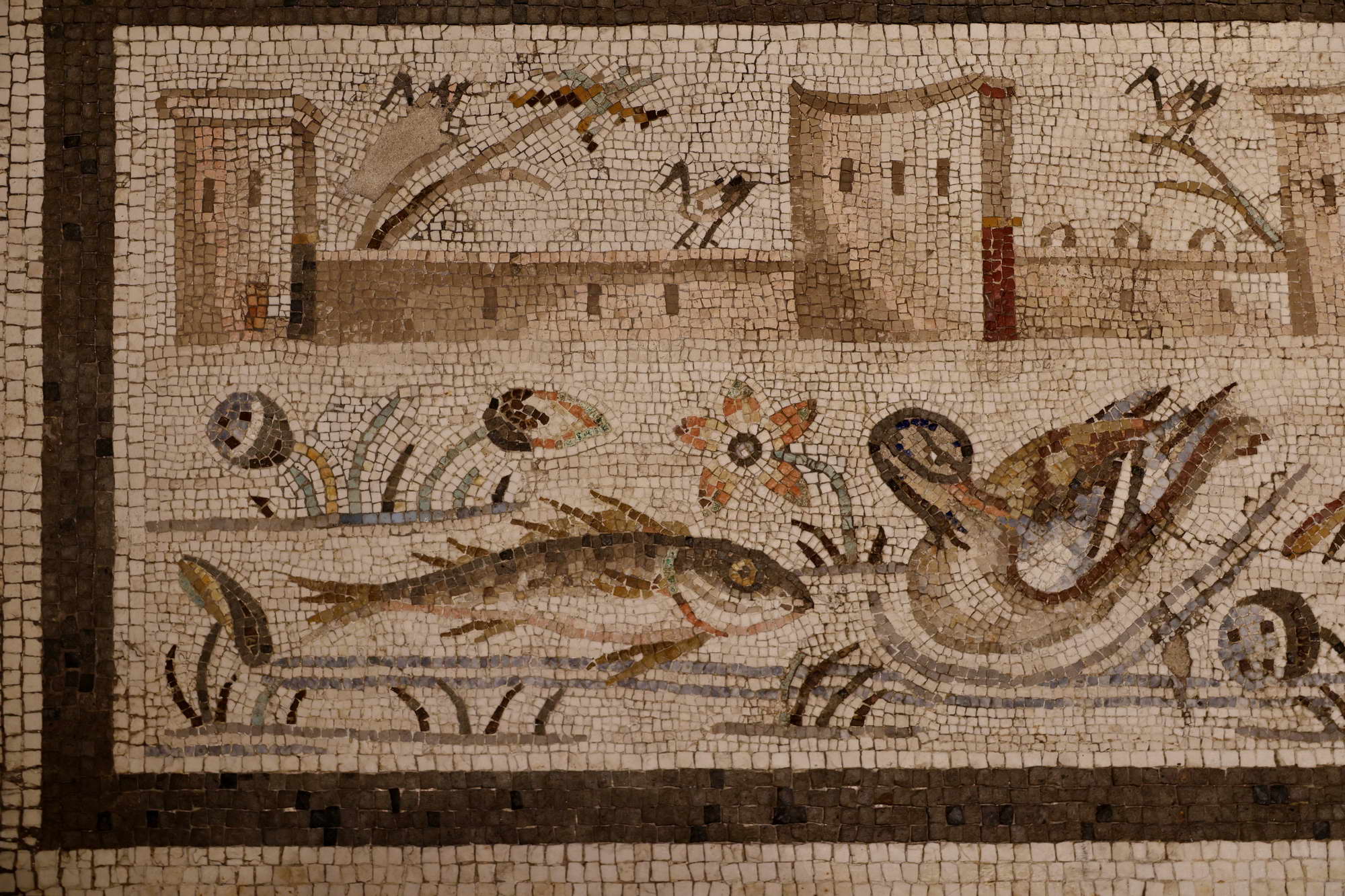 Exotic fish and birds, rendered with exquisite shading. In the background are the famous Egyptian sanctuaries as imagined in Rome, with ibises—the emblems of Egypt—perched on them, just as we saw on the Caere vases.
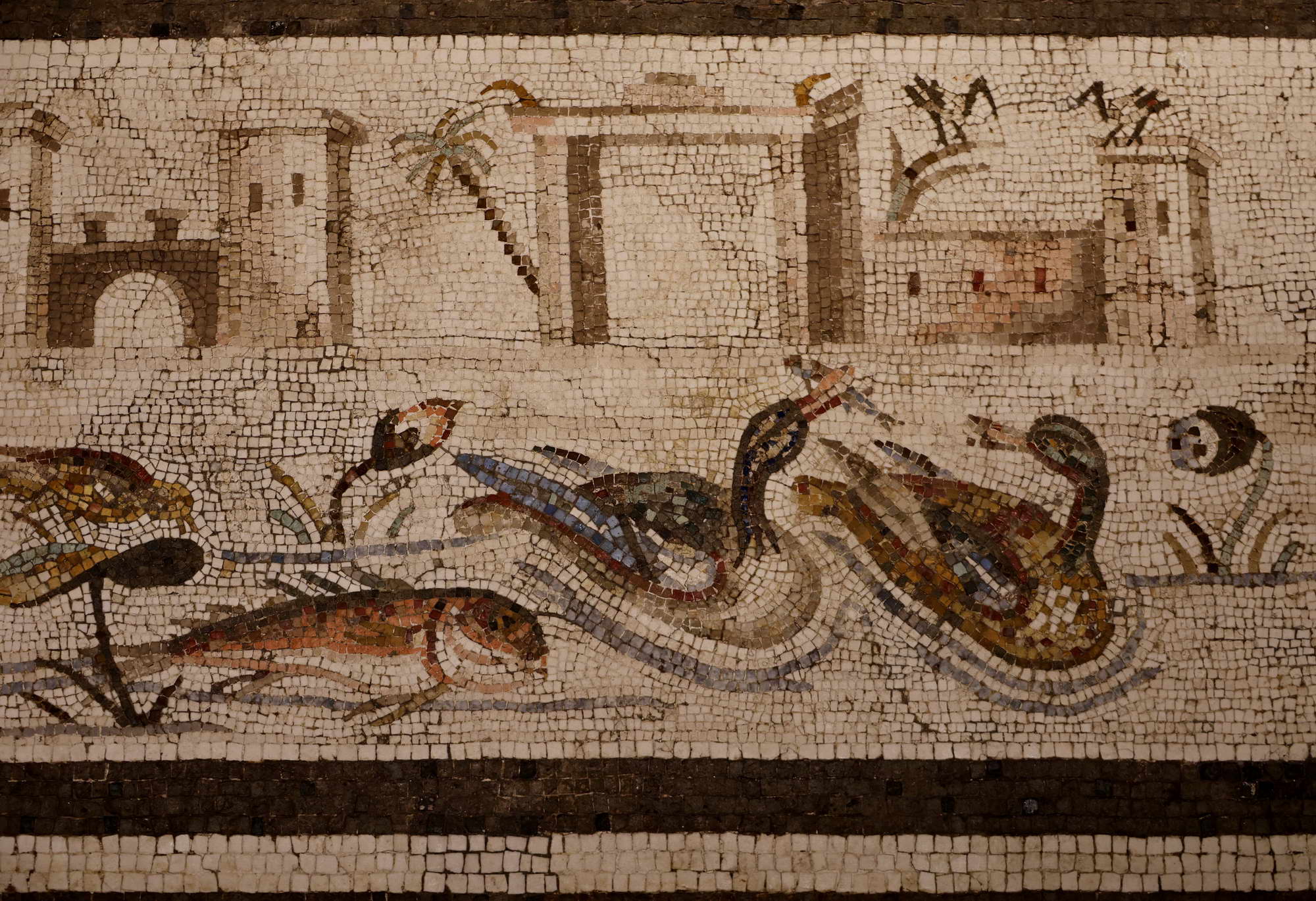 The action intensifies: water birds are now fighting one another for the catch. In the background, an Egyptian-style gateway structure (propylon).
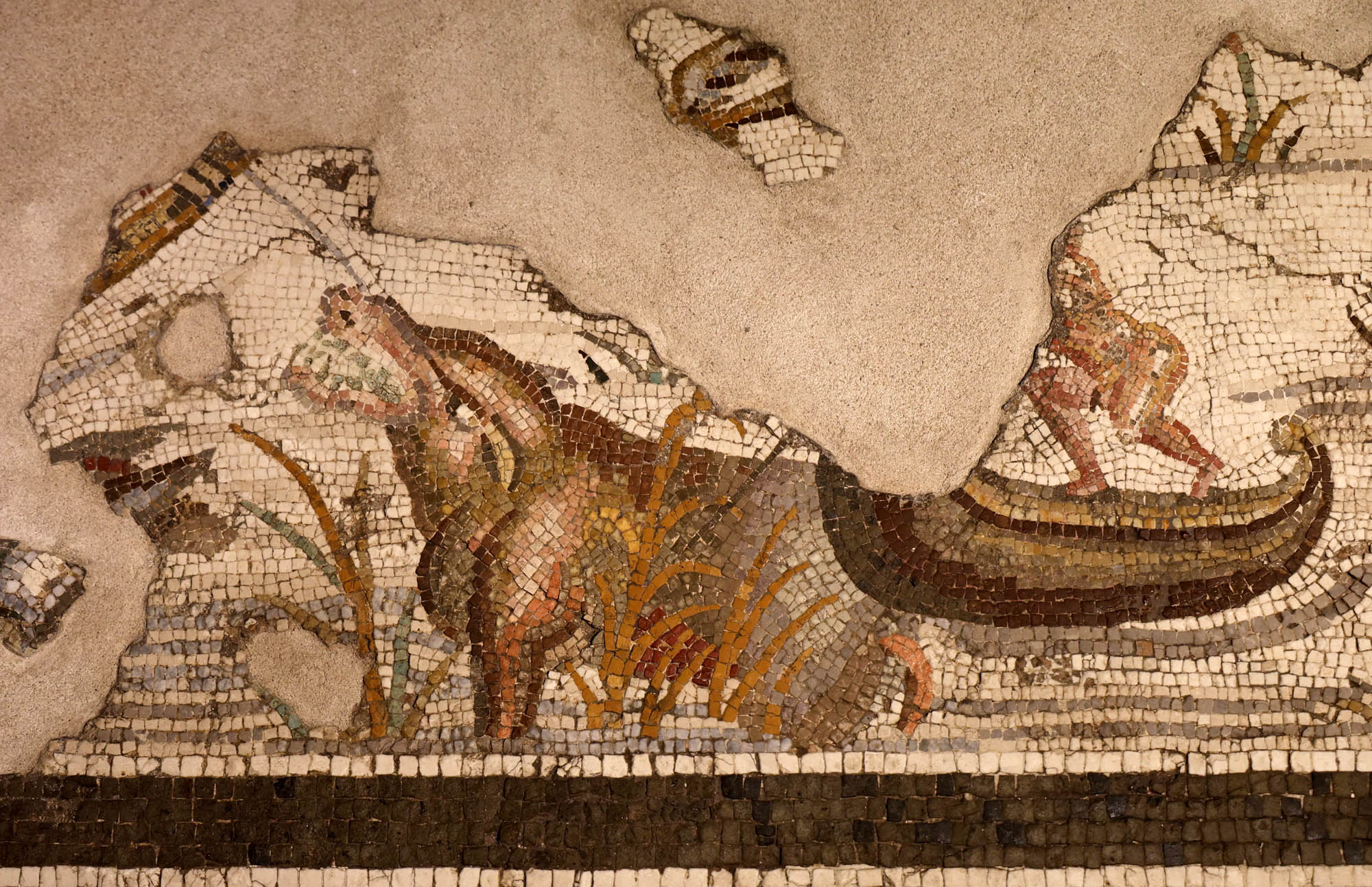
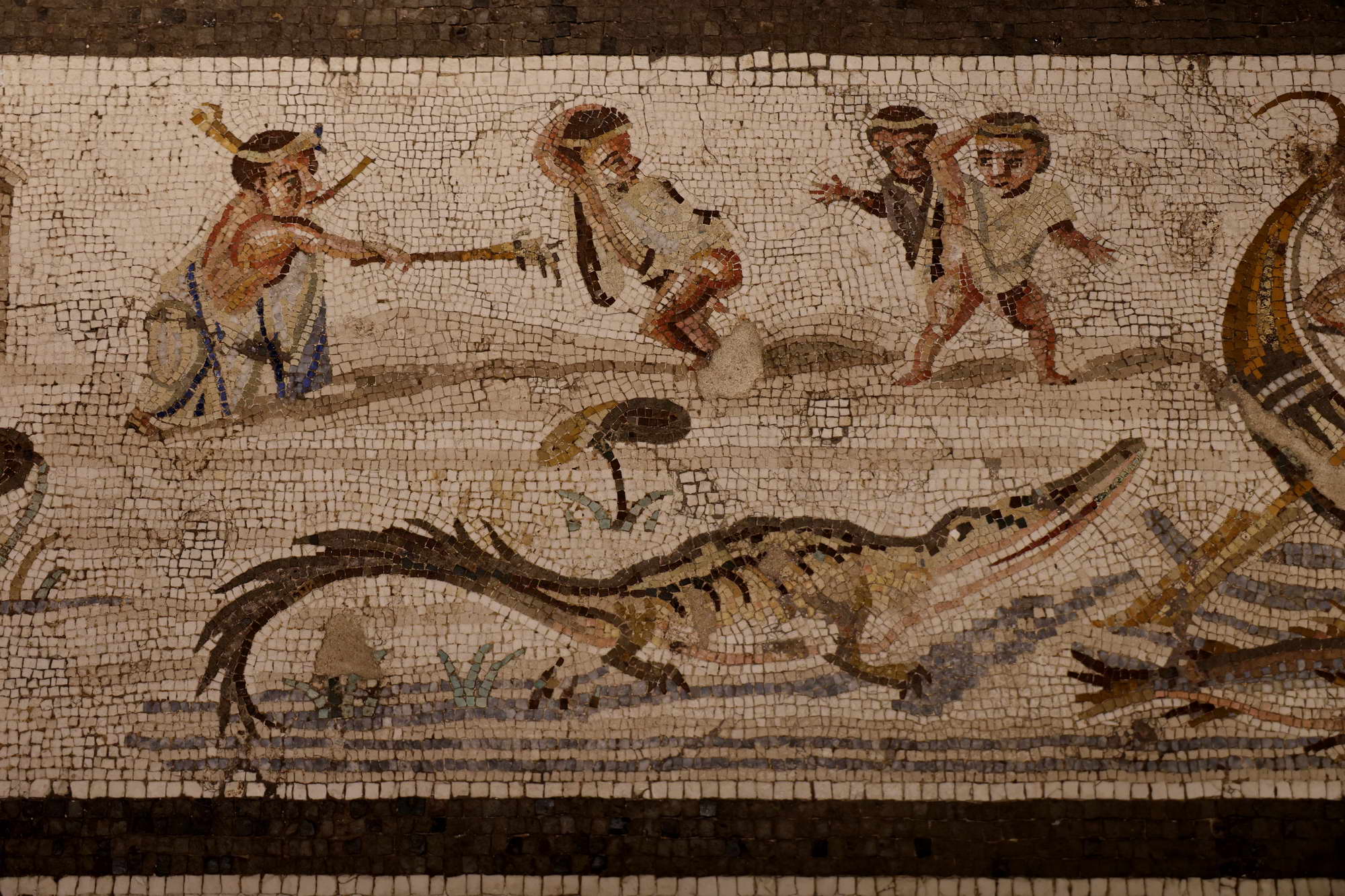 A classic Hellenistic pygmy battle (well, they do live in Africa too, don’t they?). Of the four pygmies, only the one on the left is brave enough to swing his club at the crocodile, depicted with remarkable realism. The others, much to the amusement of the spectators, prefer to make a run for it. But the crocodile is more interested in the papyrus boat sailing to the right.
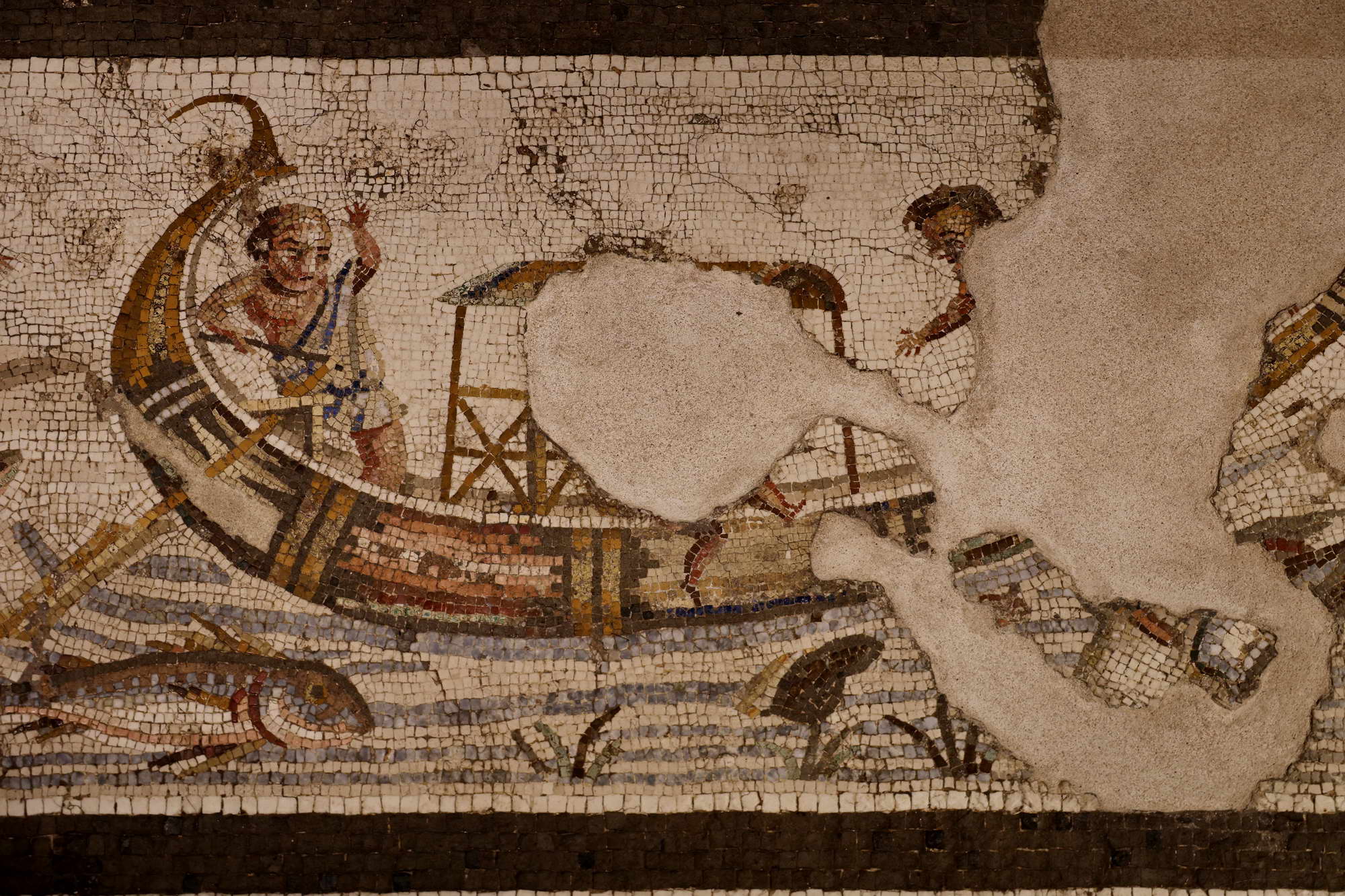 Another remarkably lifelike depiction: a papyrus boat (baris), with a raised platform in the middle to shield the tourist aboard from the sun. This time, however, a pygmy is tumbling from it into the water, as his two flailing legs reveal.
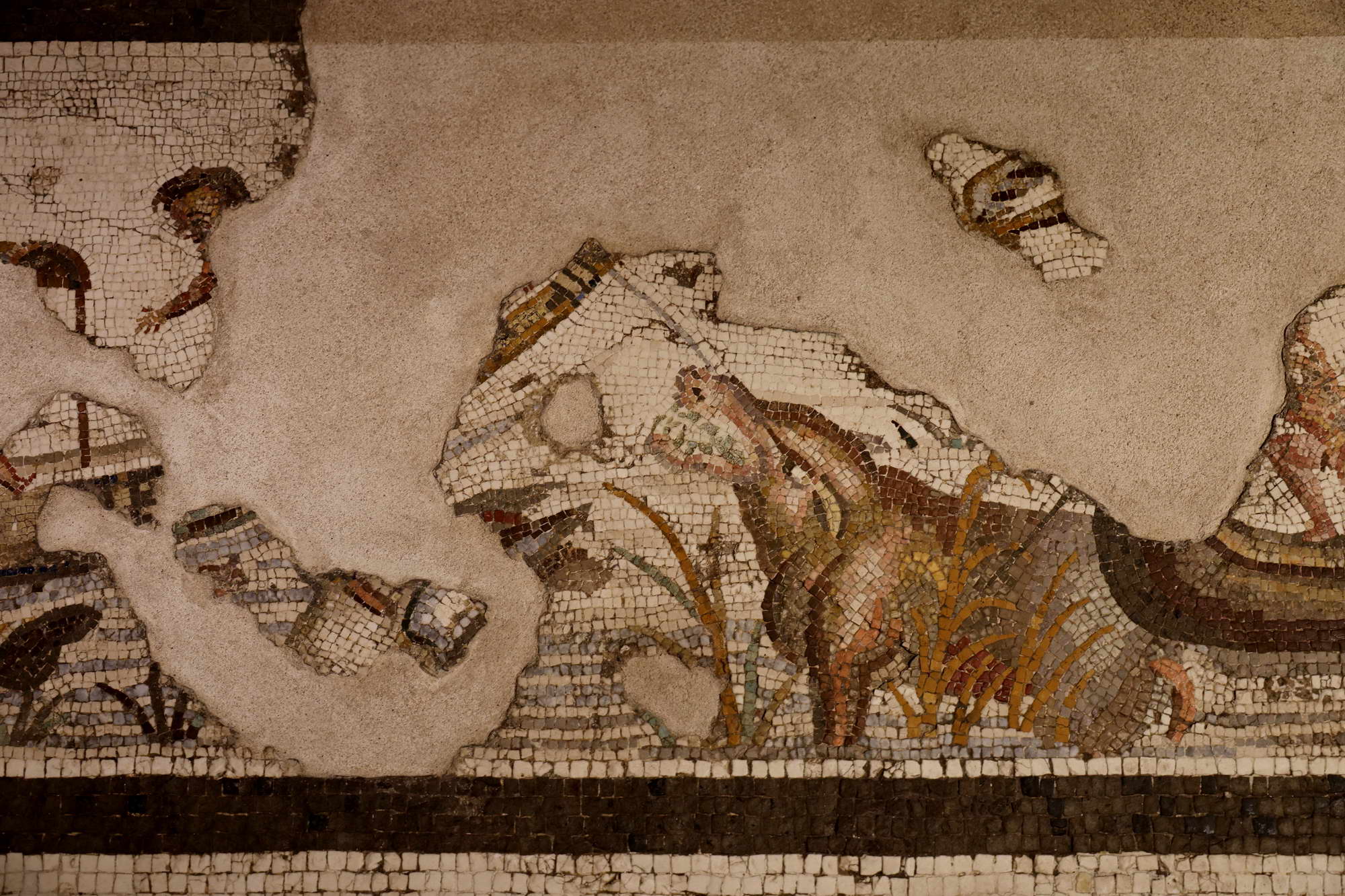 And now the climax, at the centre of the frieze: the furious Nile hippopotamus! He probably rammed the papyrus boat. He bares his teeth menacingly, but someone in the boat on the right is already hurling a spear at him. Such is Africa, after all: monstrorum nutrix (nurse of monsters, Lucan), nova monstra creavit (it brought forth new monsters, that is, after the flood, Ovid), monstrorum genetrix, metuenda colonis (mother of monsters, feared by the farmer, the Cleopatra poem), semper aliquid novi adfert (it always brings something new, Pliny). That is why we love it—or rather, love seeing it on mosaic floors, as in the Villa Romana del Casale in Sicily.
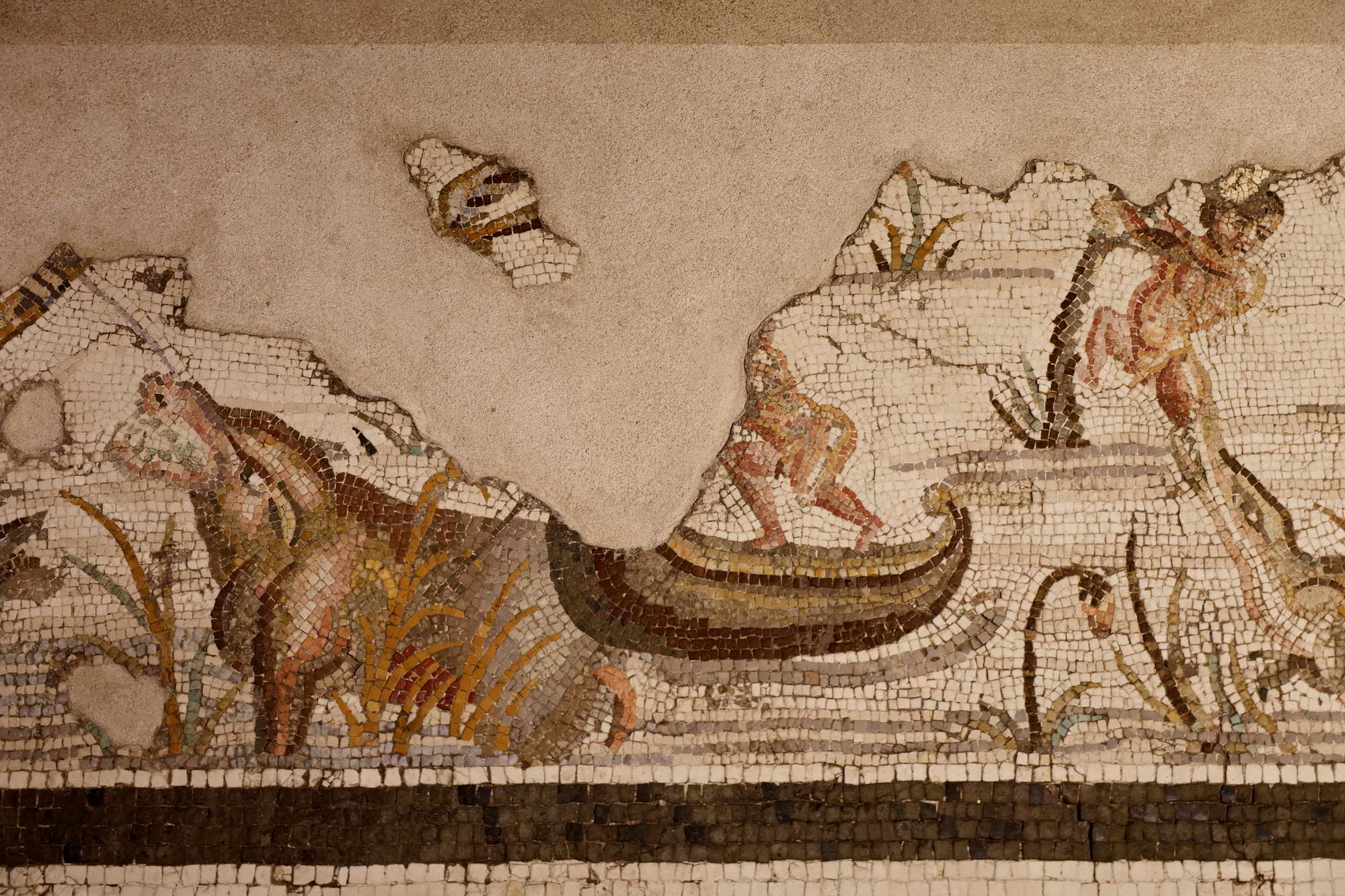
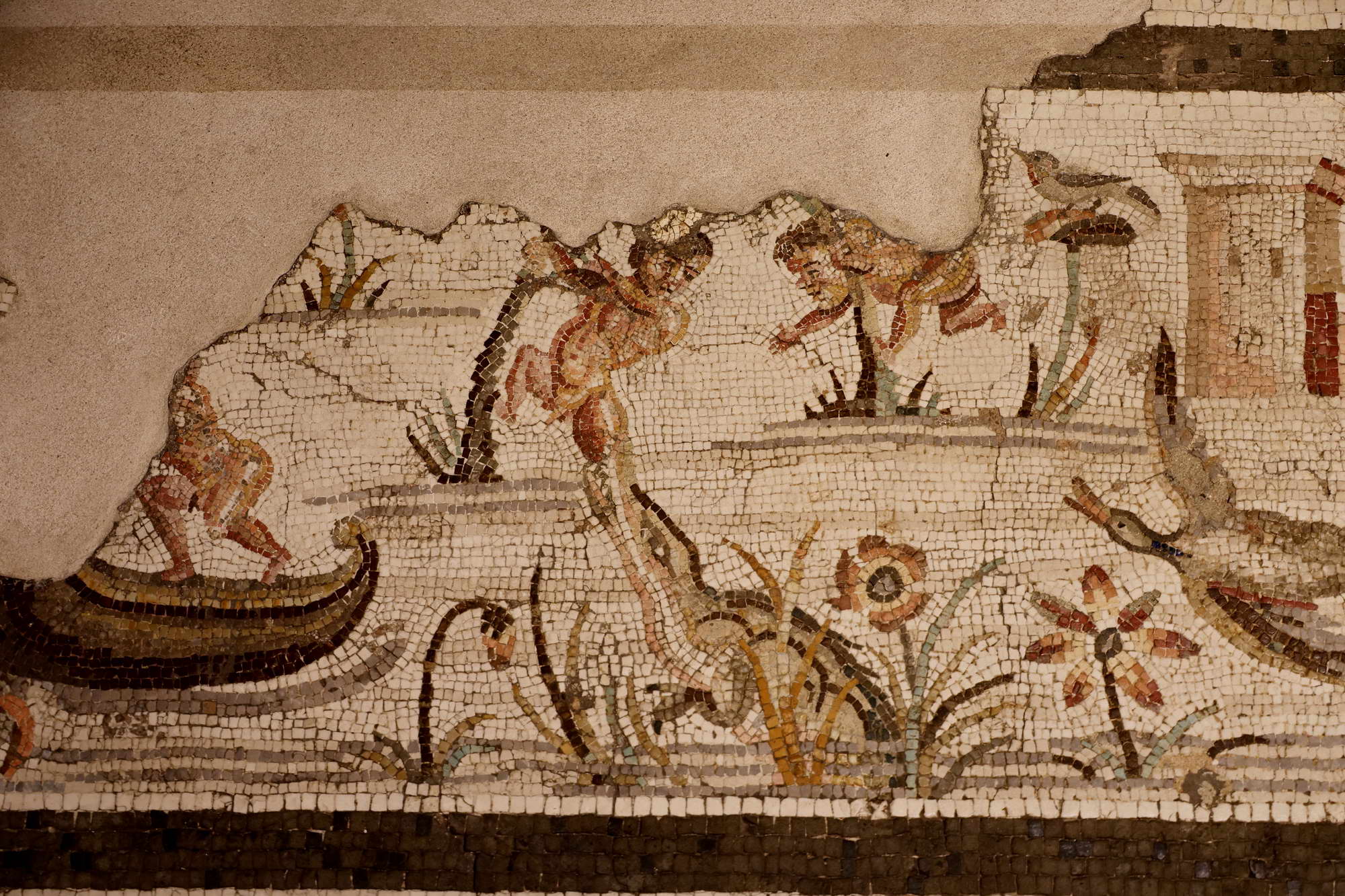 And meanwhile, on the right, in a scene that continues the previous one in mirror symmetry, a crocodile has seized a pygmy by the leg! What fun! You won’t see anything like that at the circus in Privernum.
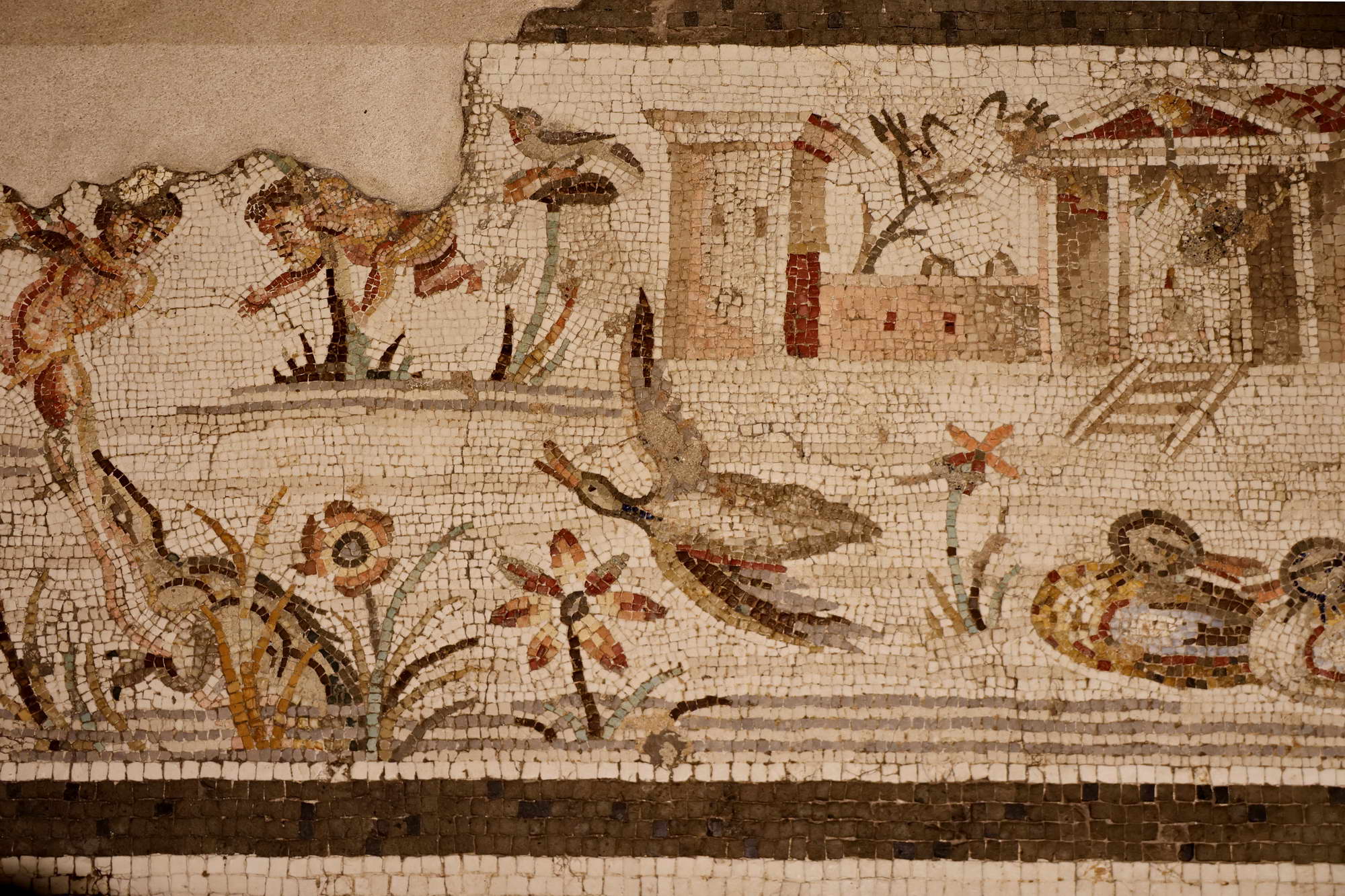 The wild duck taking flight adds to the pygmies’ terror. But gradually the cries die away, and after the comic battle staged for the entertainment of Roman tourists, we return to the eternal tranquillity of the ancient river, its sanctuaries and exotic animals.


Add comment