


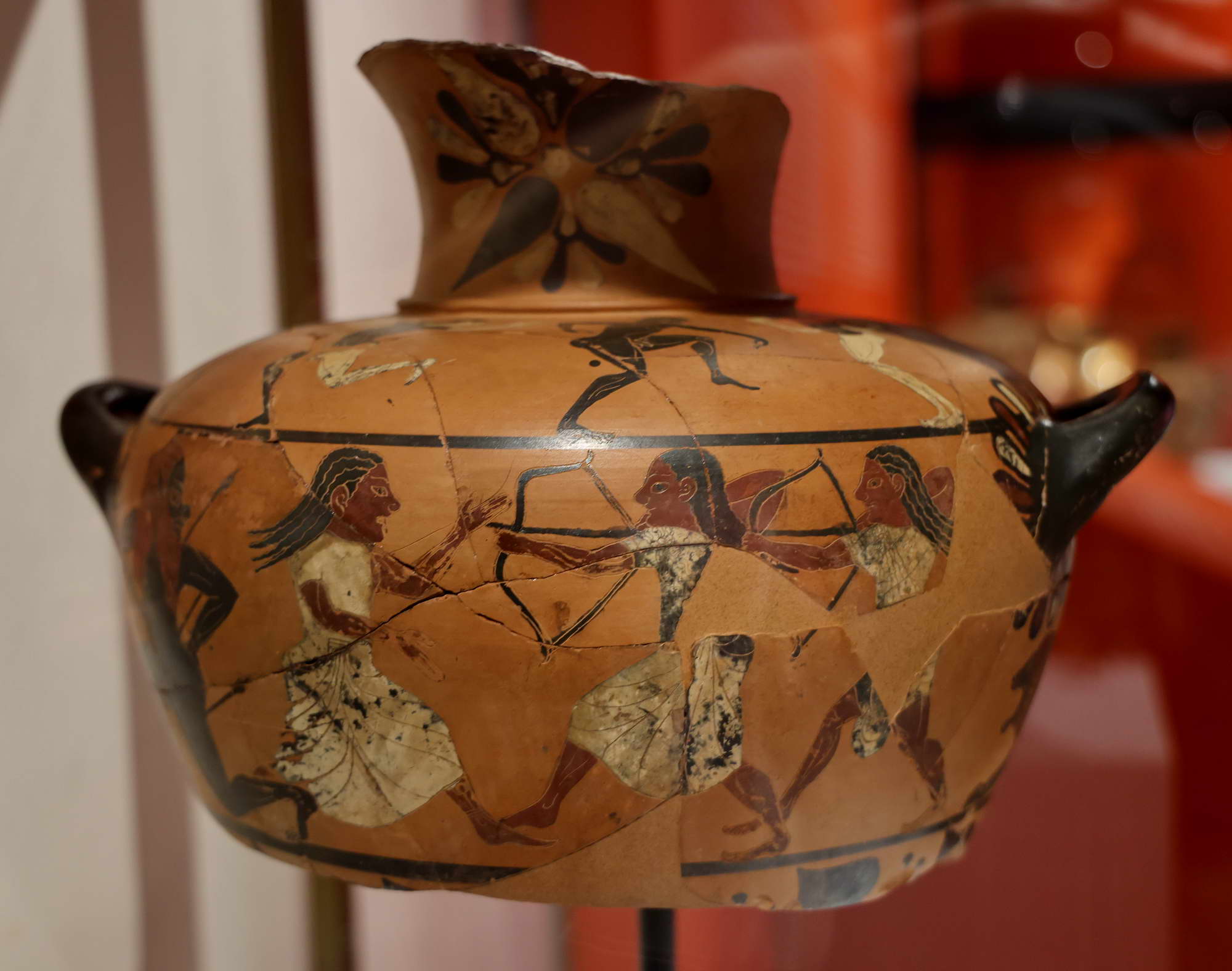
 Villa Giulia CH 9
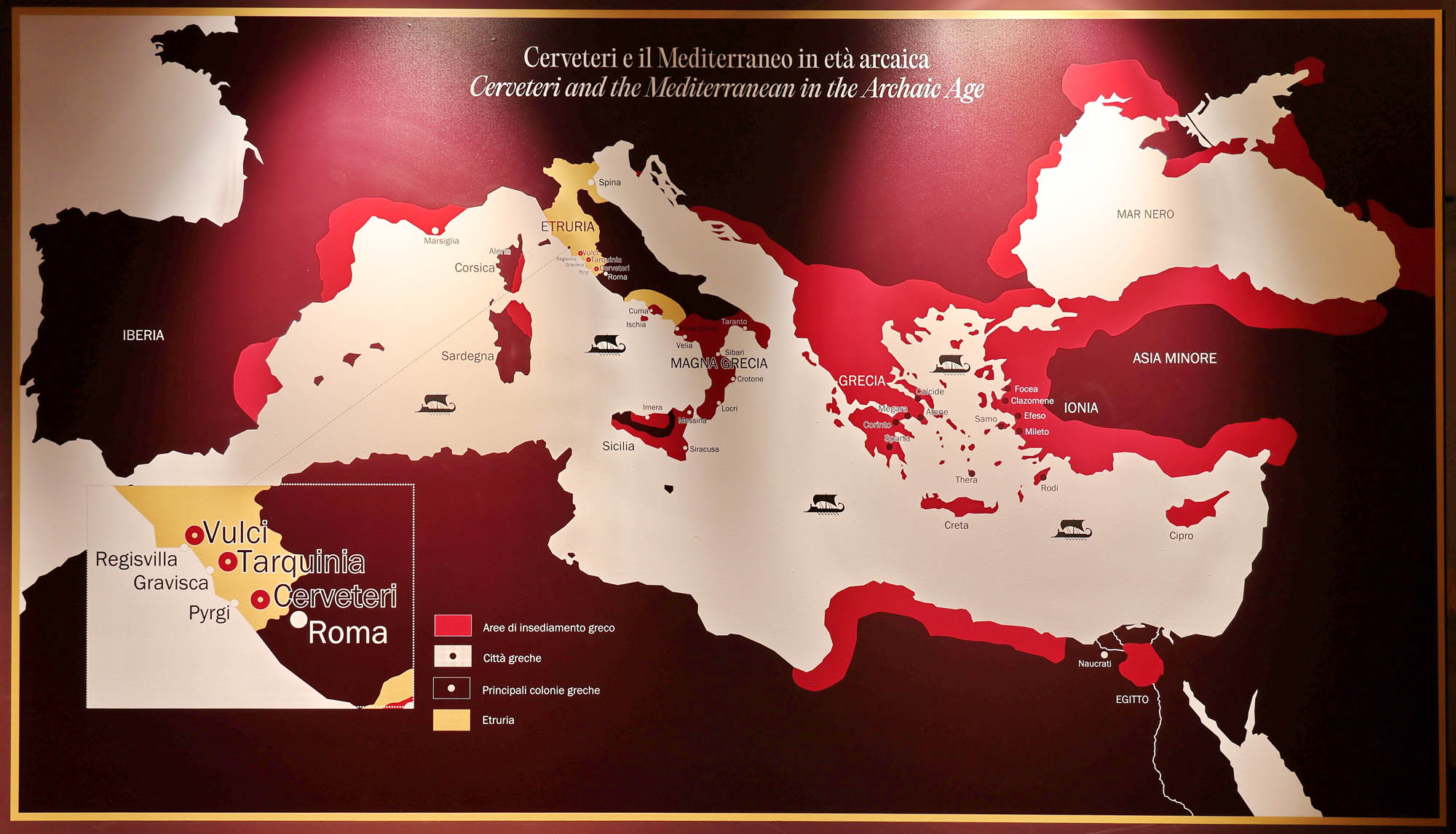
When Harpagus, the Median general of the Persian king Cyrus the Great, laid siege in 546 BC to the flourishing Ionian port city of Phocaea, the inhabitants faced a choice, Herodotus tells us: they could submit or abandon their homeland. The Phocaeans chose the latter.
The entire city took to the ships and sailed to the western Mediterranean. Following an oracle from Delphi, they founded the city of Alalia (modern Aléria) on the eastern coast of Corsica, from where they engaged in lucrative piracy throughout the Tyrrhenian Sea. Their enterprise flourished so much that the Carthaginians and Etruscans eventually formed an alliance against them. In the Battle of Alalia, around 540 BC, the Phocaeans managed to defend their city, but lost most of their fleet and, with it, their livelihood.
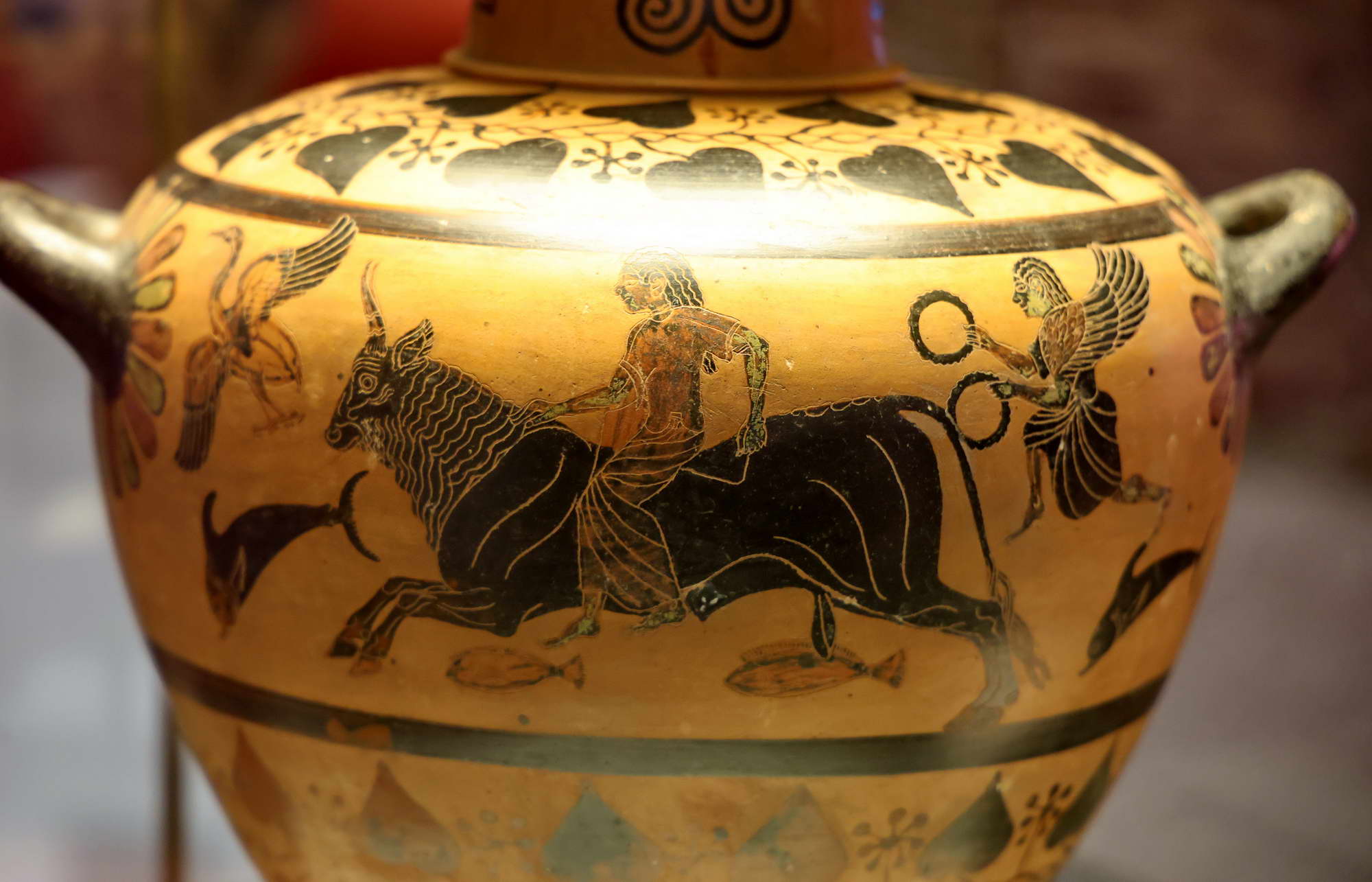
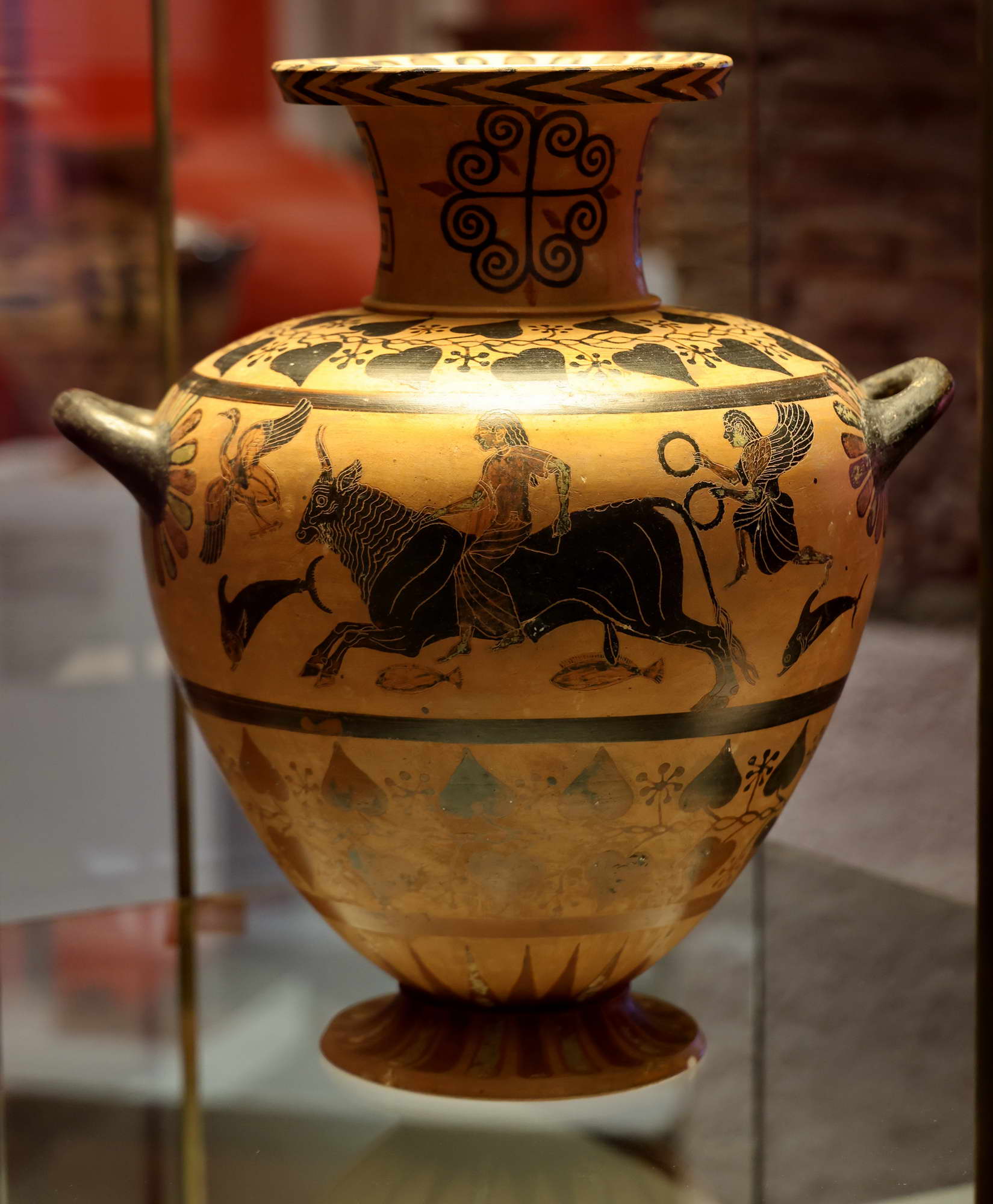 Villa Giulia CH 1. The Abduction of Europa. Zeus, having assumed the form of a bull, carries Europa amid a rich array of marine life. Behind them, a winged female figure (Iris, messenger of the gods, or Nike, goddess of victory) holds ritual ribbons and blesses the bridal voyage. The heron flying ahead of the procession reveals the Eagle Painter’s fascination with birds.
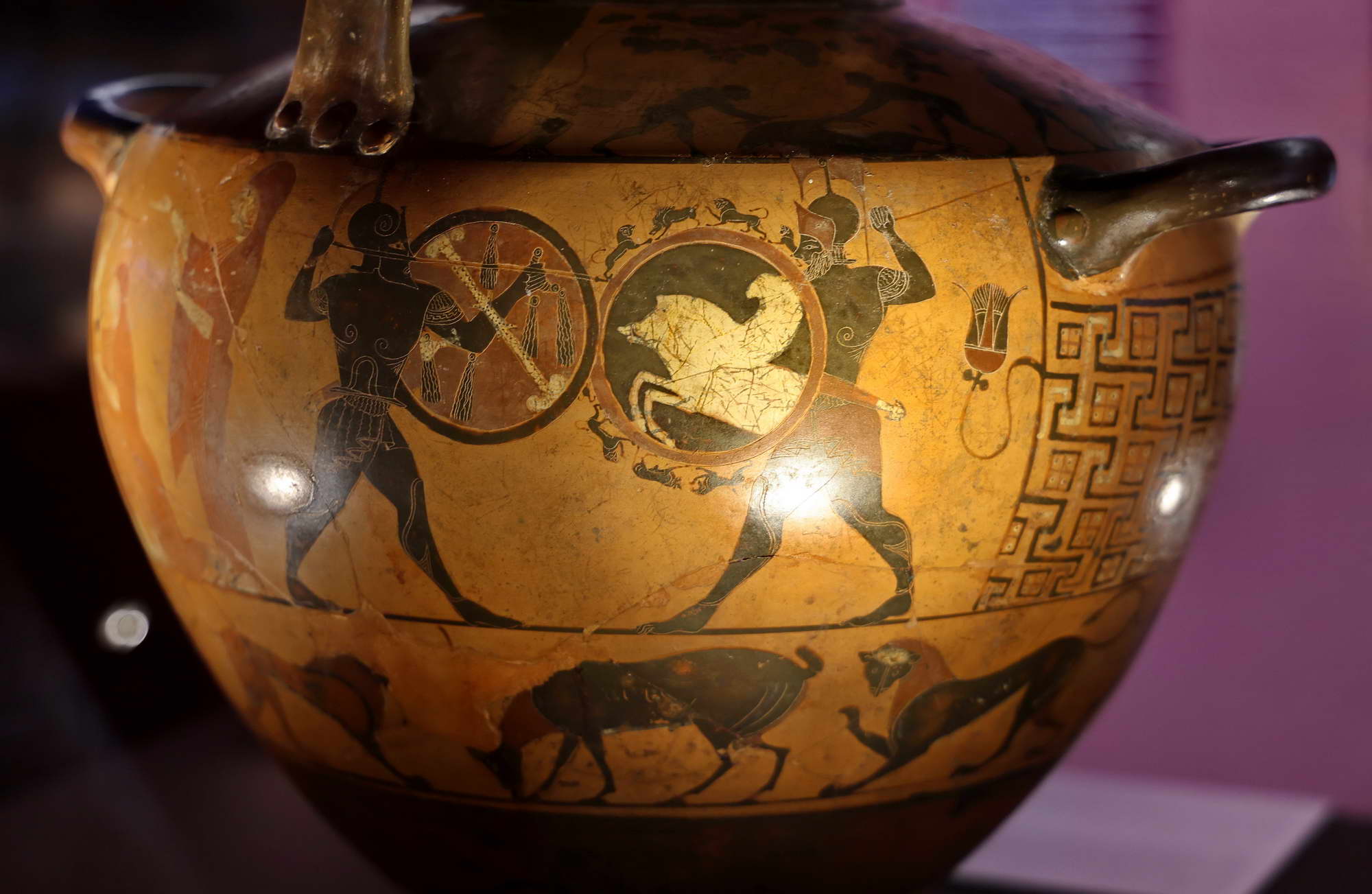
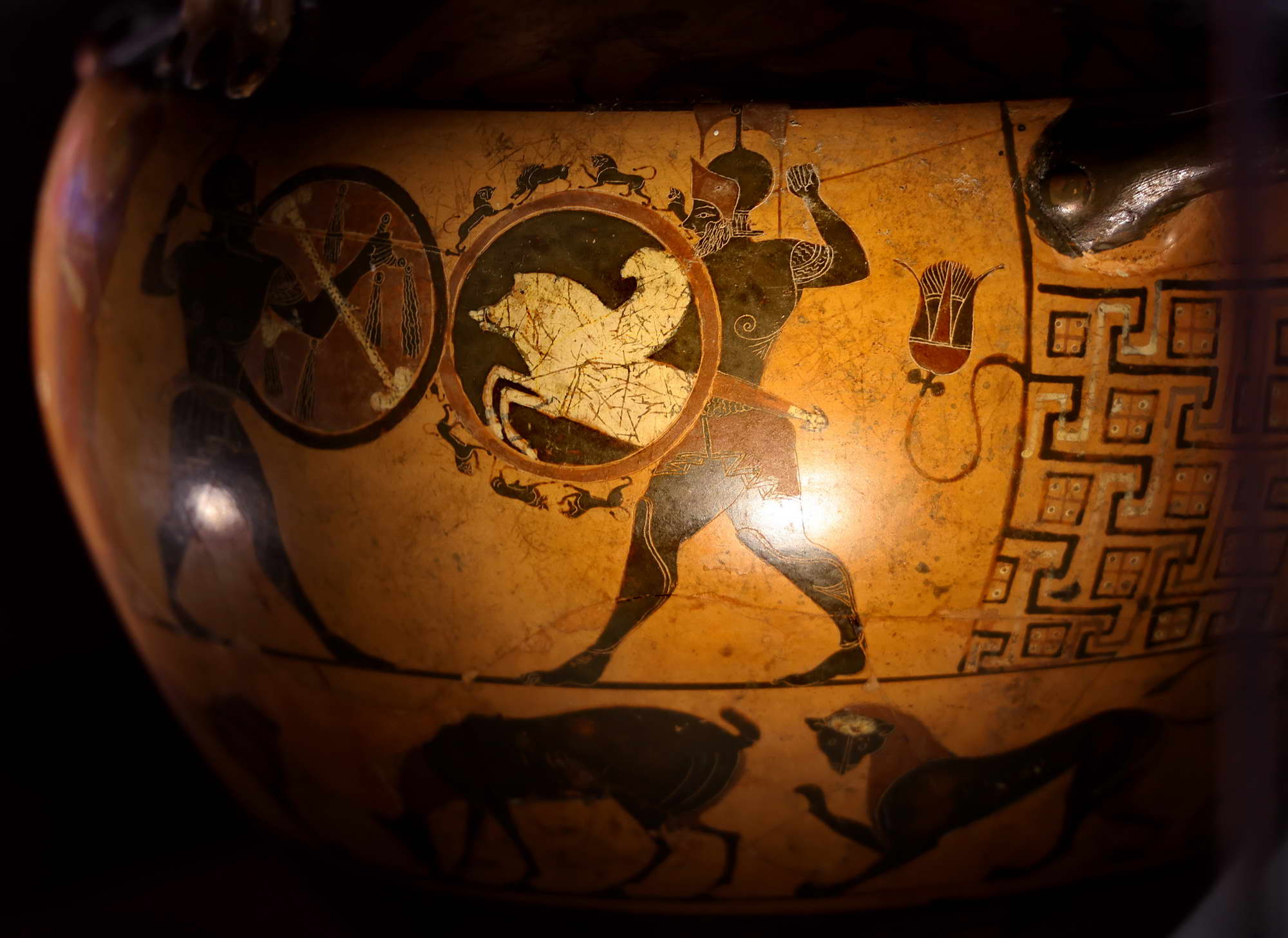
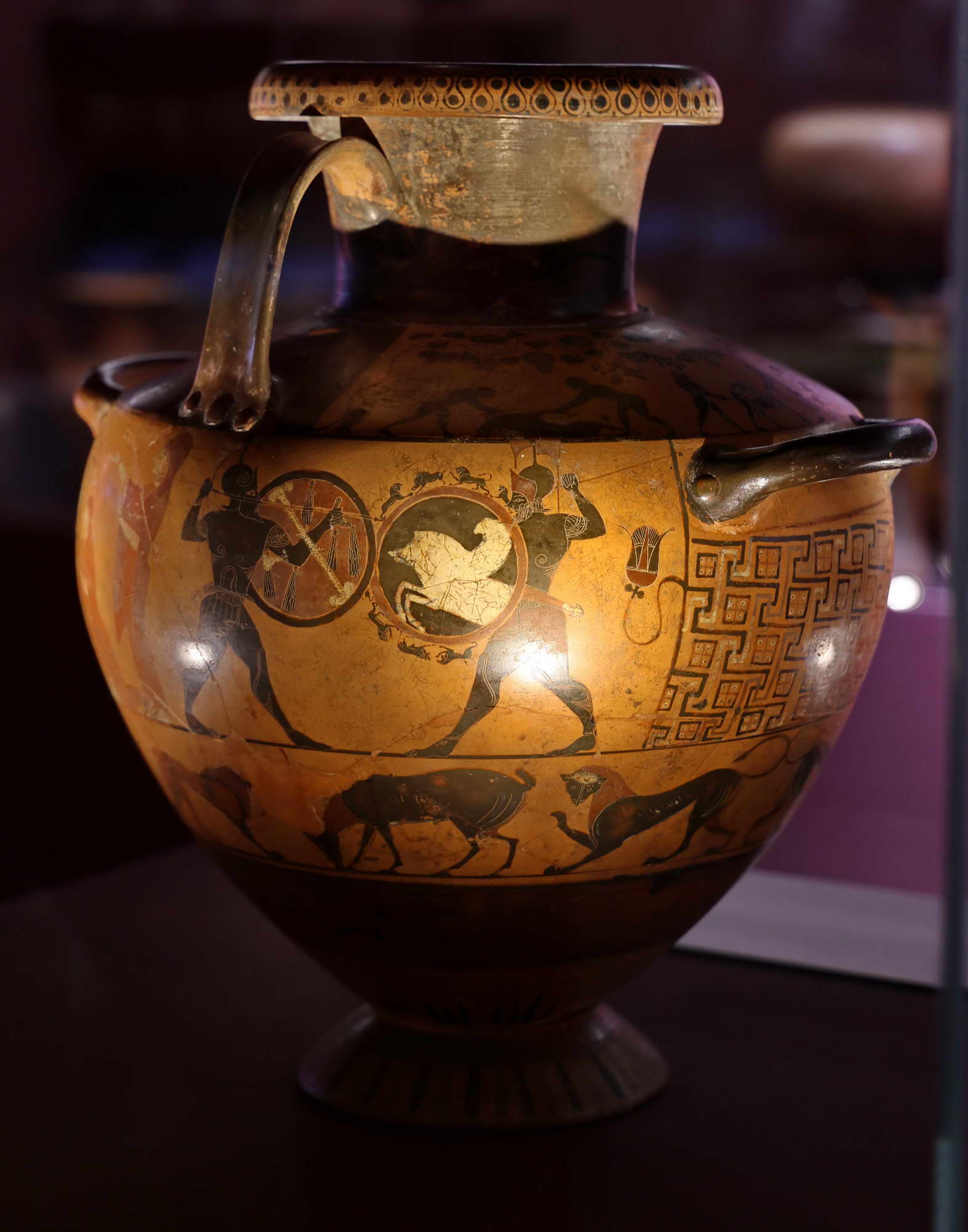 On the reverse, two hoplites fight one another. The sacred ribbons blessed in sanctuaries on one warrior’s shield foreshadow his victory, while the image of the Clazomenian boar on the other’s shield strikes fear into his opponent and serves as a kind of “hidden signature,” linking the scene to the Ionian region from which the painters came. The flowing maritime scene on the front, where divine will prevails, is thus set against a static land-based scene on the reverse, where human wills clash.
And so they moved on. Most of them went to Campania, where they founded the city of Elea (later Velia), which would become the home of the Eleatic school of philosophy and of Parmenides and Zeno.
A small group, however, settled in the port of Pyrgi, belonging to the wealthy Etruscan trading city of Caere (Cisra or Caisra in Etruscan, modern Cerveteri). There they established a pottery workshop which, between 530 and 510 BC, produced one of the most fascinating and colourful groups of Etrusco-Greek vase painting: the Caeretan hydriae, or water jars.
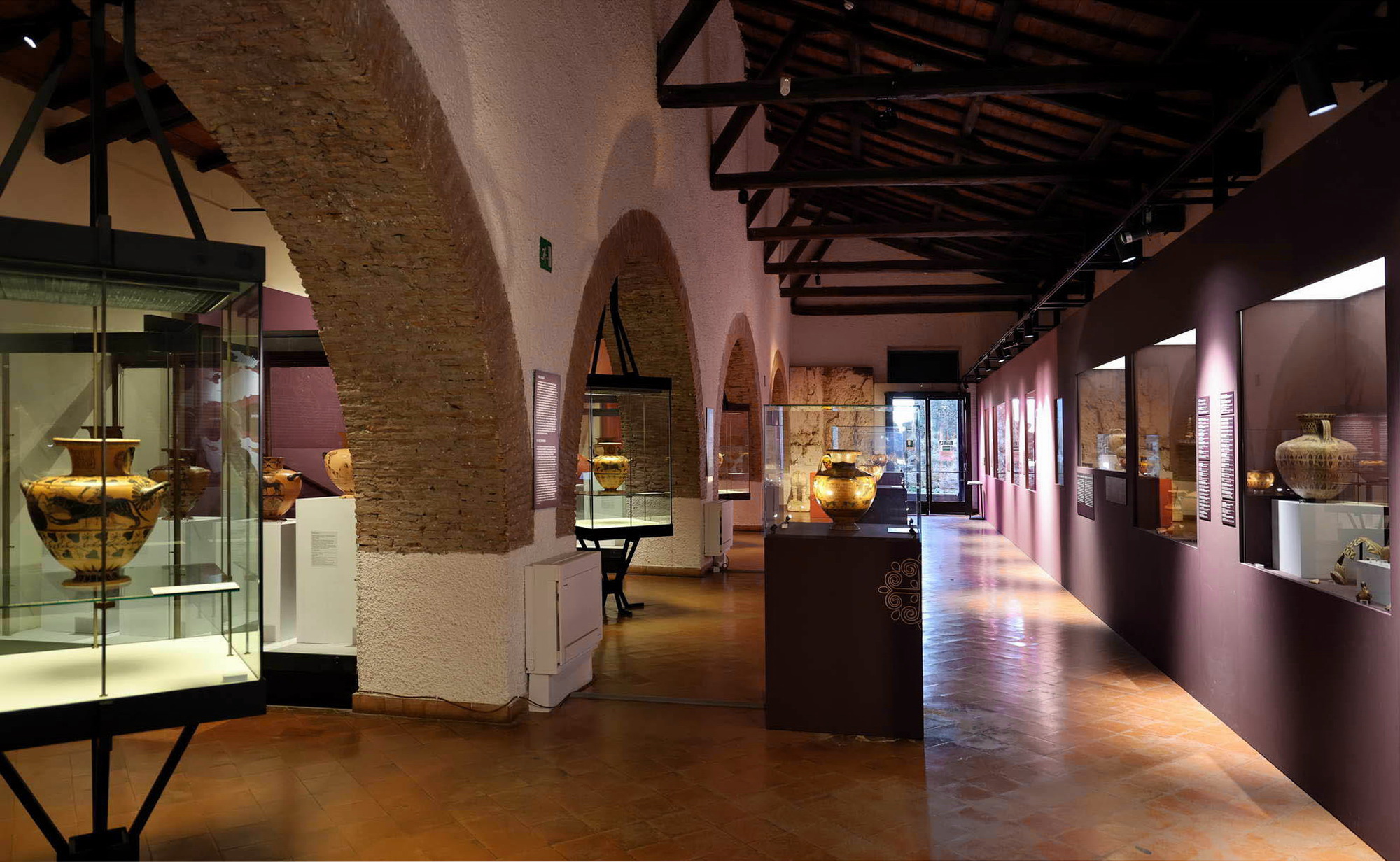
Only around 40 of these jugs—and the rounded deinoi from the same workshop, vessels used for mixing wine and water—have survived in the tombs of Cerveteri’s Banditaccia necropolis. Since their discovery, they have been scattered far and wide, and individual examples are now housed in museums across the world, from the Getty Museum to the British Museum, the Louvre, Rome’s Villa Giulia, Vienna’s Kunsthistorisches Museum, and the Hermitage. The finest of these pieces—from Paris, London, Rome, and the local collection in Cerveteri—are now being exhibited together for the first time at the place where they were made, in the Cerveteri Archaeological Museum, under the title “Seeing Etruria through Greek Eyes: The Hydriae of Cerveteri.”

At this time, Caere was an extraordinarily wealthy cosmopolitan city. Its ships sailed throughout the Mediterranean, bringing home luxury goods above all, including Greek vases by the tens of thousands. These vessels were immensely popular among the Etruscan elite. Many were placed in their tombs, furnished like houses, which is why they have survived here in greater numbers and in better condition than in the Greek lands where they were originally made.
Among the surviving Greek vases, one group is quite exceptional: these were not imported, but made by a Phocaean workshop in Caere’s port. The craftsmen—apparently two in number, now known as the Busiris Painter and the Eagle Painter after scenes they depicted—recognised what appealed most to Etruscan taste and adapted their style and subject matter accordingly.
Imported vases, especially those from Attica, relied largely on the two-tone contrast of red and black. But, as the wall paintings in their tombs show, the Etruscans adored a wealth of colour: to them, luxury meant vivid, exuberant hues. The Greek craftsmen working at Caere therefore used generous amounts of added white, purple, and bright red on the figures’ clothing and skin, as well as in the luxuriant vegetal ornament.
Classical Greek vase painting, by contrast, favoured harmonious proportions and restraint. Its figures move in a solemn, stylised manner. The Etruscans, however, wanted to see a celebration of life, dynamism, and drama. The figures’ movements are almost exaggerated, yet they seem astonishingly alive. Dancers leap, the folds of garments billow, and gestures become theatrical. The Etruscan patron wanted to feel the energy of the scene.
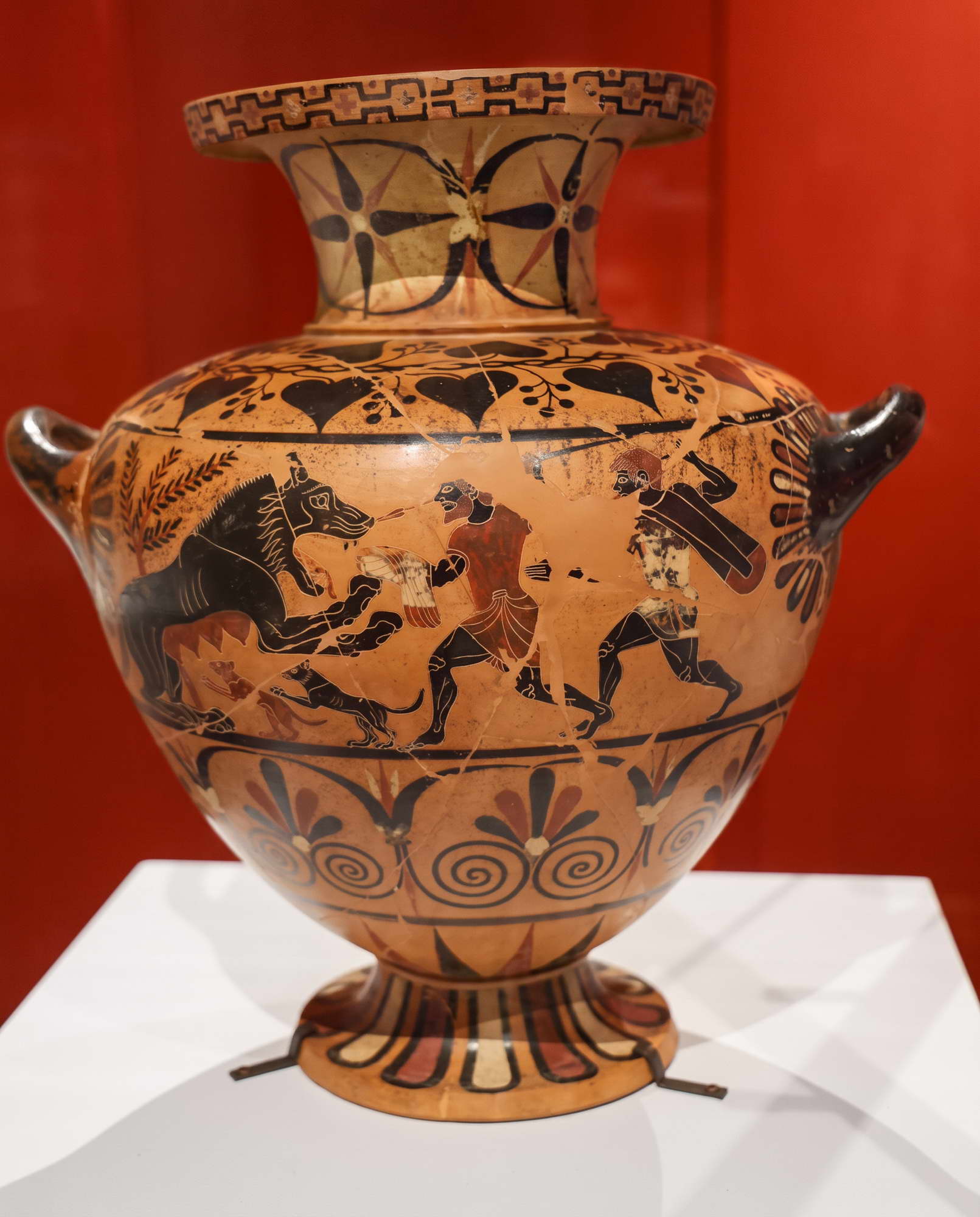 Kunsthistorisches Museum CH 10. A farmer and his son fend off the attack of a lioness with their spears. Beneath the lioness’s teats, two tiny cubs are squealing.
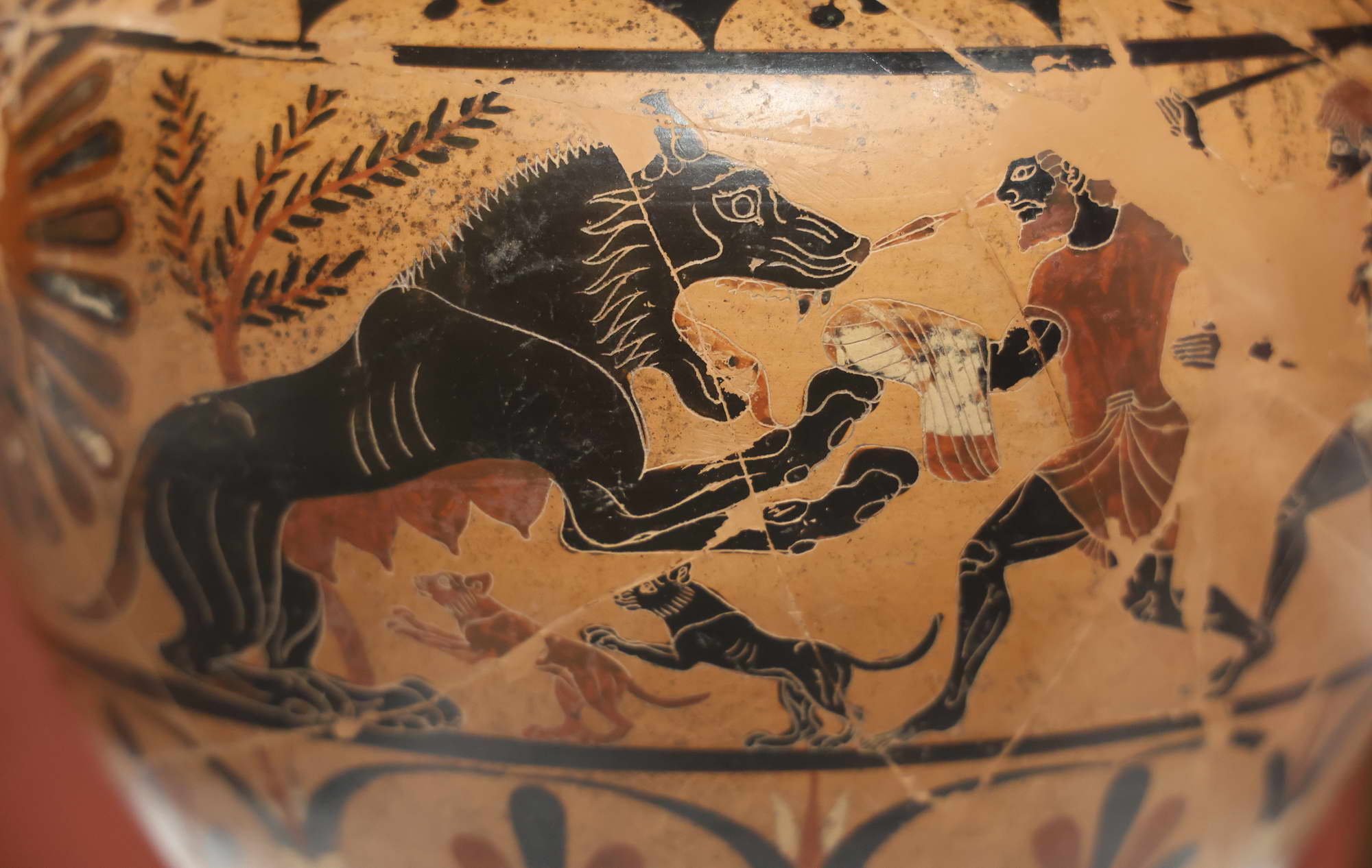
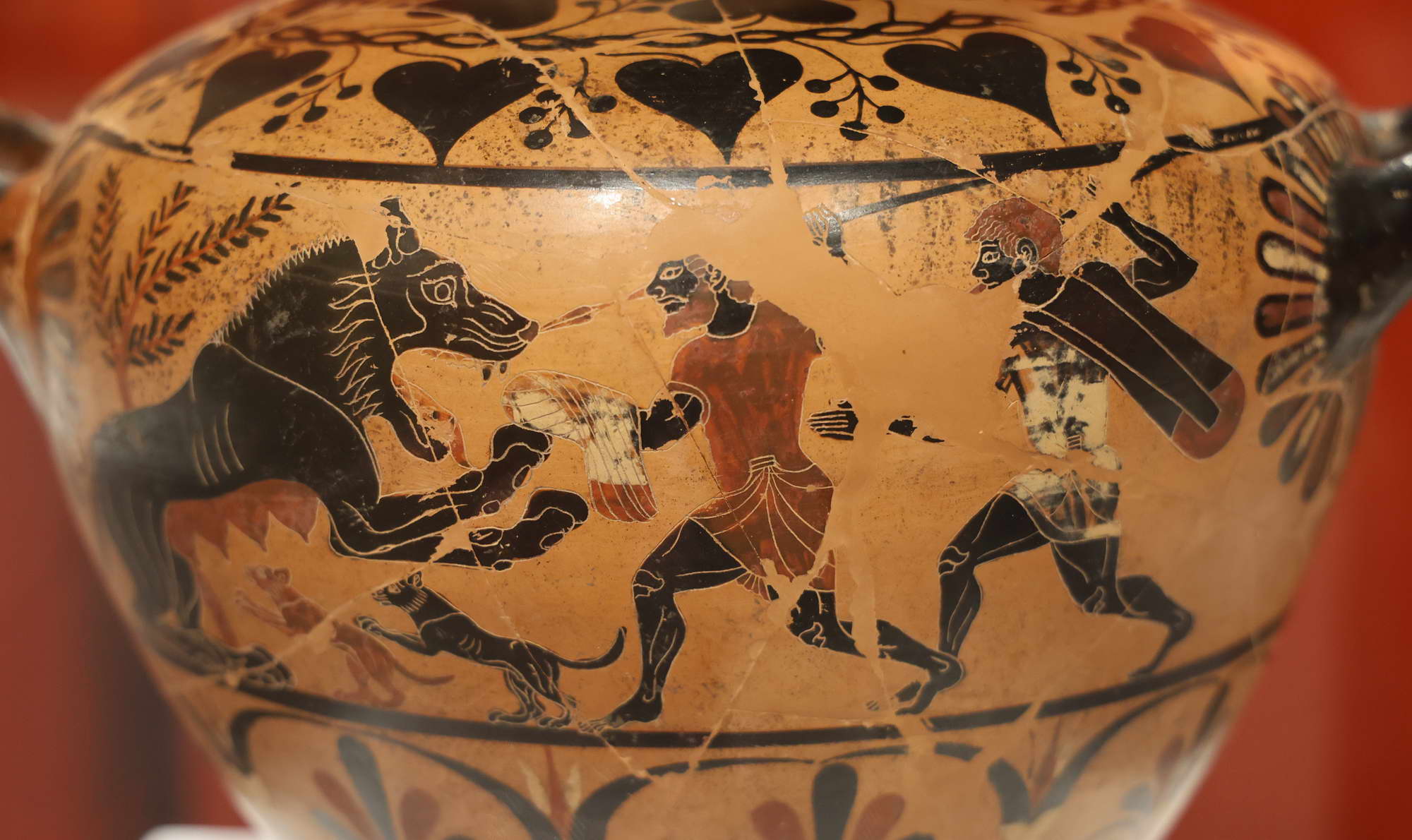
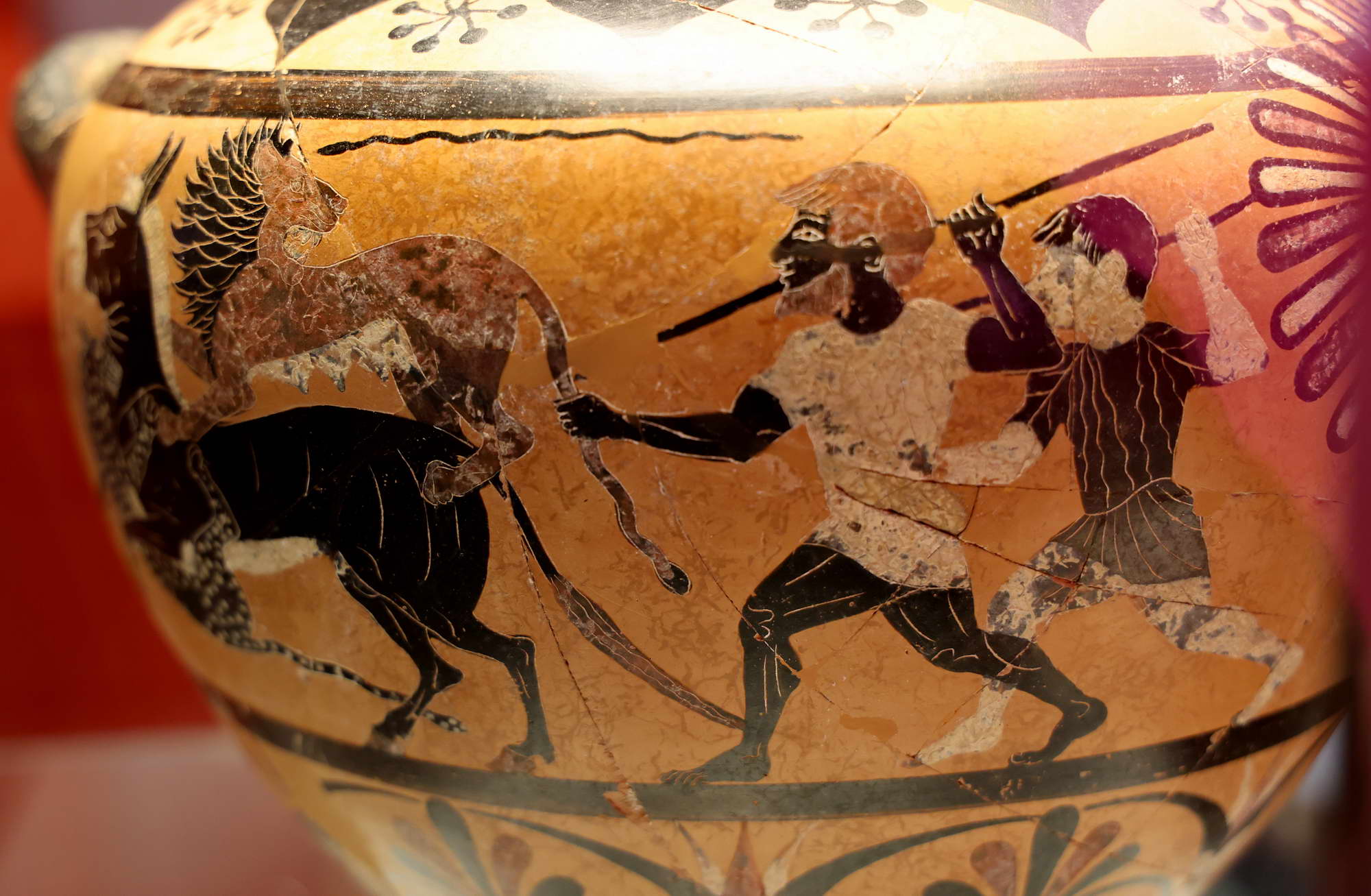
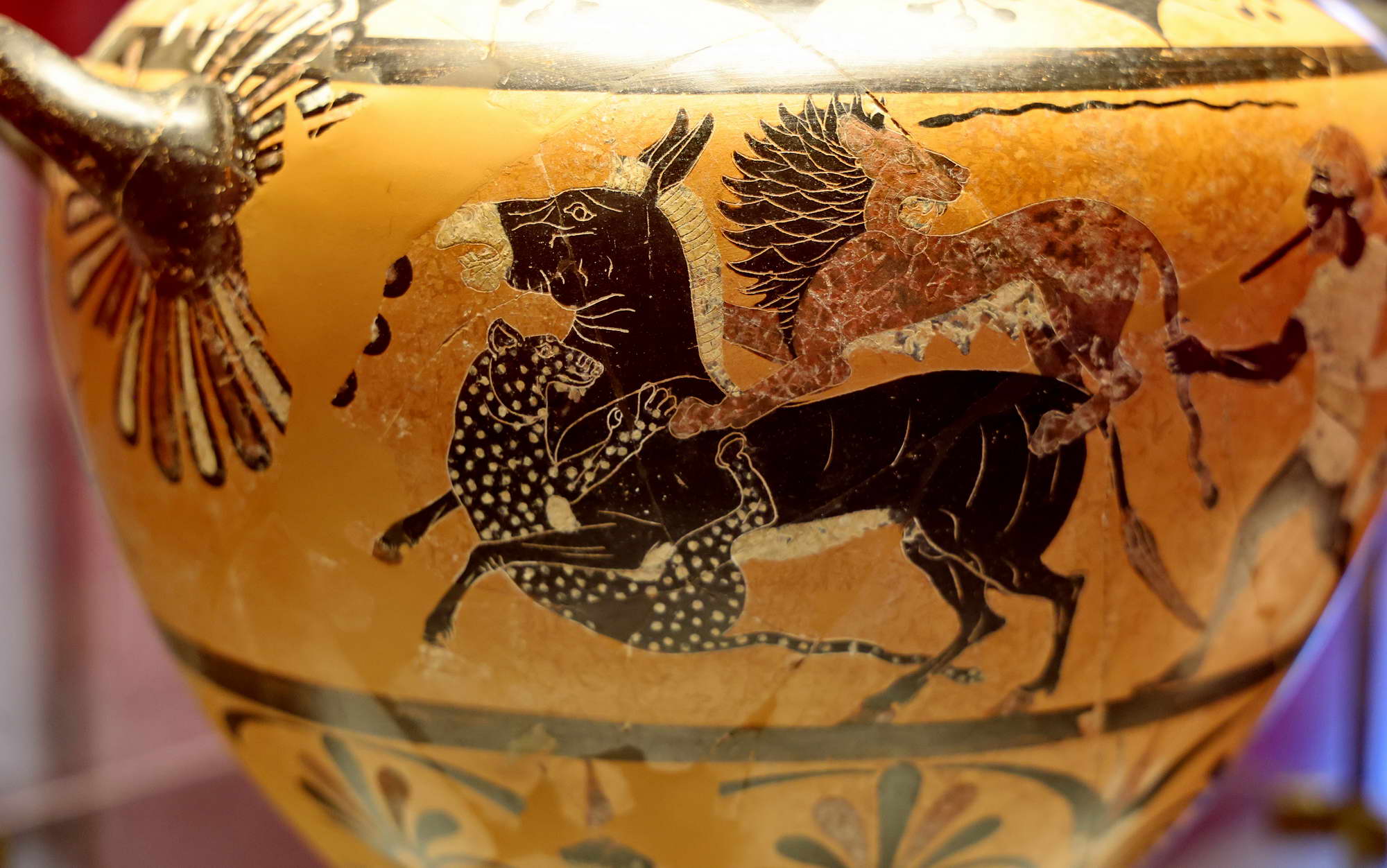 Villa Giulia CH 31b. A farmer and his son try to drive away with sticks a lion and a leopard attacking their donkey. I have written about this vase before, noting how closely the attack by the two big cats follows a well-established iconographic formula, later also used by August Kiss in his sculptures standing in front of Berlin’s Altes Museum.
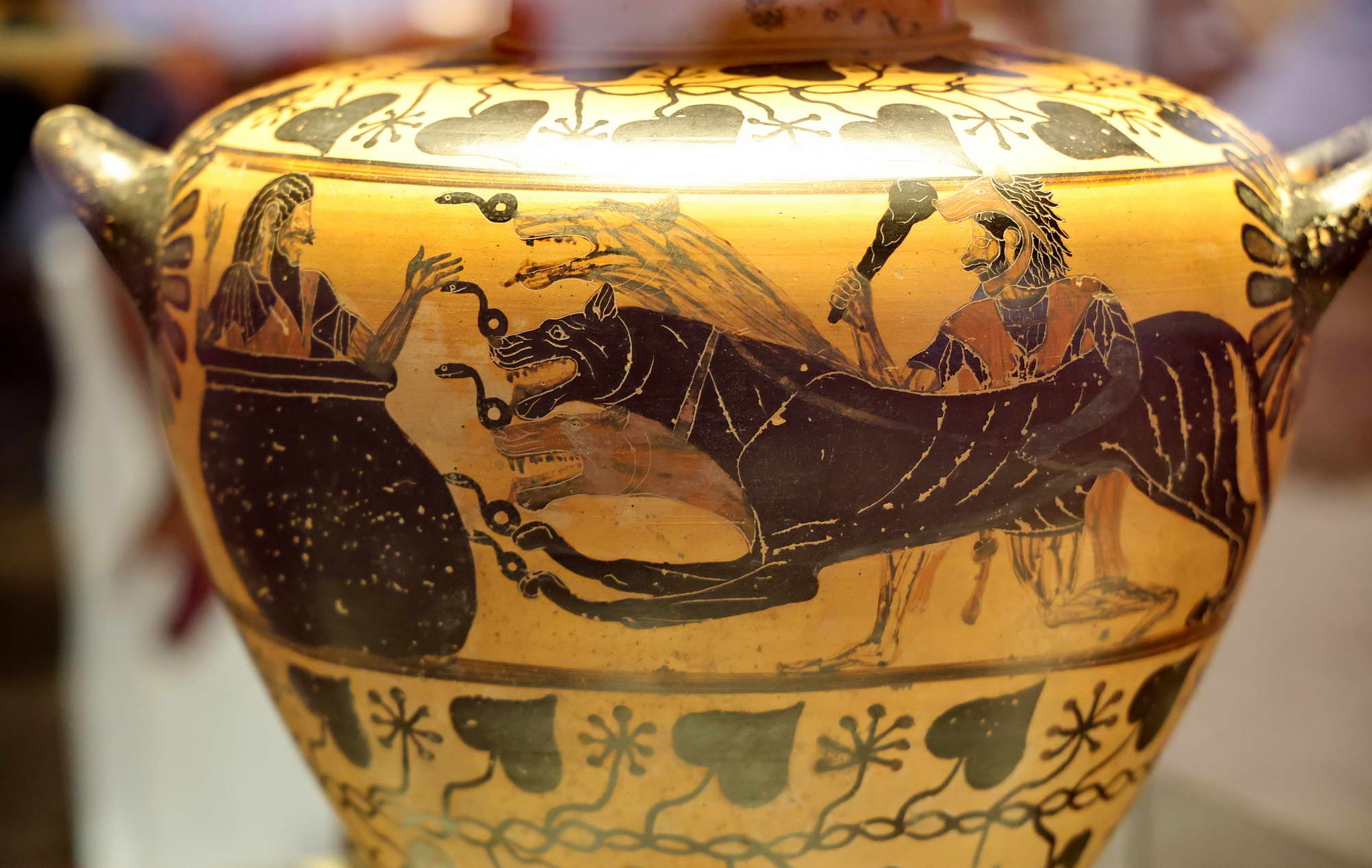
Whereas mythological scenes on classical Greek vases are treated with solemn dignity and an almost religious reverence, the Caere hydriae are deliberately ironic and parodic. They turn the deeds of heroes into something close to comedy. When Heracles brings Cerberus from the Underworld before King Eurystheus, the king does not merely recoil in terror: he hides absurdly inside a huge clay jar. On the Busiris hydria, Heracles tramples the miniature Egyptian priests beneath his feet in an almost cartoonish manner. Bald, spindly-legged and cowardly, they flee from him in grotesque poses.
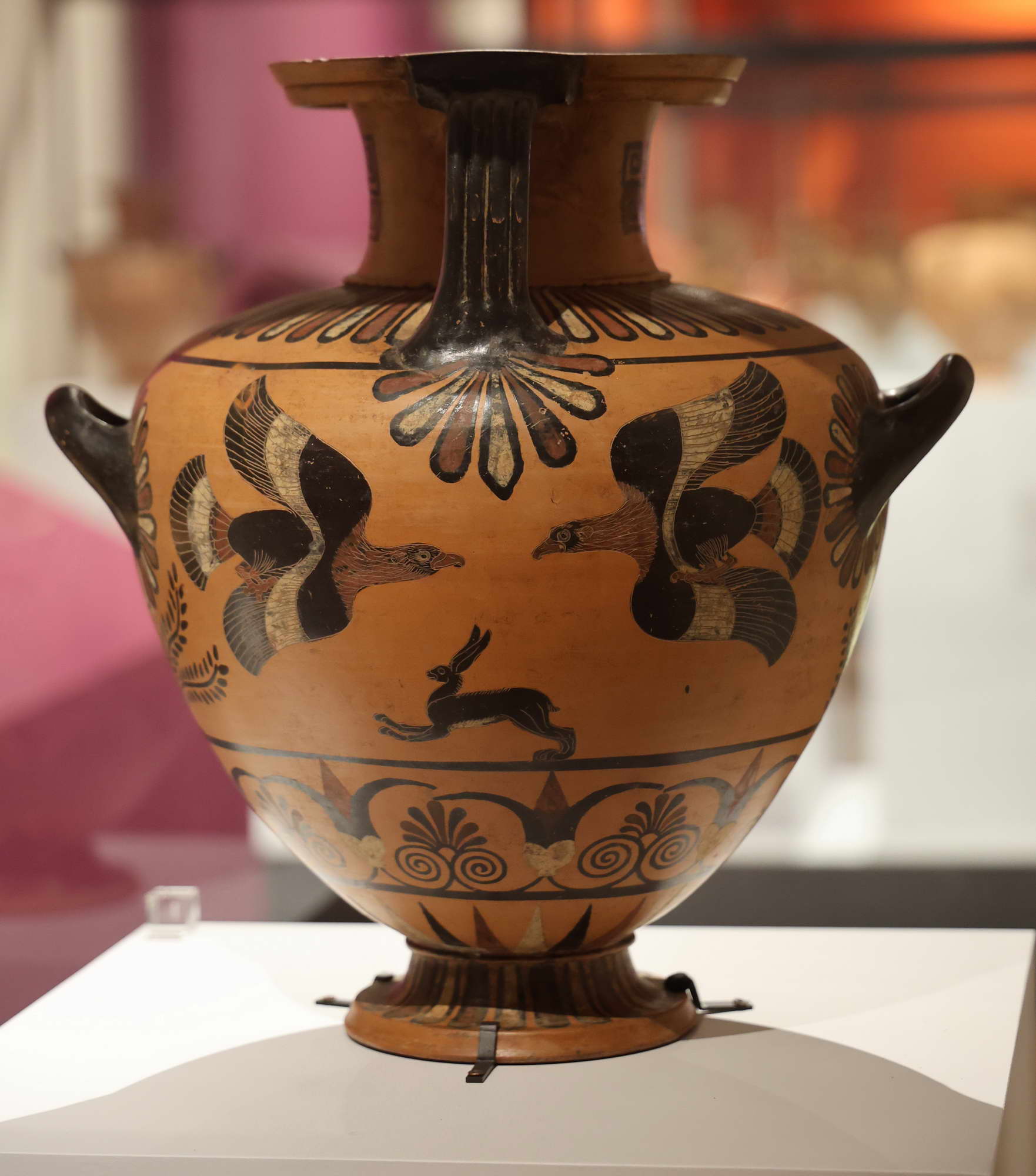
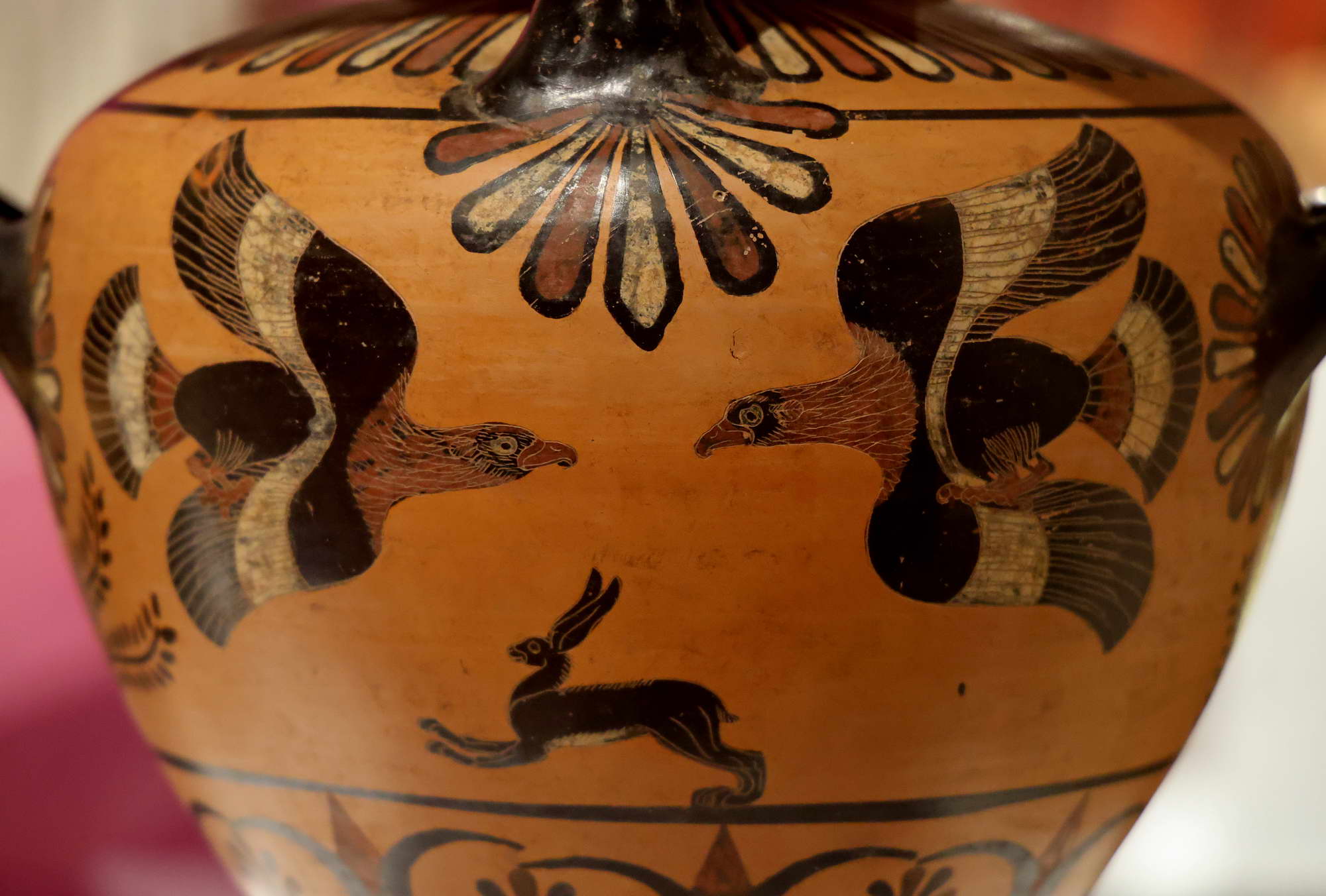
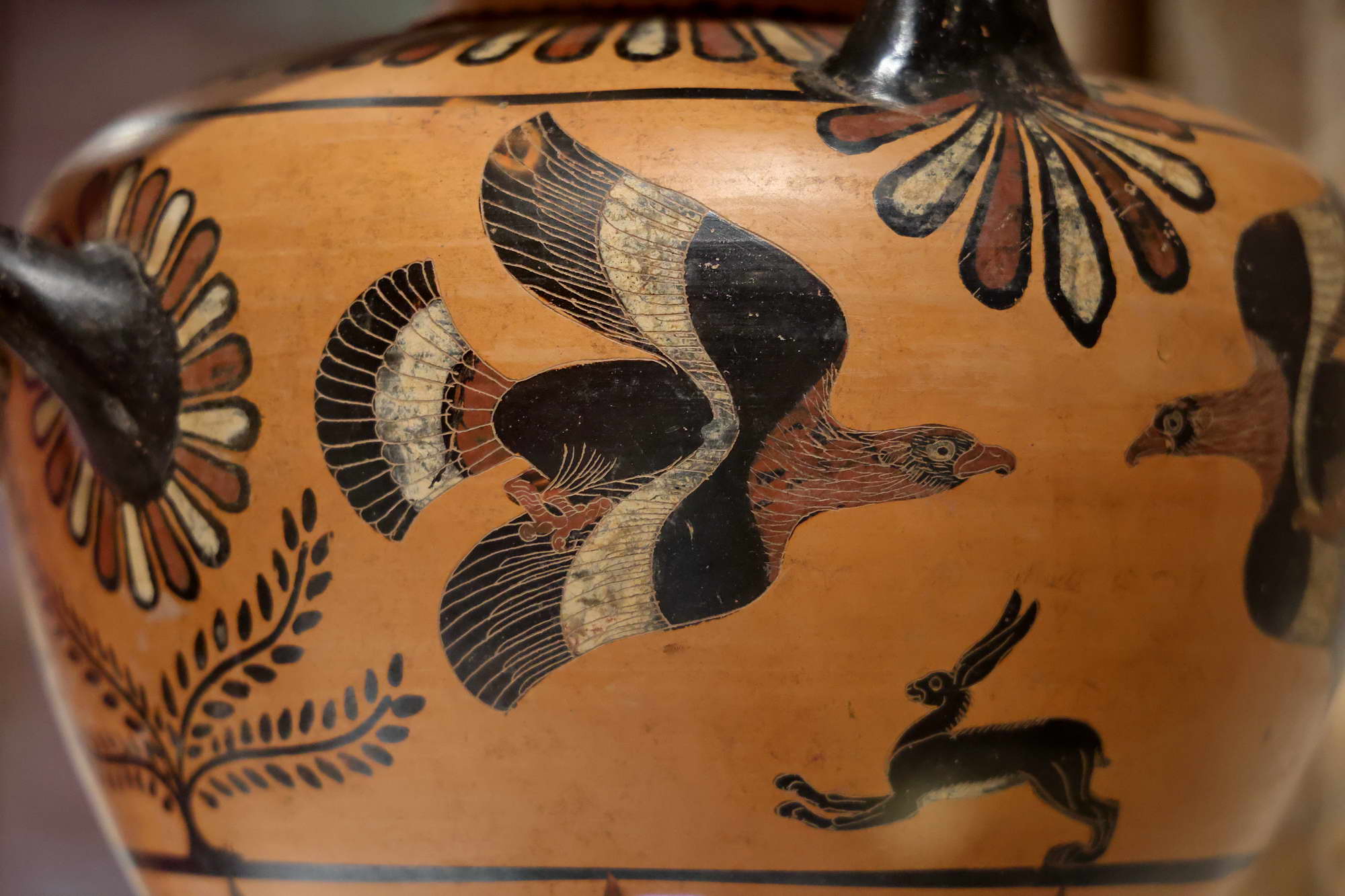
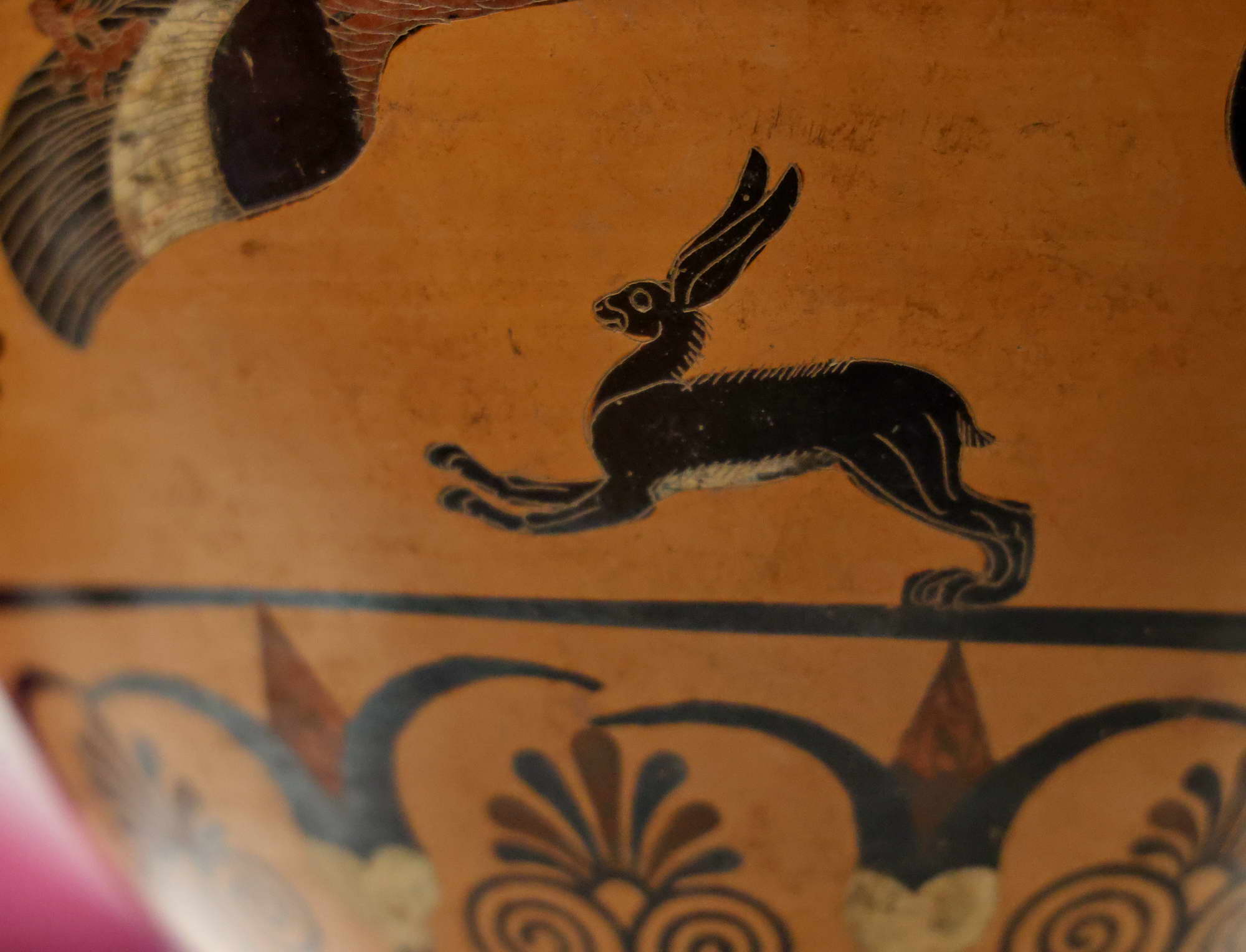
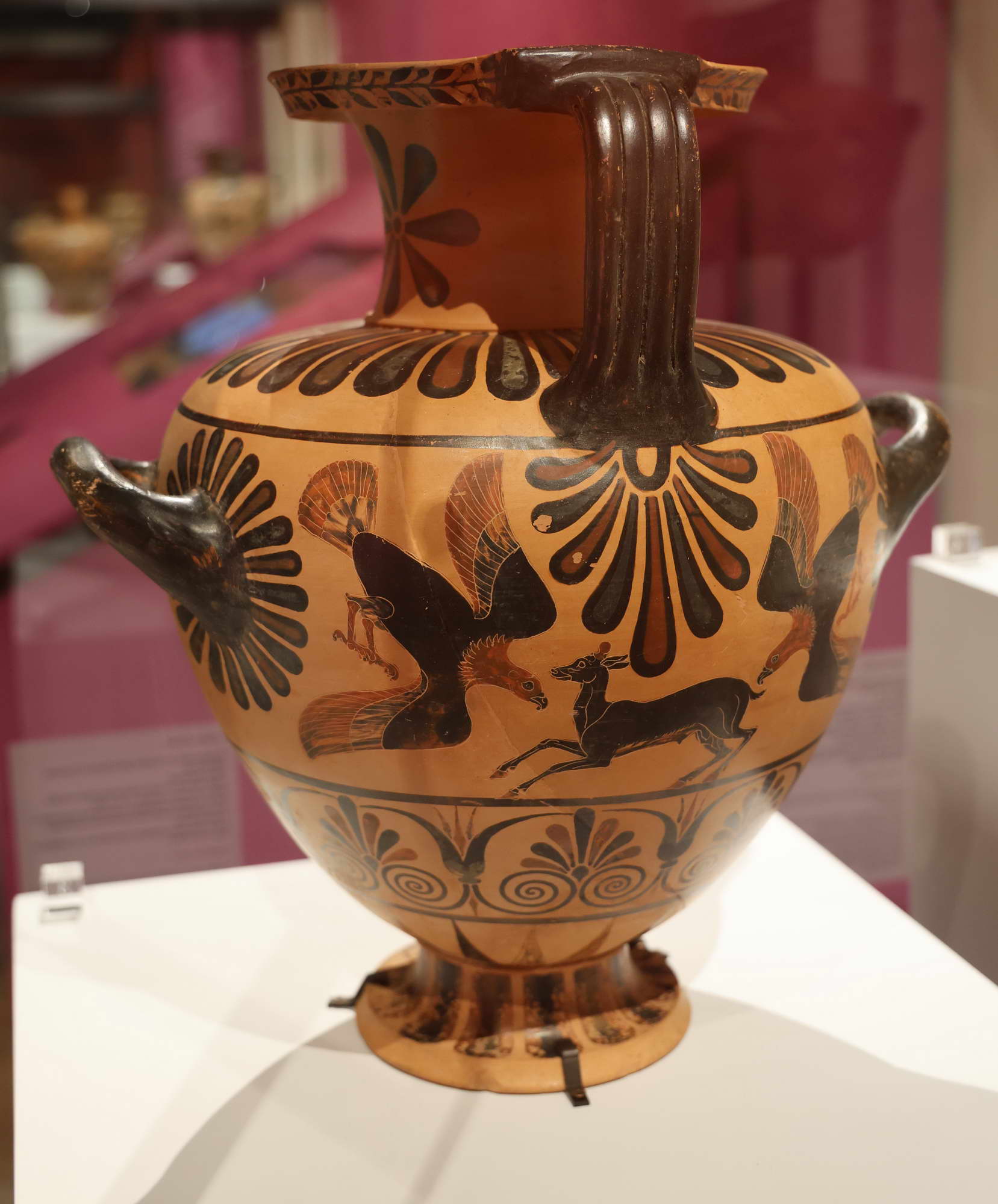
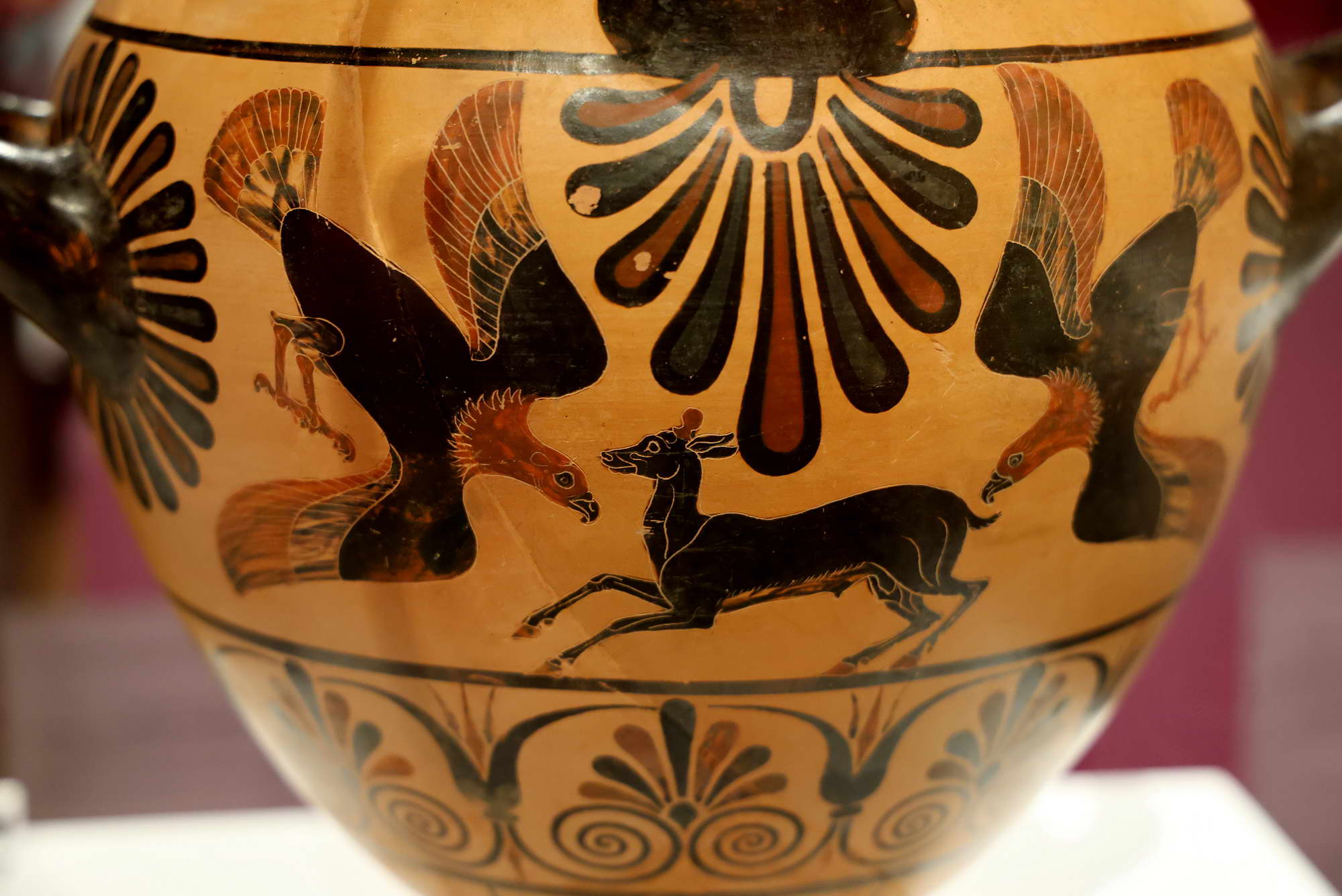
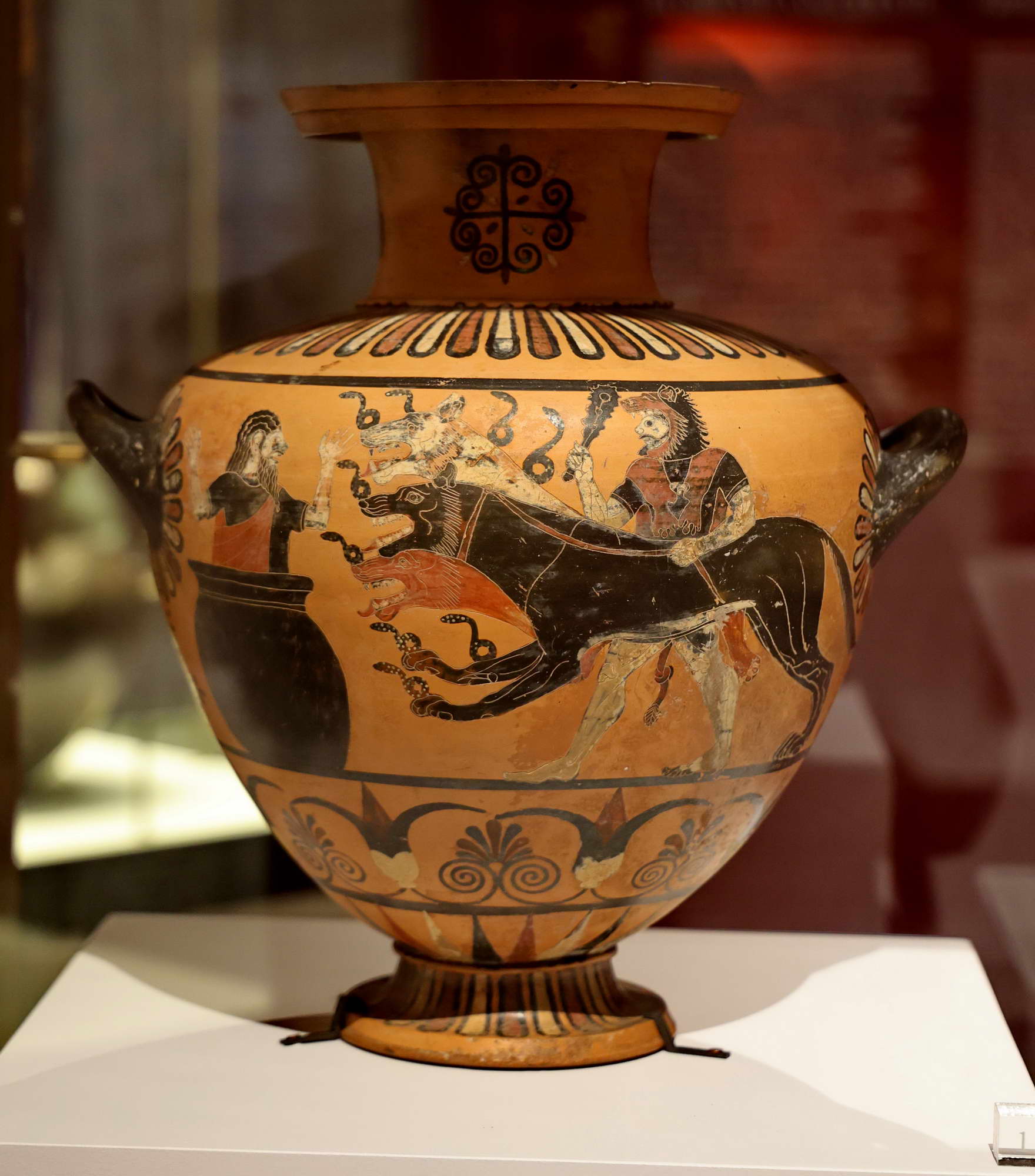 Louvre E 701. Heracles brings Cerberus, the hound of the Underworld, before King Eurystheus, who hides in terror inside a pithos, a large storage jar for grain or oil. On the reverse, two eagles swoop down on a hare: this scene gave the master the name Eagle Painter. The two images echo one another: the majestic eagle and the cowardly hare mirror the relationship between Heracles and Eurystheus, while the eagle striking its prey evokes Heracles’ dominance as he captures Cerberus. The horizontal movement of the main scene is balanced by the vertical dynamism of the image on the reverse, making the vase’s rotation at banquets all the more engaging.
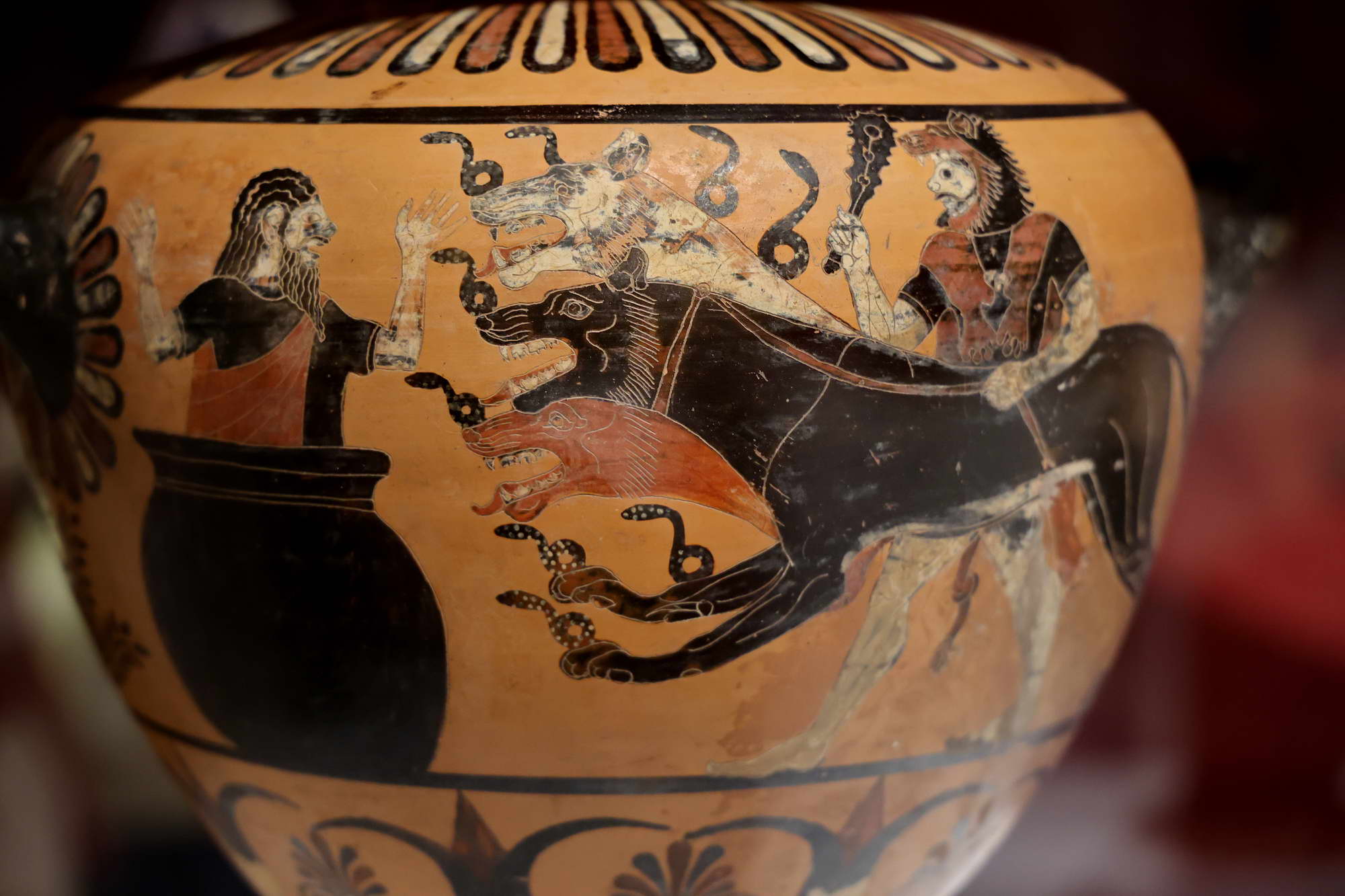
 Villa Giulia CH 11. The reverse of this alternative version of the Cerberus scene depicts something quite different, and interpreting it requires familiarity with the workshop’s entire output. Here, the Busiris Painter sets against Eurystheus’s cowardice a scene that expands on the lower frieze of the Busiris vase, Kunsthistorisches Museum C 34. On that vase (see further below), Heracles lays into the priests of the Egyptian pharaoh Busiris; the lower frieze comments on this episode with a lion and a leopard attacking a wild boar. Their iconography closely resembles that of the big cats attacking the donkey on Villa Giulia CH 31b, shown above. The scene on the reverse here conveys the attack with only the hindquarters of the upper predator and the forequarters of the lower one, but sets them against the trembling priests in their unmistakably Egyptian dress. And on the vase’s neck, an “Easter egg” appears in the form of a tiny ibis or flamingo, a subtle reference to Egypt.
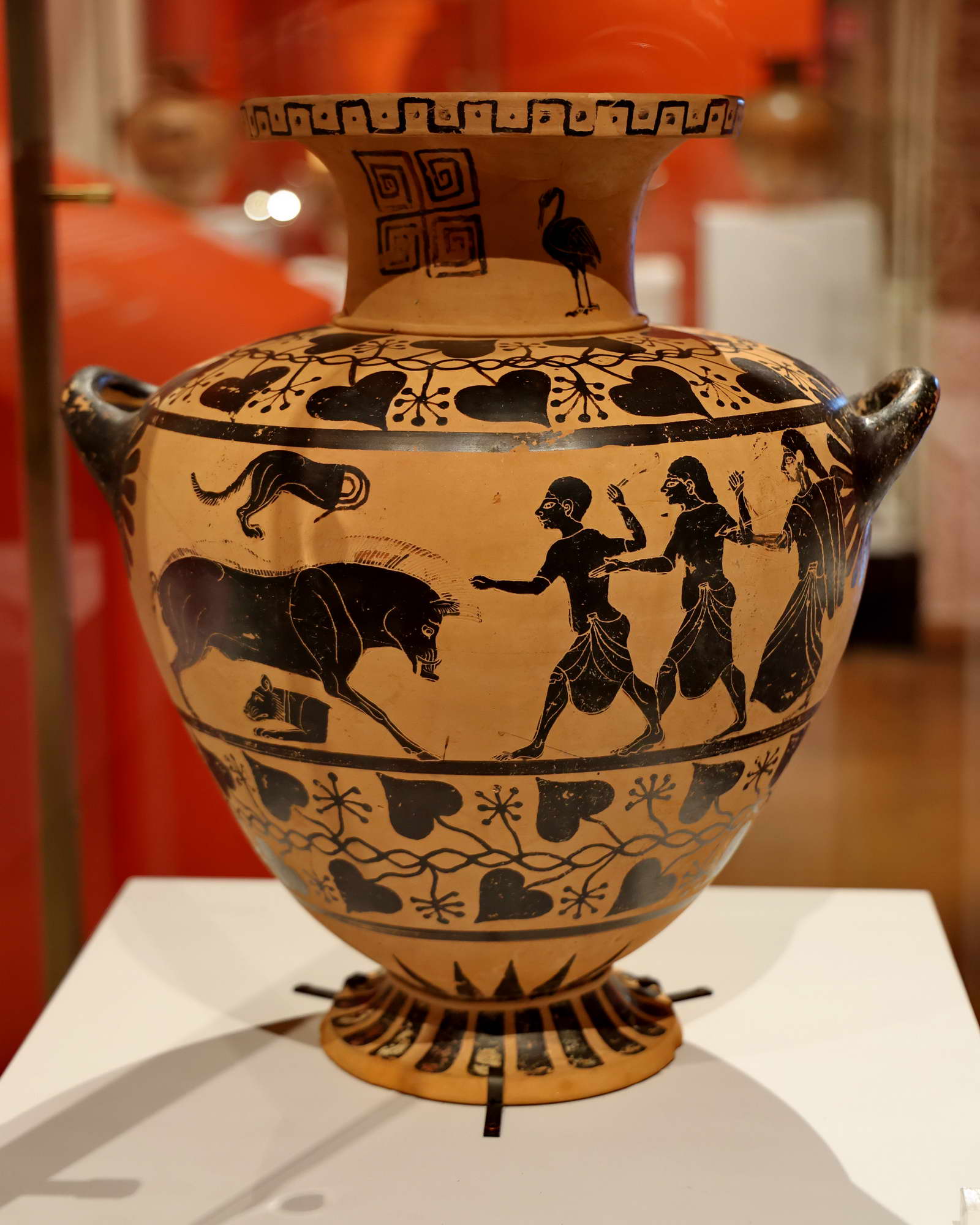
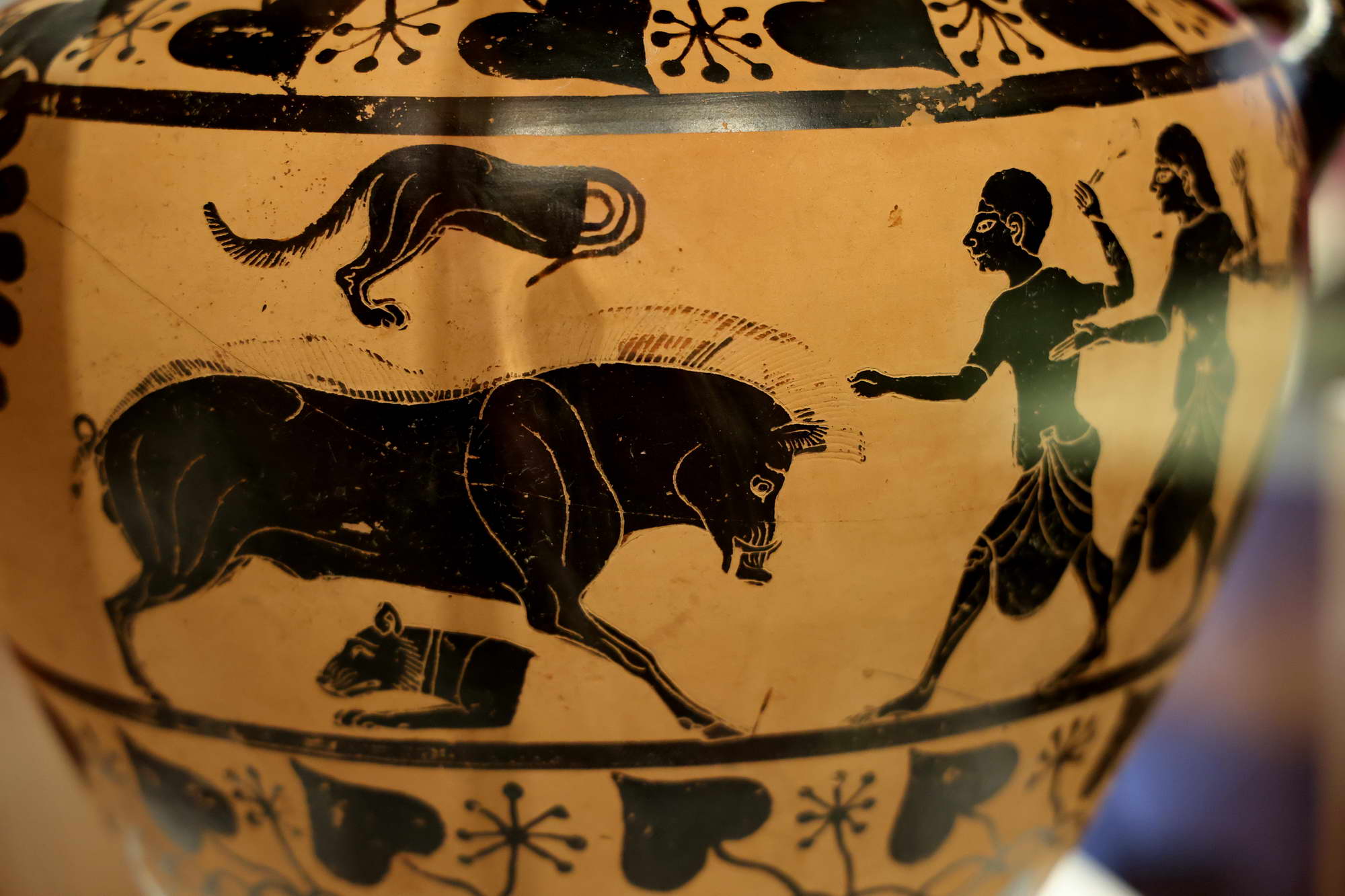
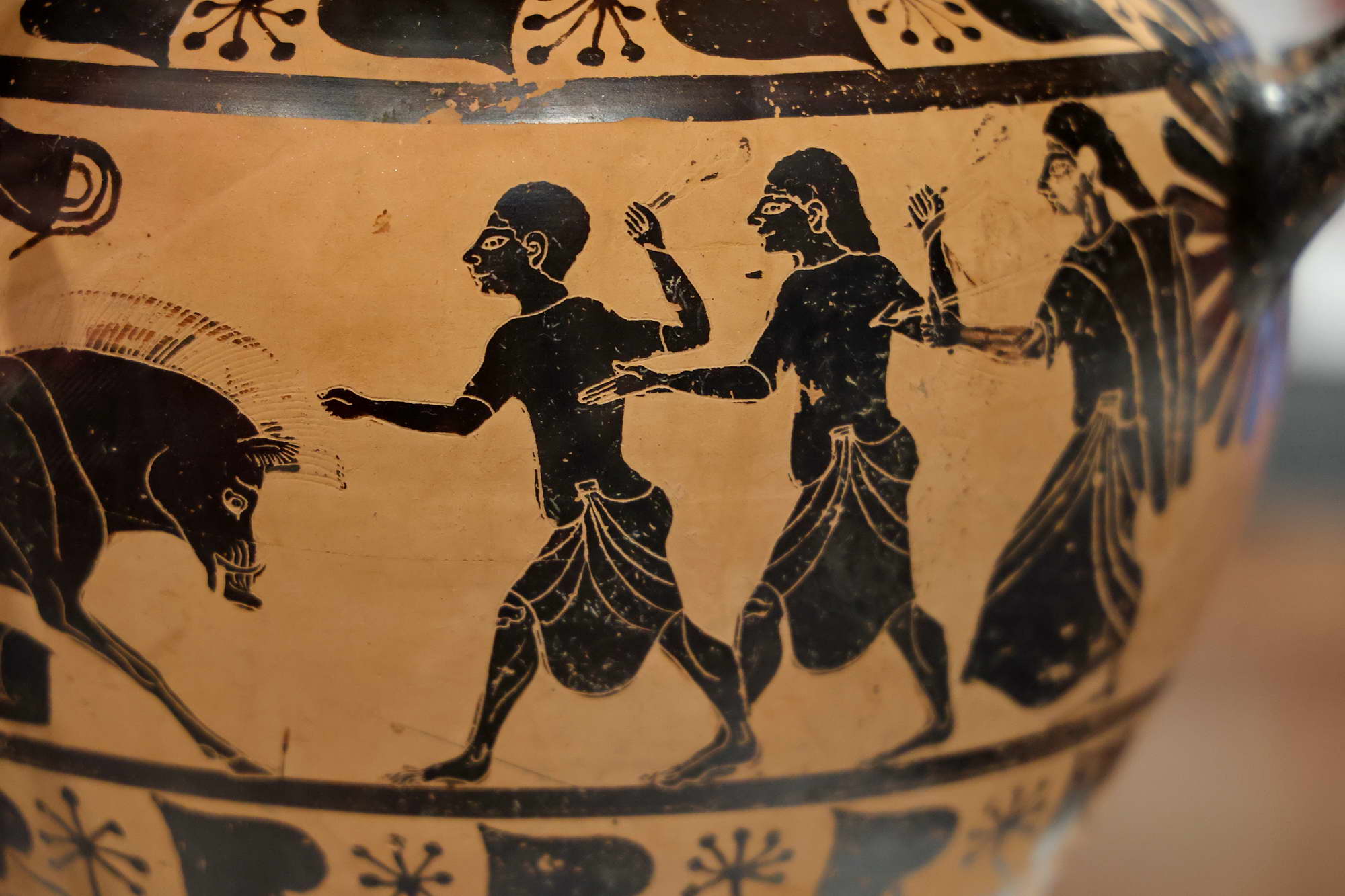
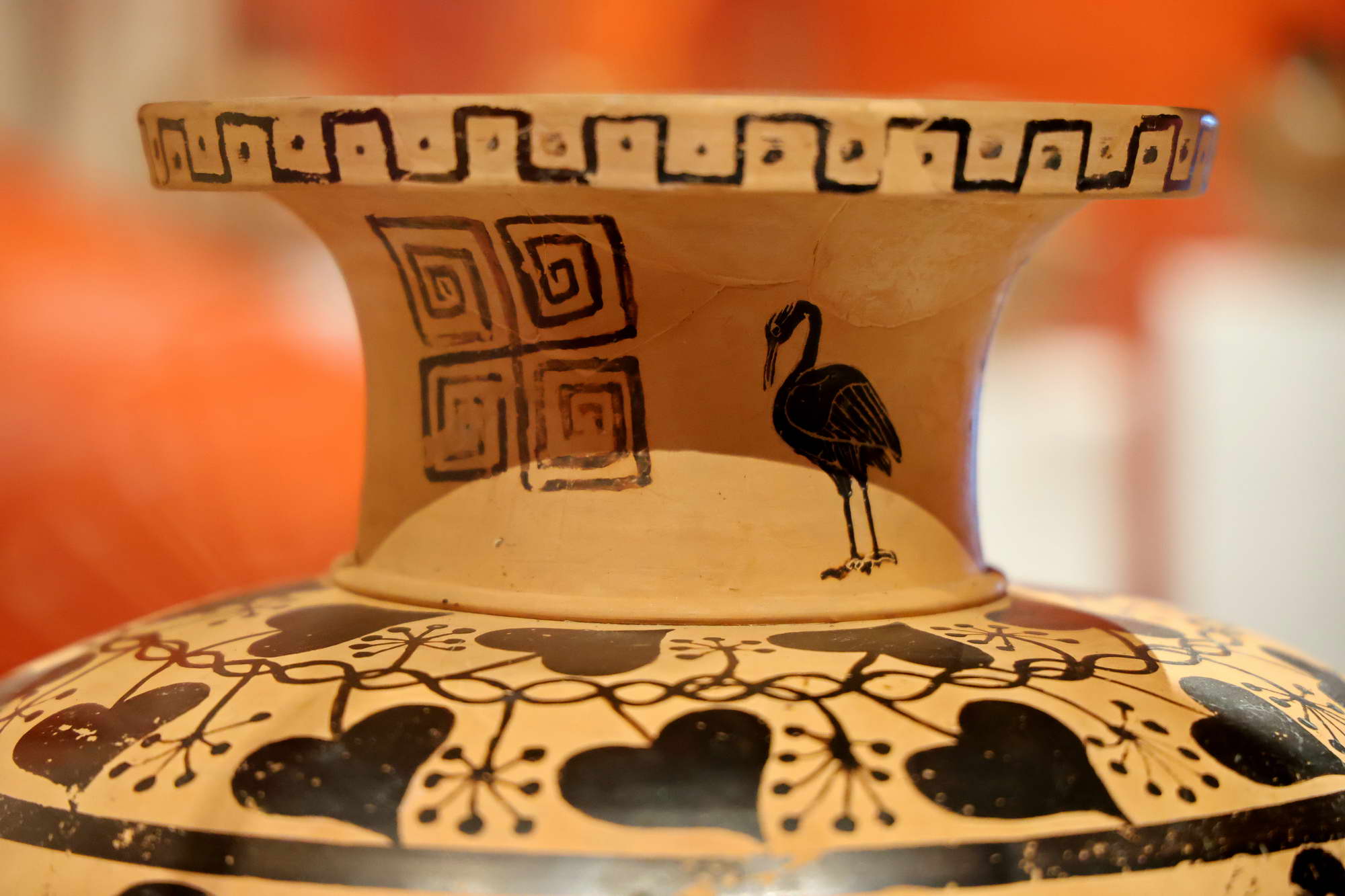
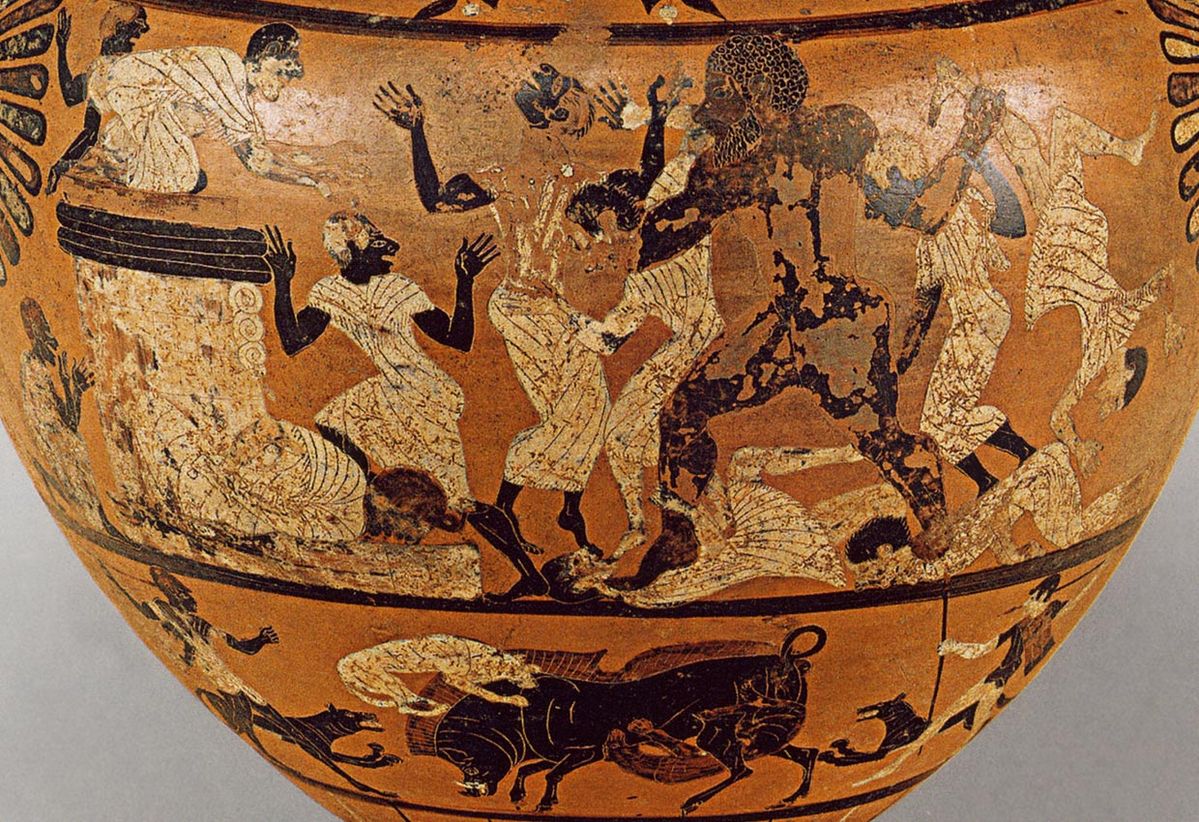 Kunsthistorisches Museum CH 34. The Busiris vase (not included in the exhibition)
Greek vase painters in mainland Greece adhered strictly to the Homeric epics or to ritual traditions. The craftsmen of Caere, by contrast, delighted in altering details of myths or choosing episodes that the Greek mainstream tended to neglect. On the hydria held at the Getty Museum, the Hydra is not a thirty-headed monster but a far more easily comprehensible, dragon-like creature. The scene is further enlivened by a gigantic crab pinching the hero’s heel. The painter depicts it on the same scale as the heroes themselves, completely overturning the Greek sense of proportion.
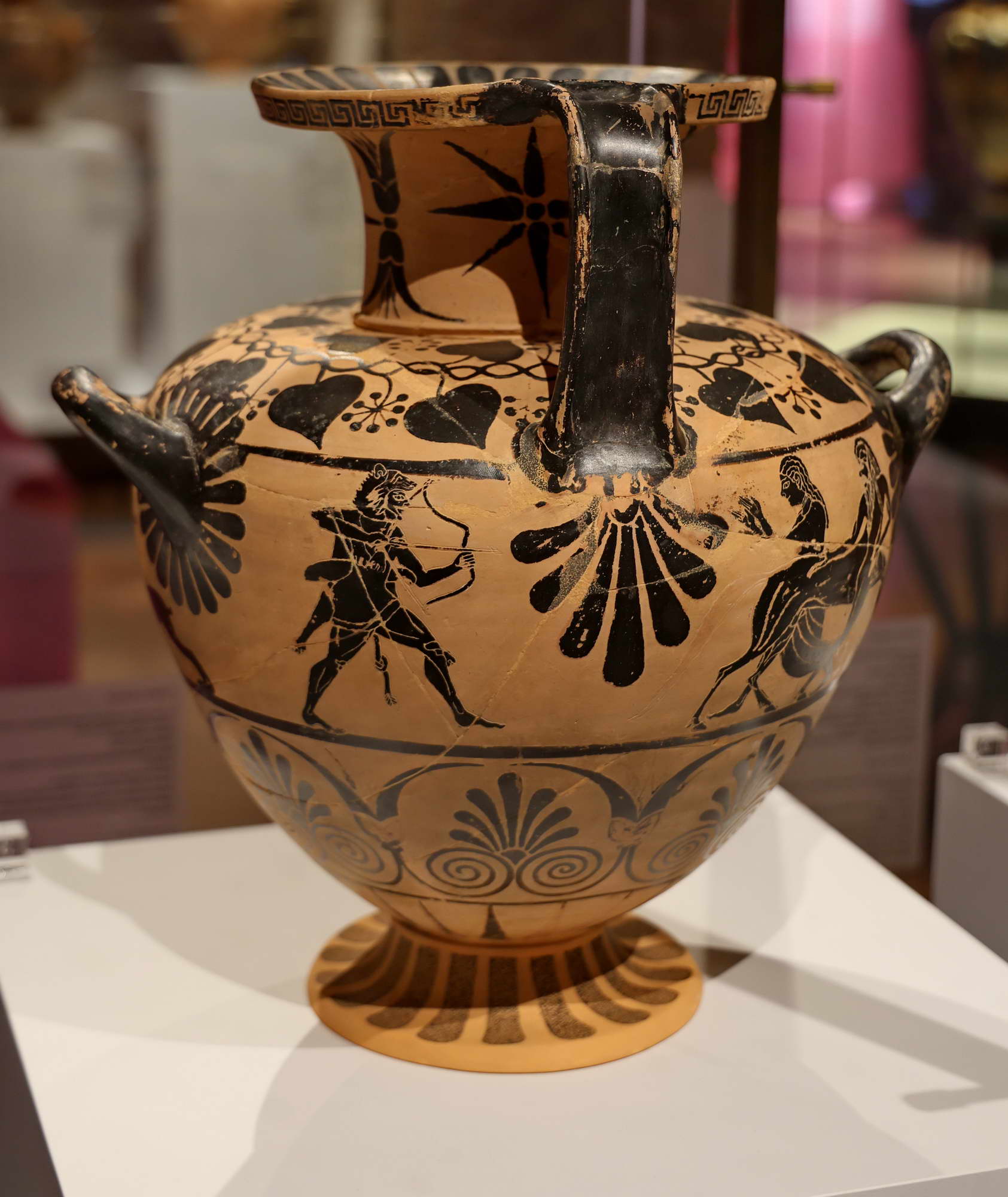
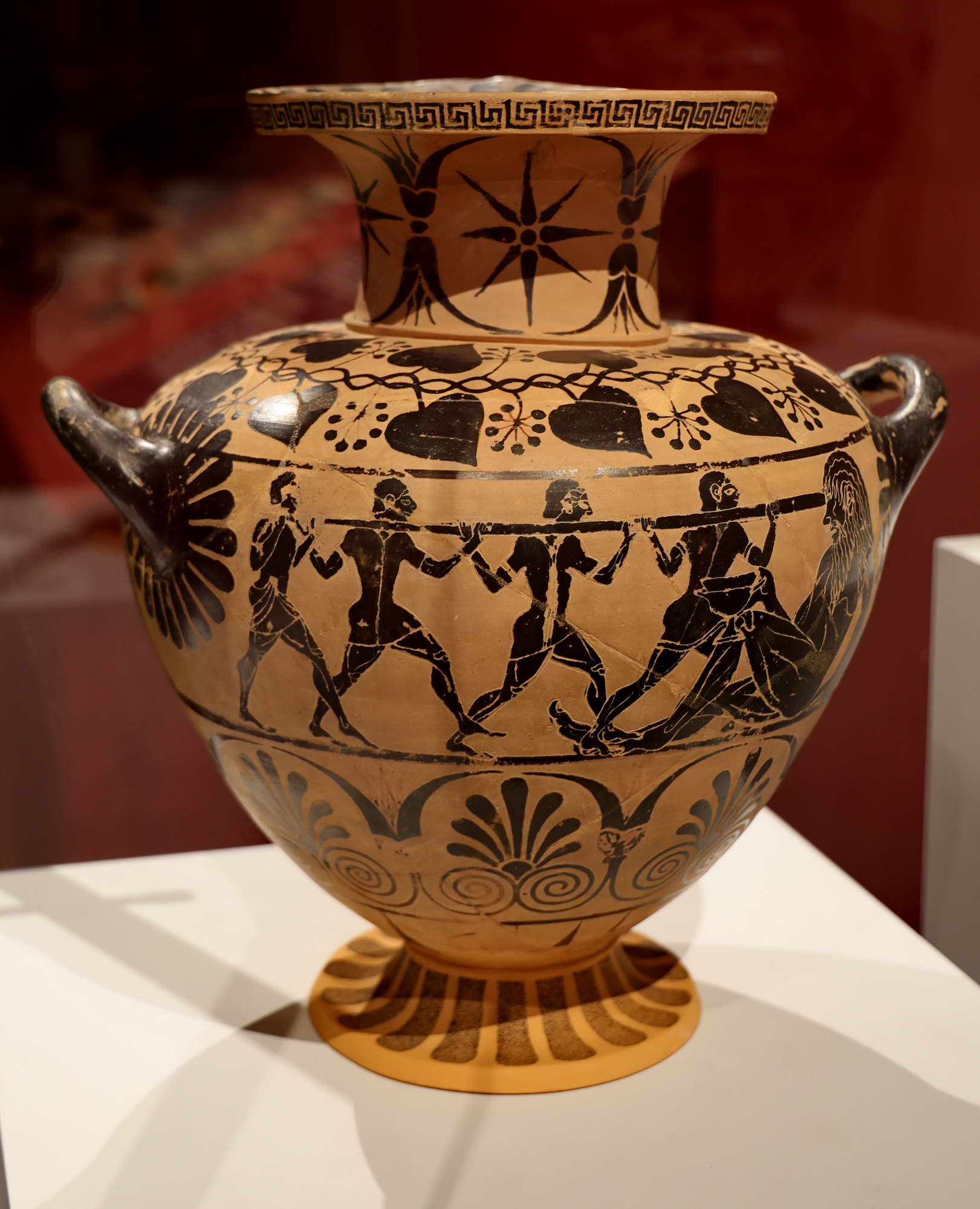 Villa Giulia CH 20. Odysseus and his companions blind the drunken Polyphemus. This was a common scene on drinking vessels, warning of the dangers of excessive wine consumption while also providing an exciting story to entertain the guests. Beneath the two handles are two “easter eggs”, not visible here: a monkey and a hare, allegorical counterparts to the drunken Cyclops and to the centaur Nessus fleeing from Heracles on the reverse. The two scenes are linked by the triumph of civilisation over savagery.
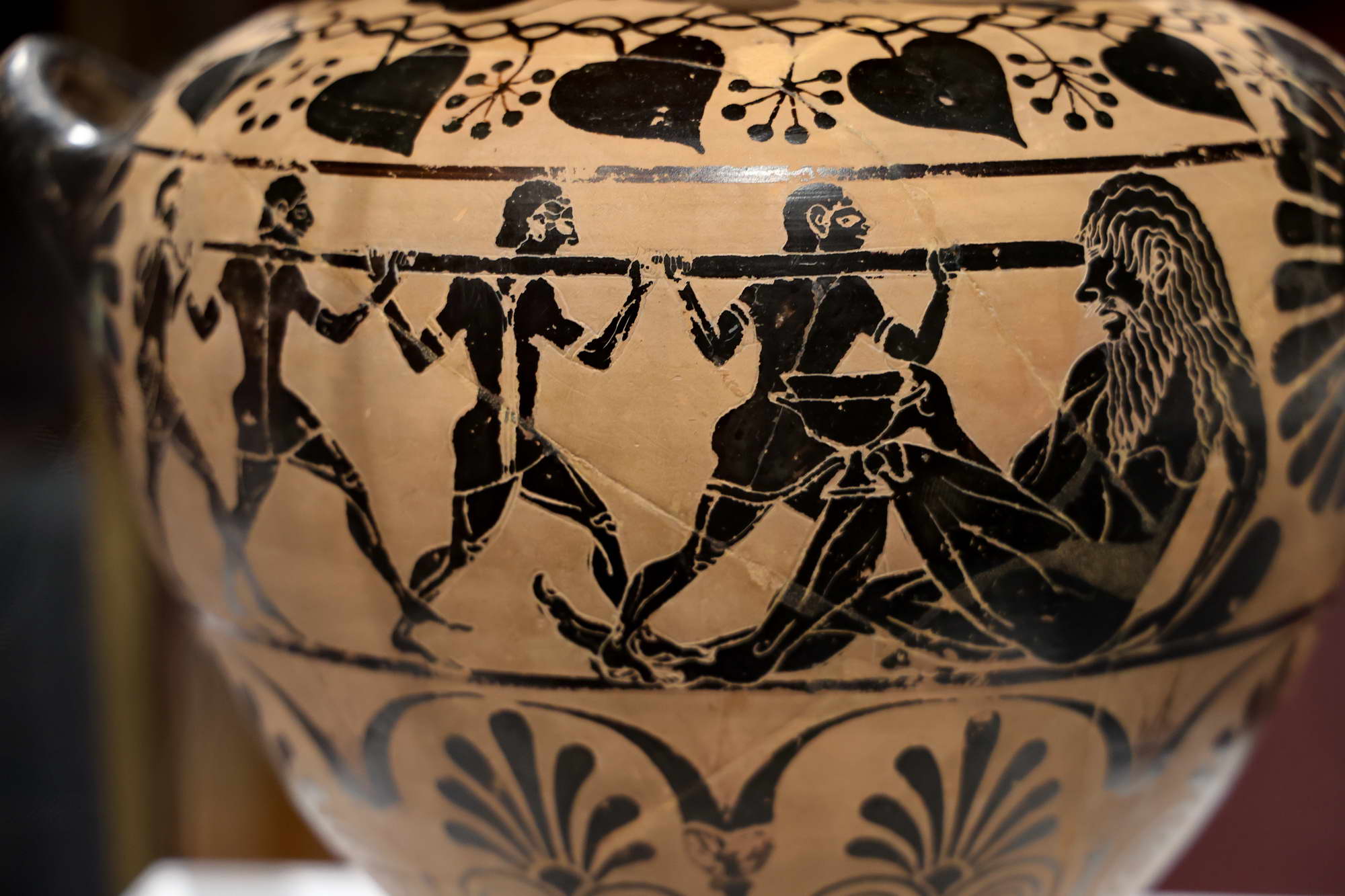
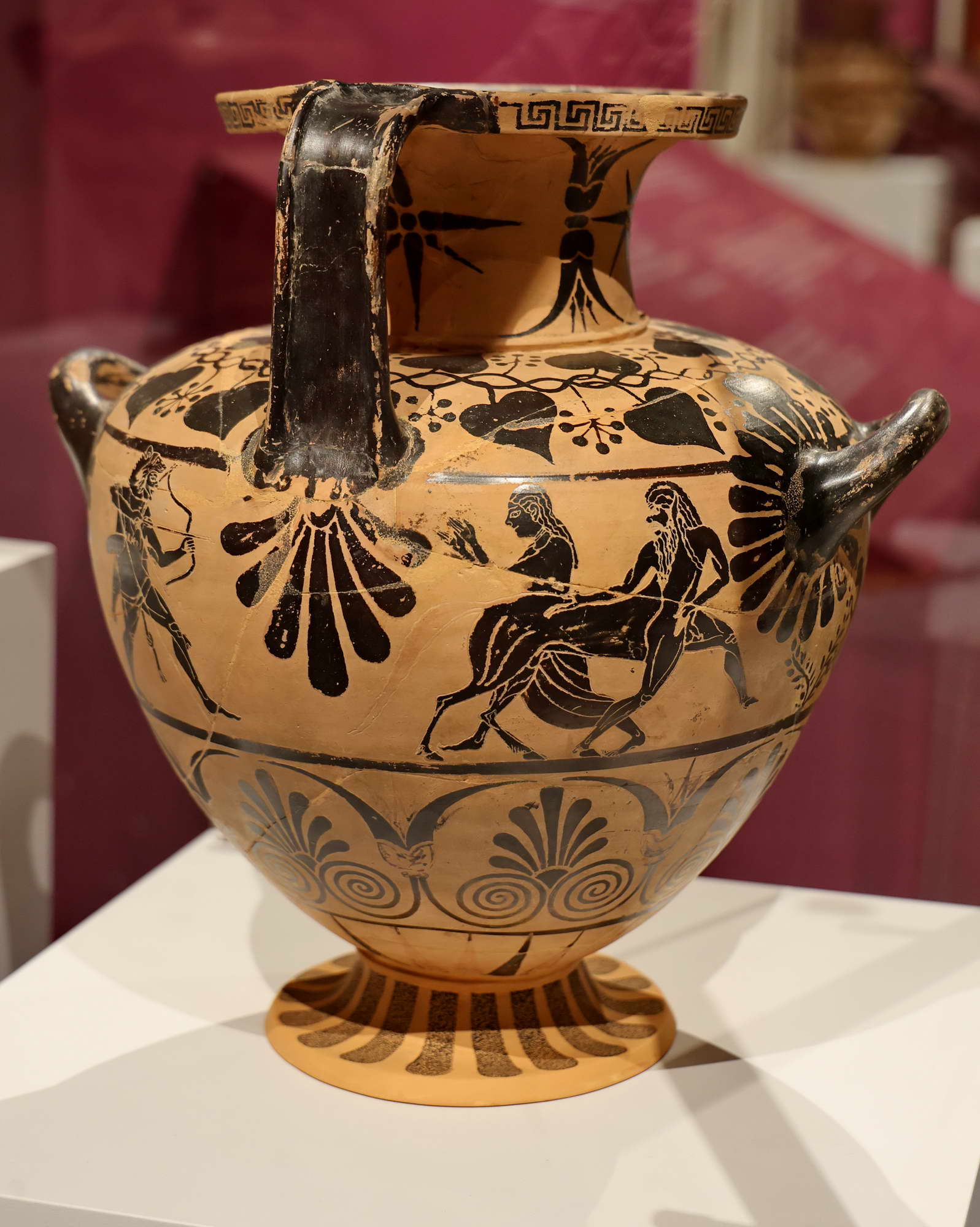
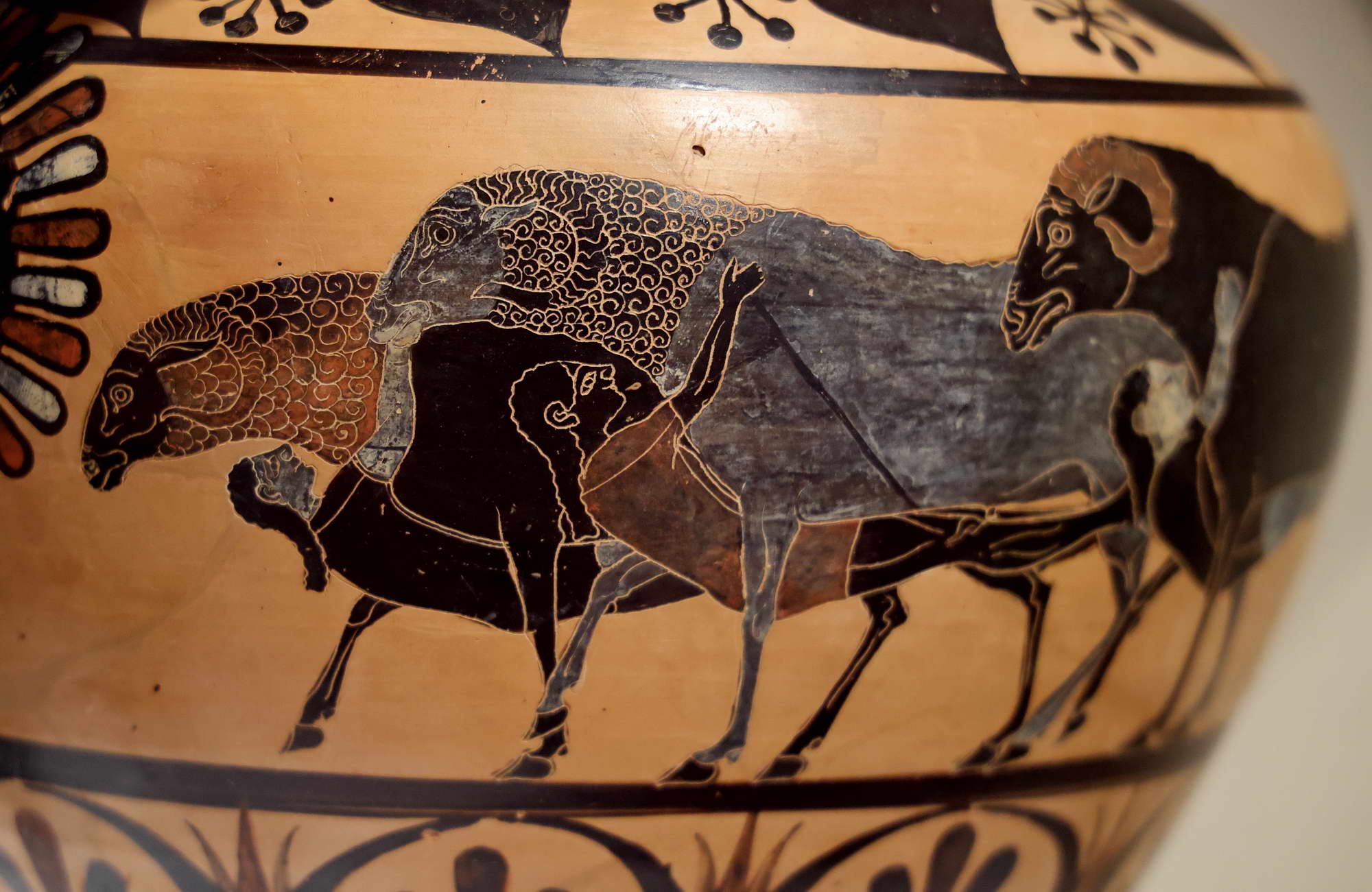
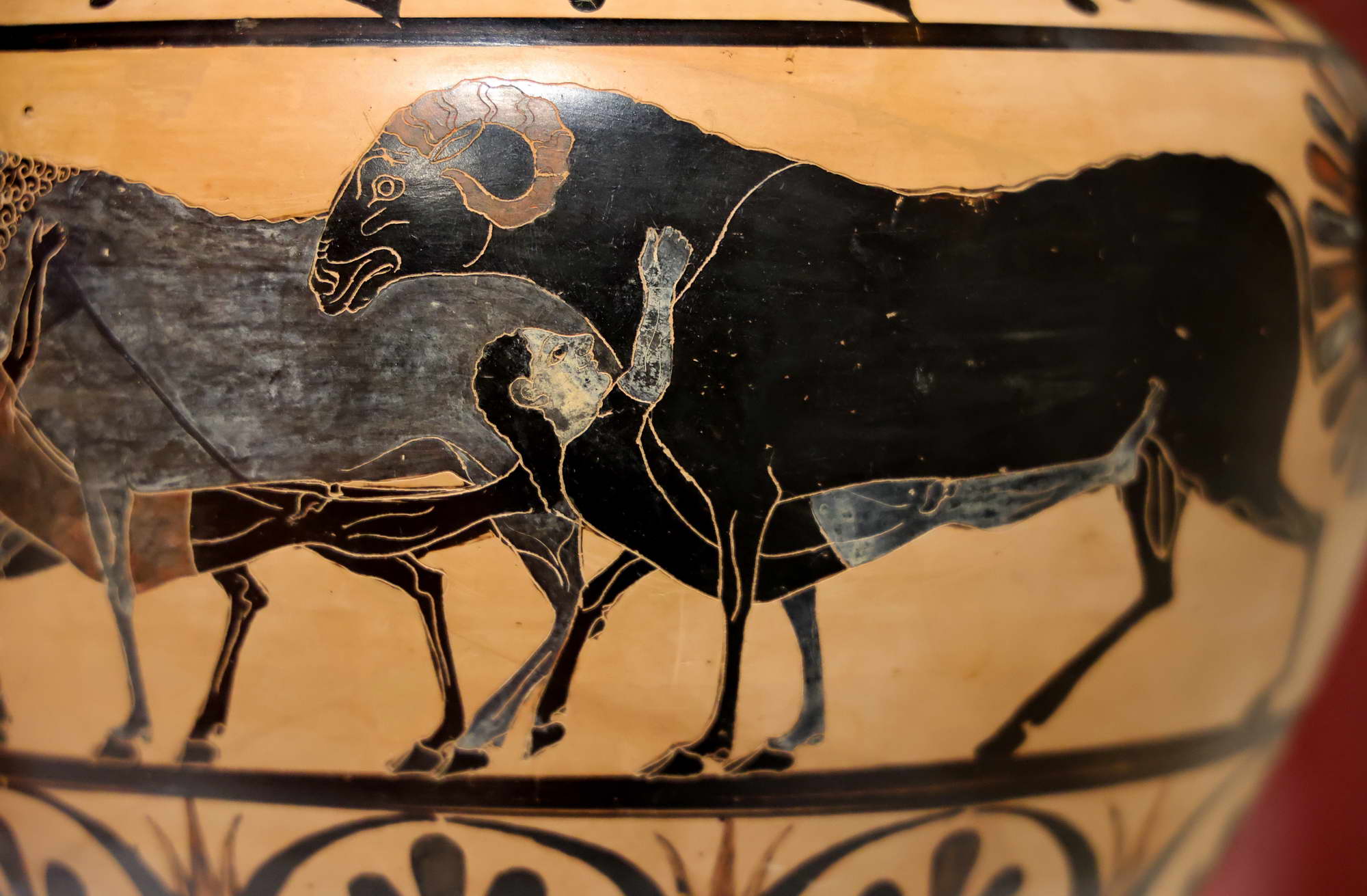
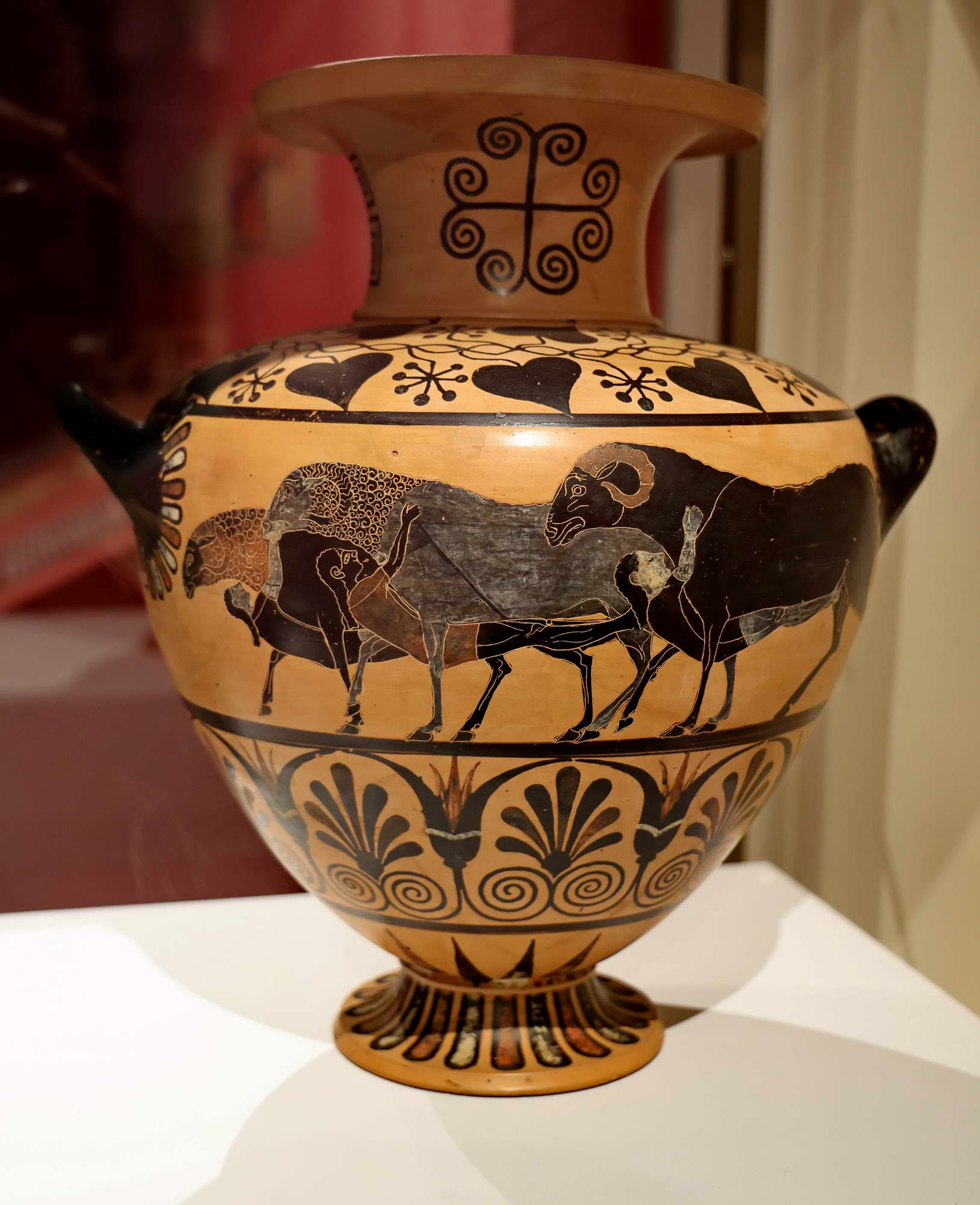 Louvre E 695. Odysseus and his companions escape from Polyphemus’s cave by clinging to the undersides of the rams.
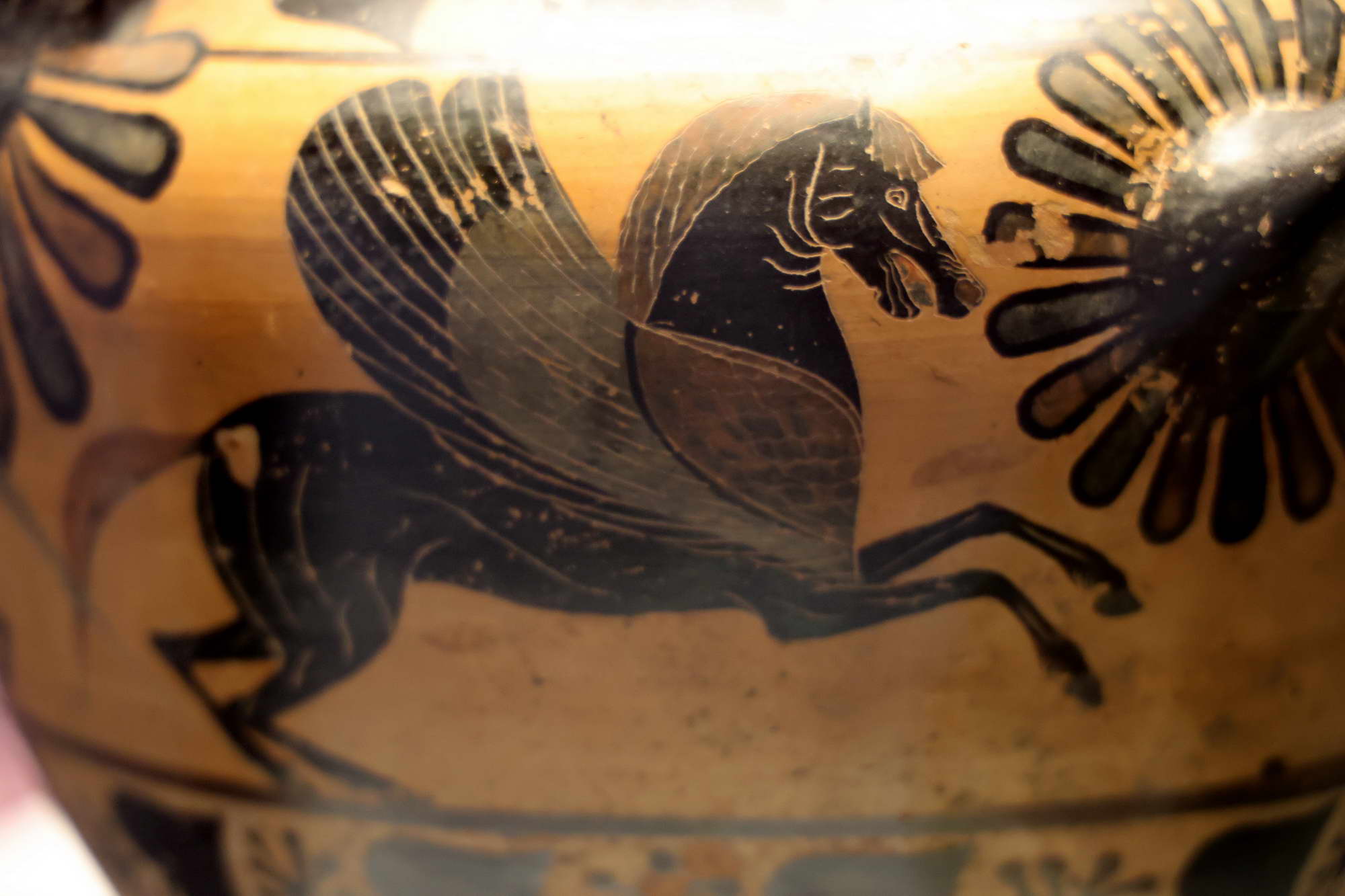
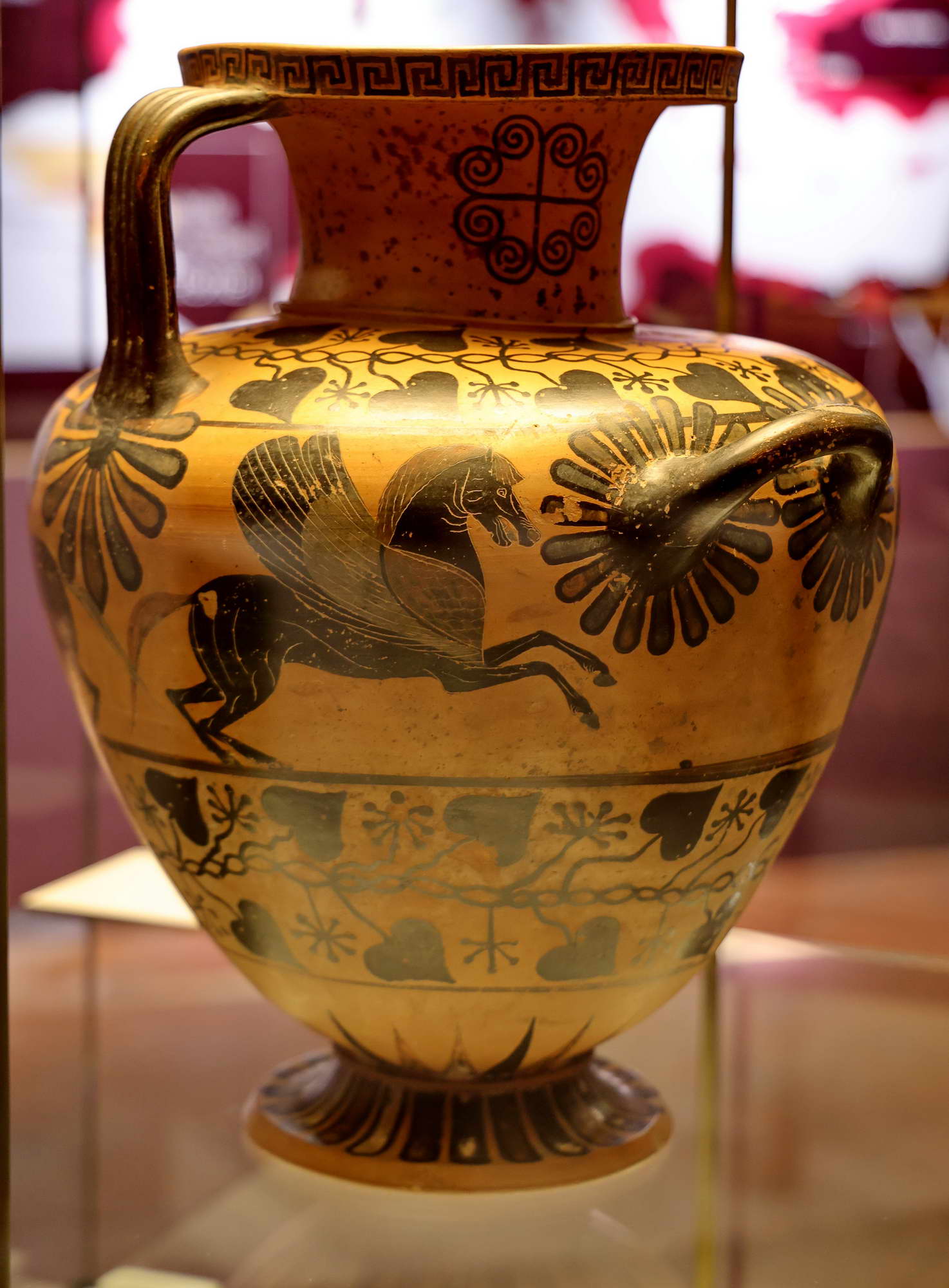 On the reverse of the Escape Vase, two winged horses rear up facing each other, once again providing a vertical counterbalance to the horizontal movement of the main scene. The winged horse played a particularly important role in Etruscan funerary symbolism as a psychopomp, guiding the deceased to the afterlife and proclaiming their rank in the world beyond.
The wall paintings in Etruscan tomb chambers show how much the Etruscans loved hiding tiny details and “easter eggs” that only an attentive eye would discover. The Caeretan hydriae, too, are full of such little figures and details, entirely absent from classical Greek vases.
Etruscan religion was far more ominous and superstitious than Greek religion, and teemed with demons. The presence of apotropaic symbols—designed to ward off evil and provide protection—was of great importance to them. Etruscan buyers therefore expected the sides of their vases to be decorated with griffins, sphinxes, winged beasts and sea monsters. Once placed in a tomb, these creatures accompanied and protected the dead on their journey to the afterlife.
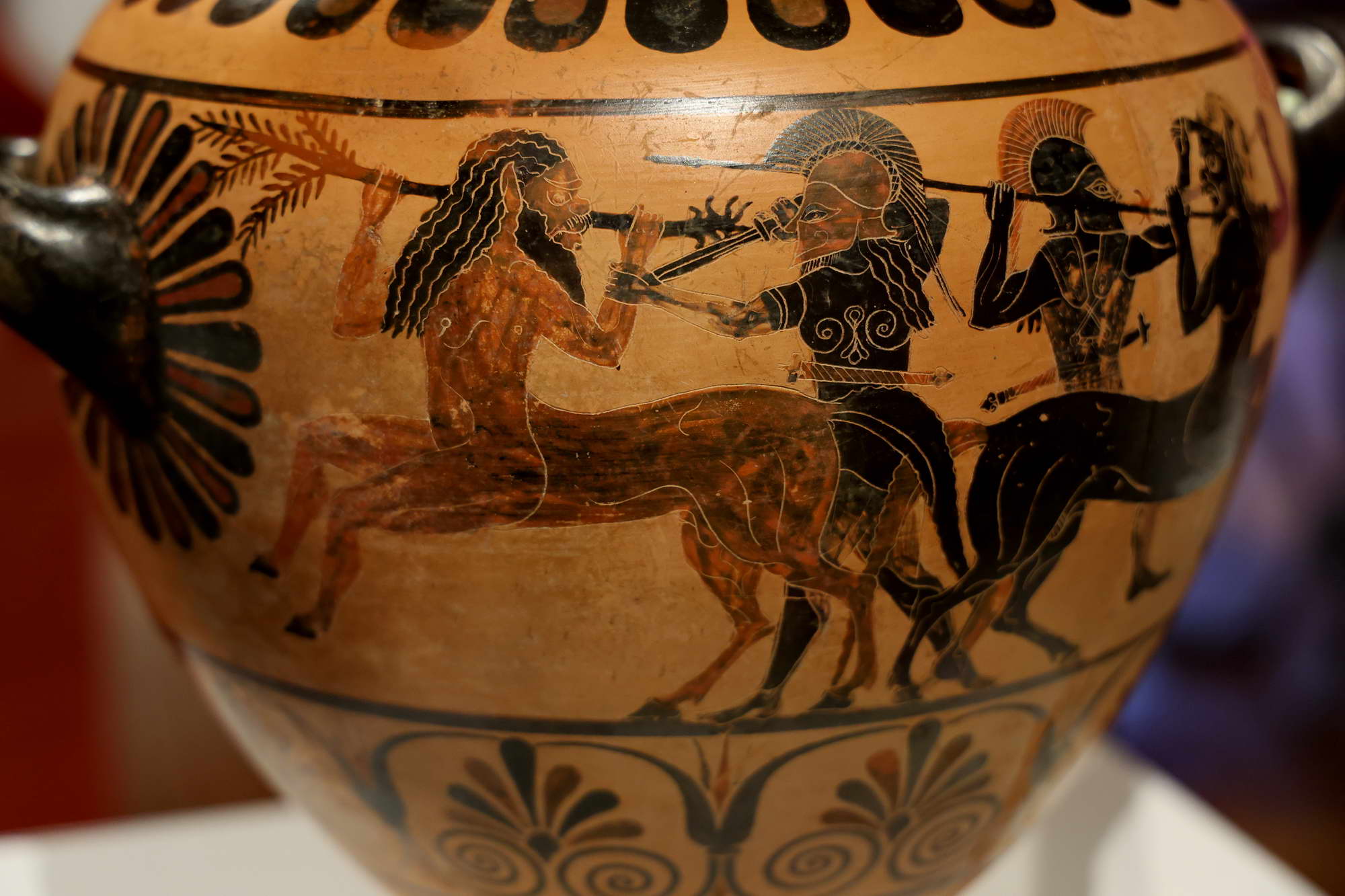
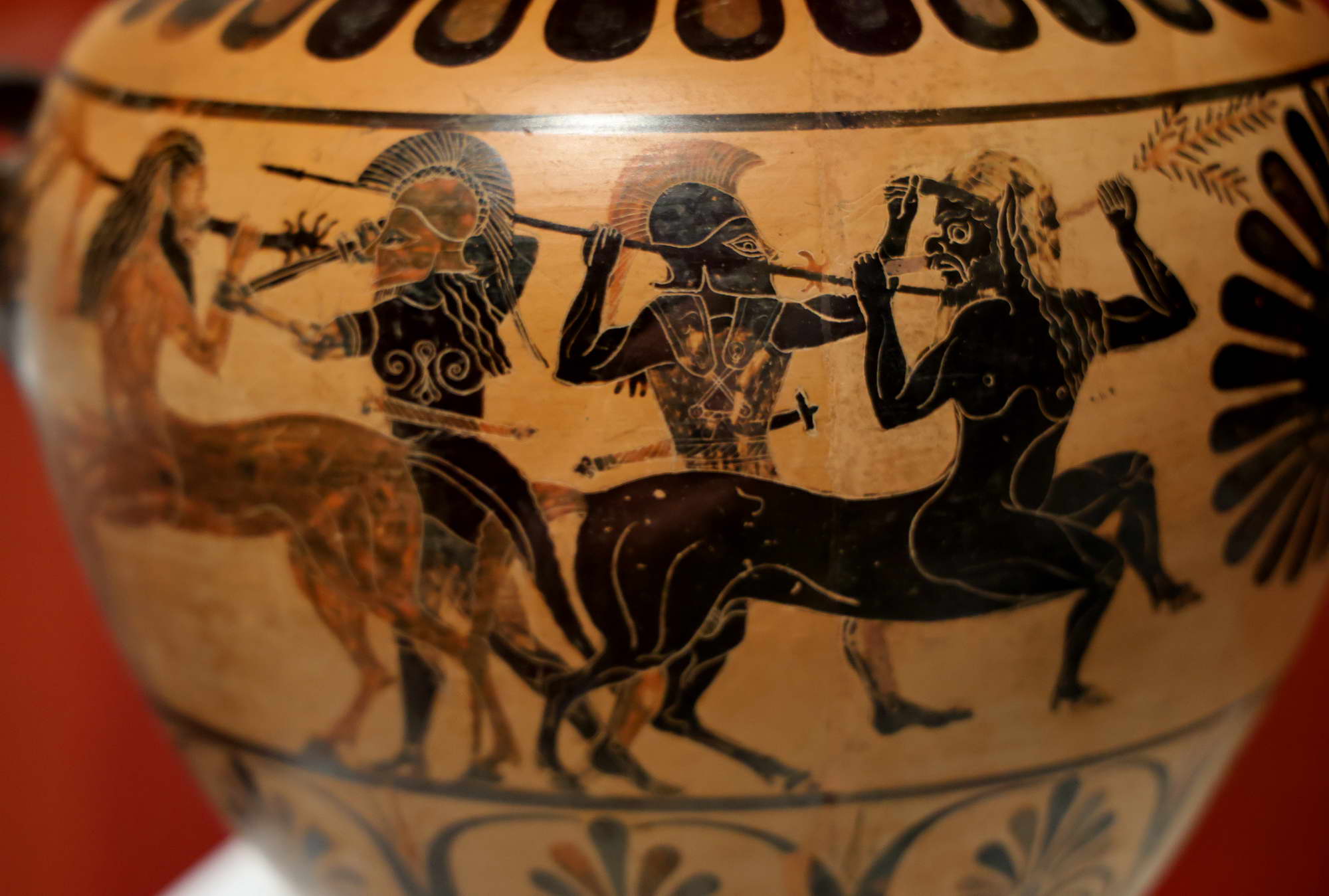
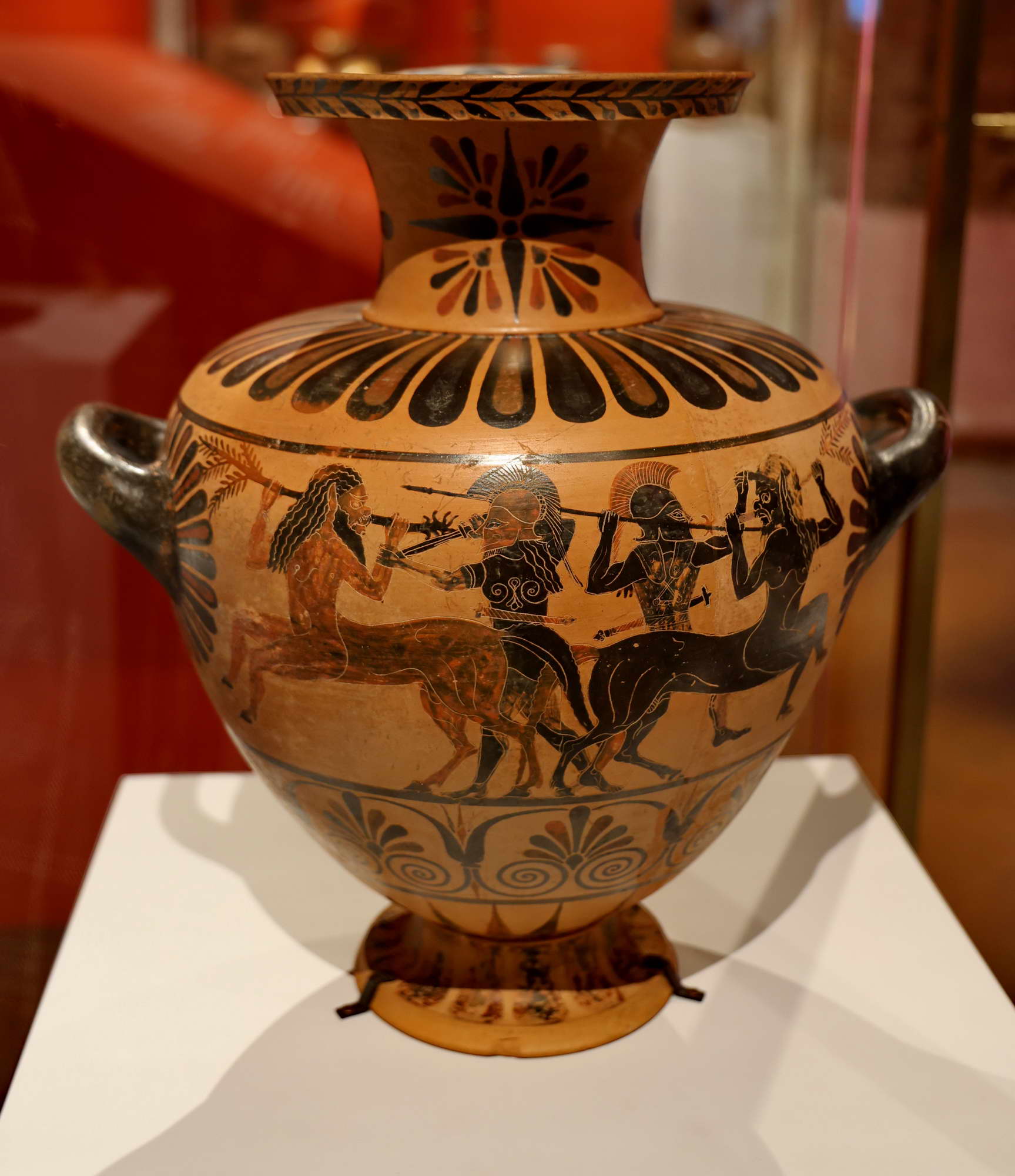 Louvre, E 697. The battle between the Lapiths and the Centaurs. On the reverse, two eagles—the trademark of the Eagle Painter—swoop down on a young deer. The two battles illustrate the vulnerability of all living things to death.
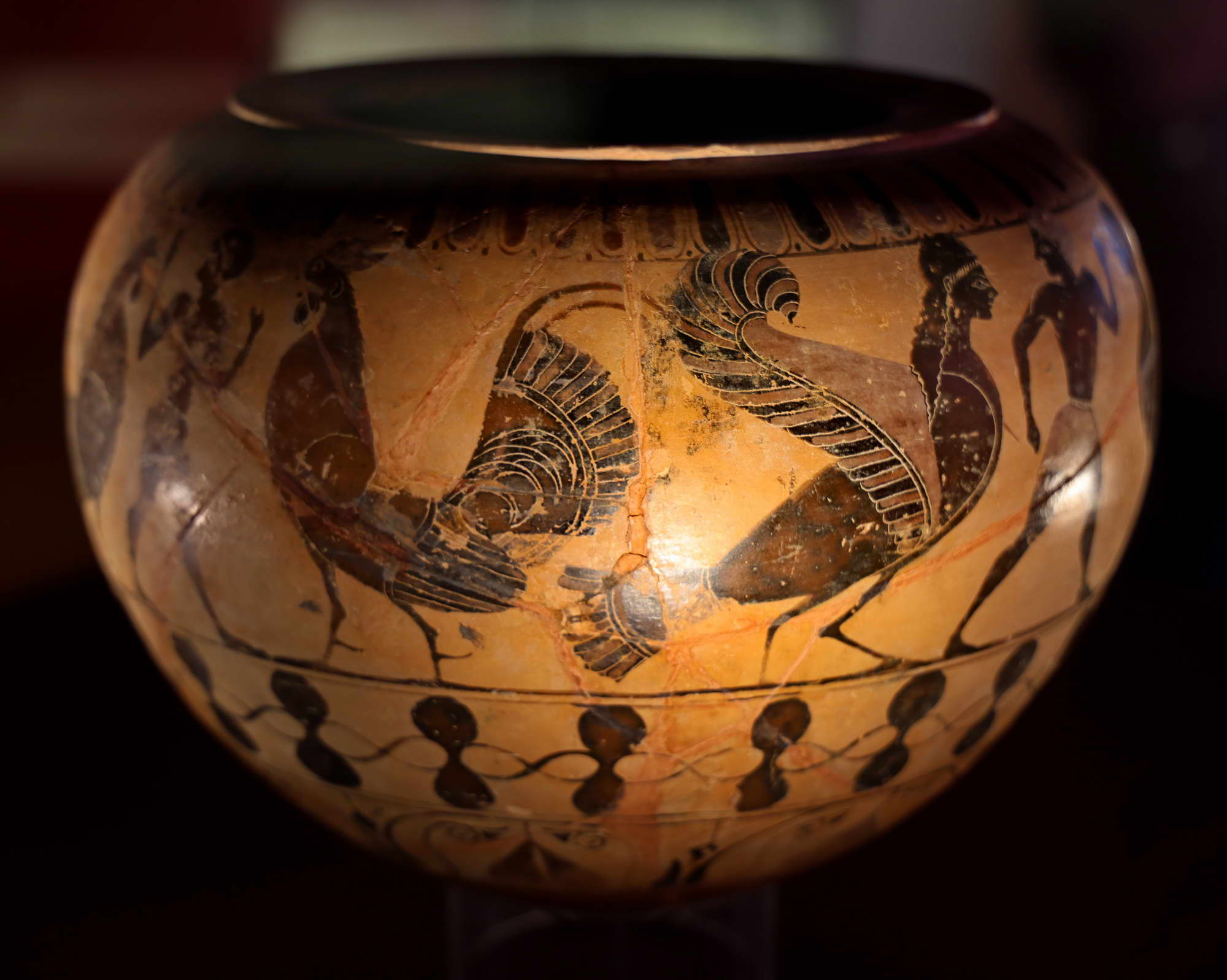
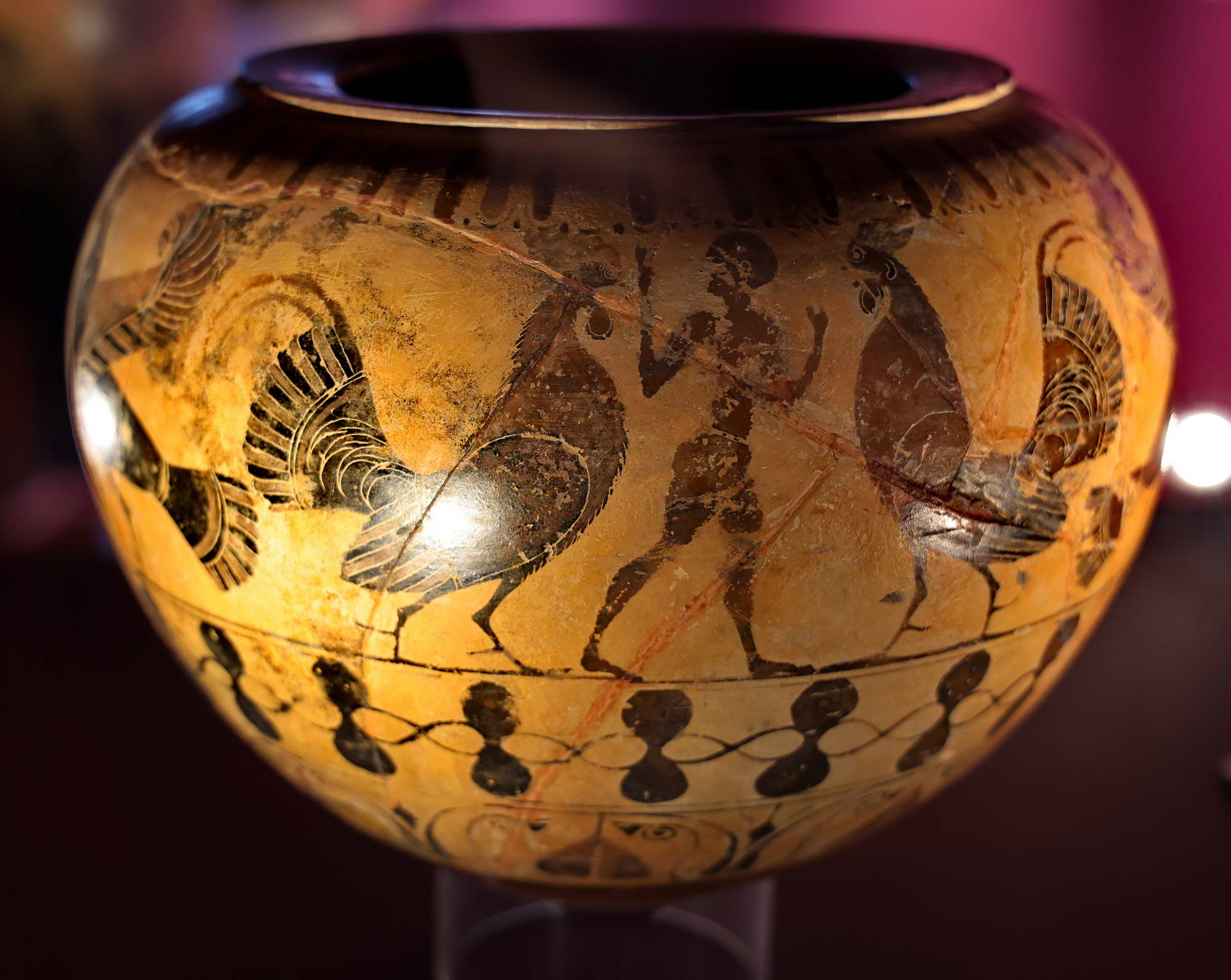
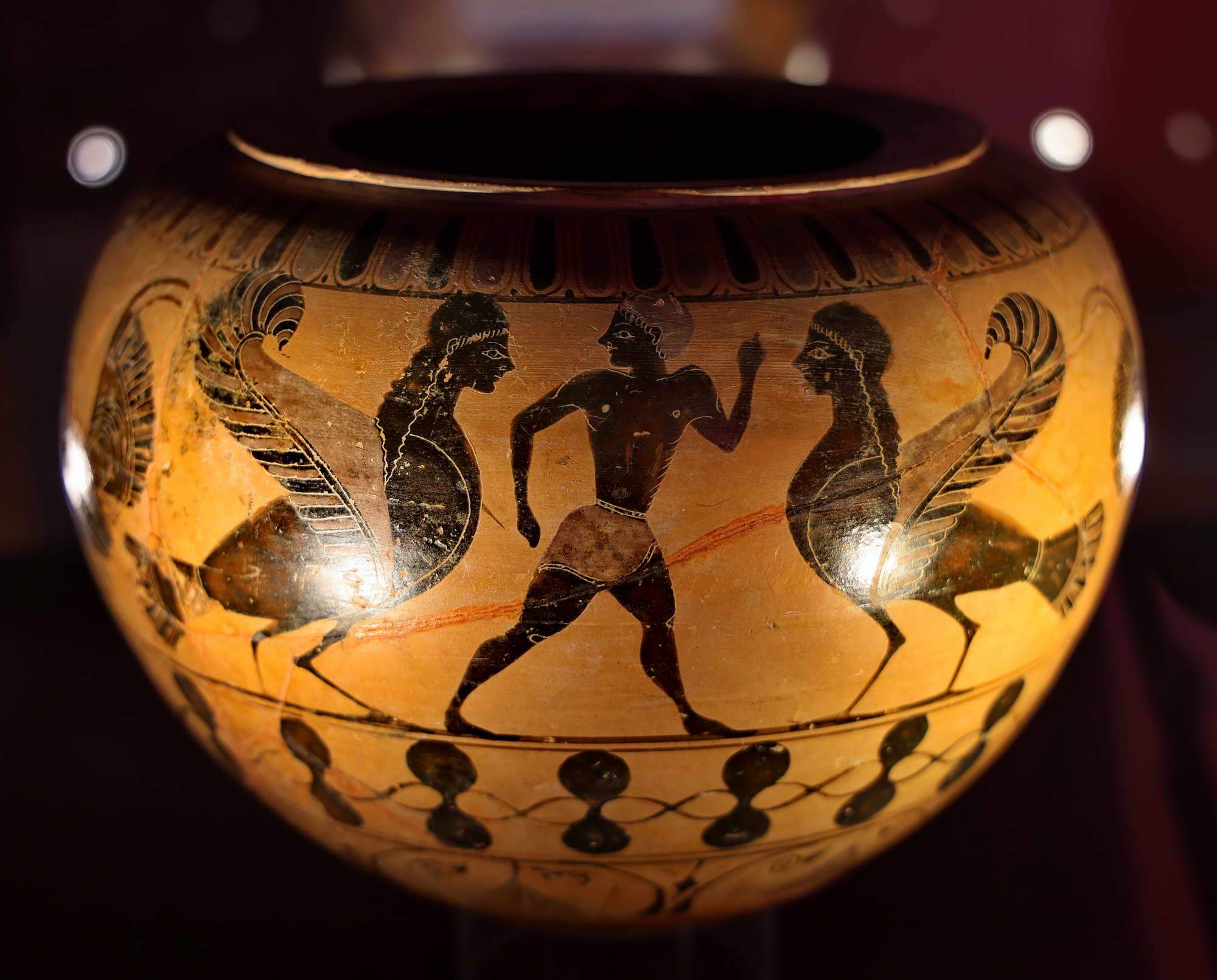 Villa Giulia, C 4 (Inv. 22205). This dinos (a vessel for mixing wine and water) is the work of another Greek master active in Caere at the same time, around 530–520 BC: the so-called Ribbon Painter. On each side, a young man stands between two sirens (guides of souls to the afterlife) and two roosters (symbols of light and rebirth).
At Greek symposia, respectable women were not allowed to participate; only men and hetairai (courtesans) could attend. In Etruscan society, by contrast, women enjoyed a more equal status: wives sat beside their husbands at banquets, drinking and celebrating alongside them. As a result, women depicted in scenes of banquets and mythological events are far more active, dignified and prominent than on purely Greek imported vases. These images directly reflect the internal hierarchy of the aristocratic families who commissioned them.
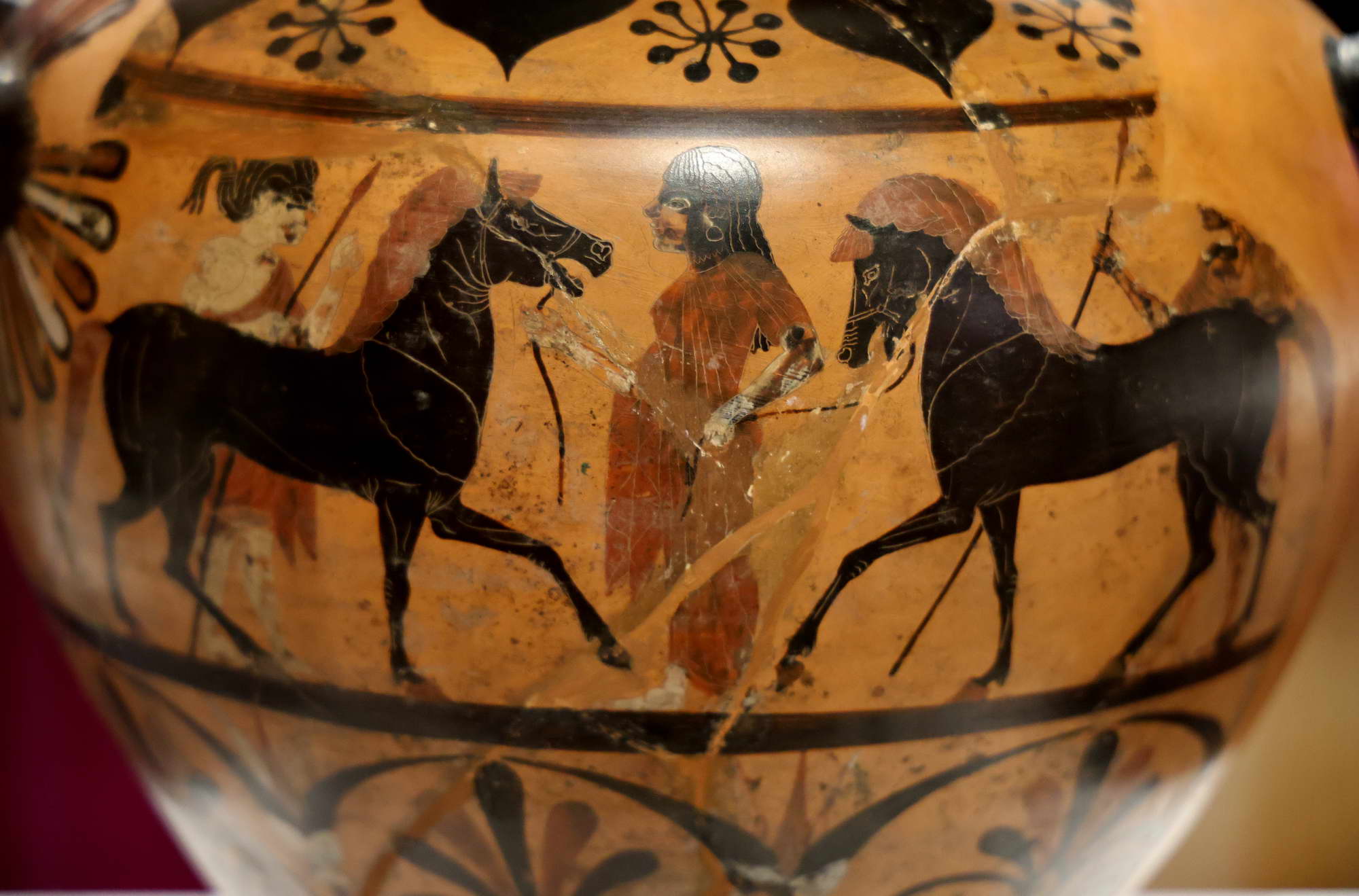
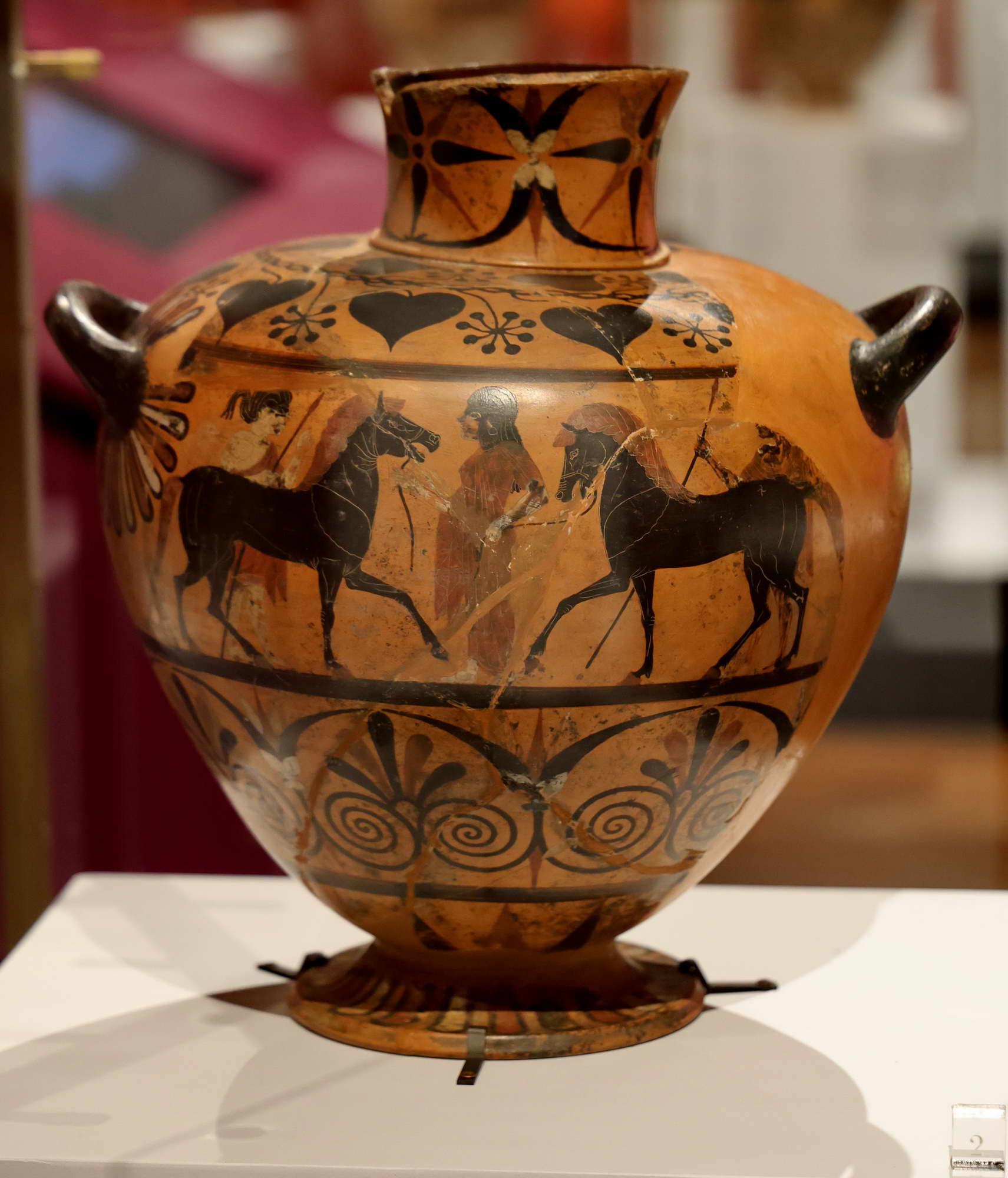 Louvre E 699. The woman in red at the center is Leda, calming the horses of the Dioscuri as they set out on their journey. On the reverse, two sphinxes sit facing outward. Together, the two scenes portray woman as mother and protector in the world of the living, and as guardian of secrets and protector in the afterlife.
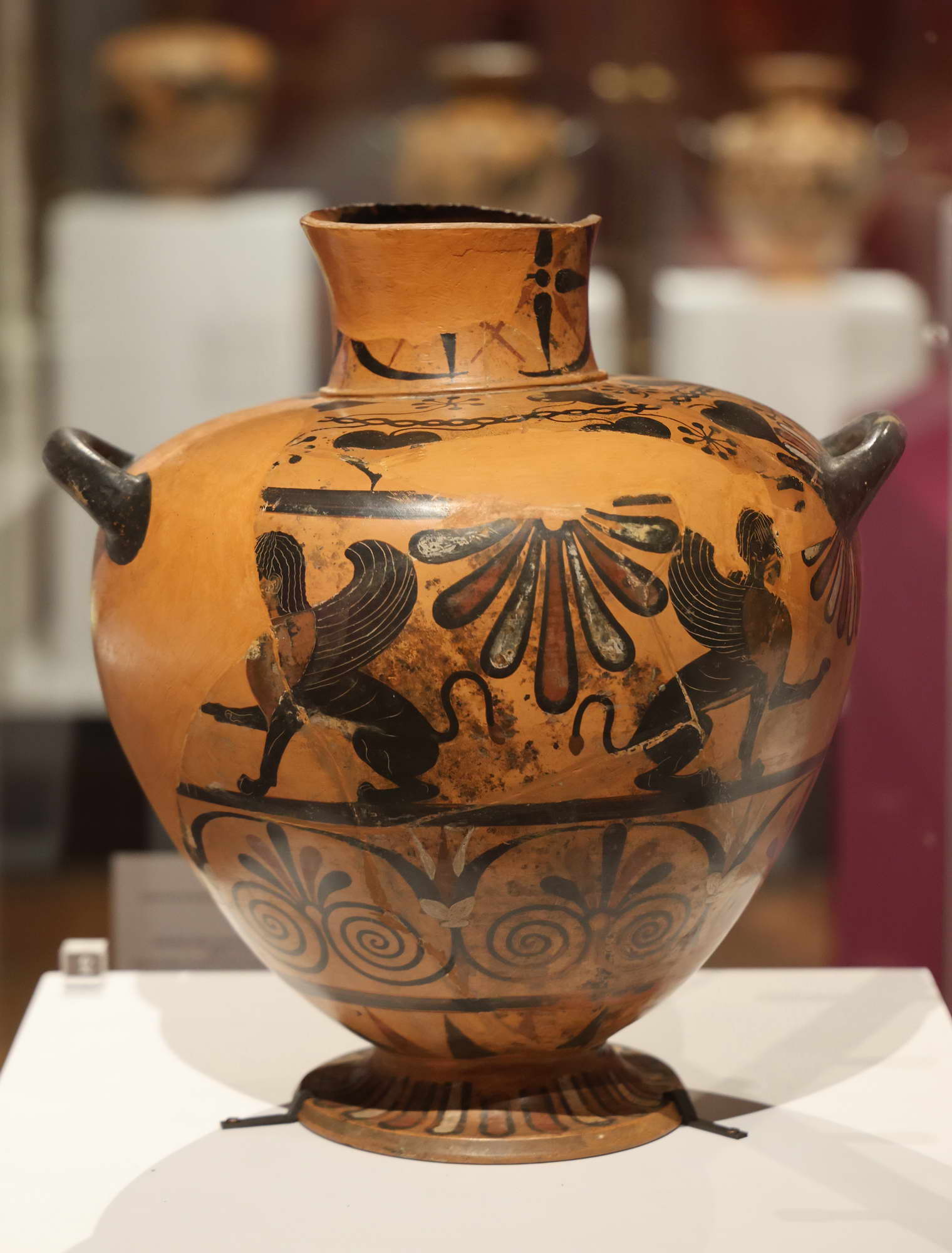
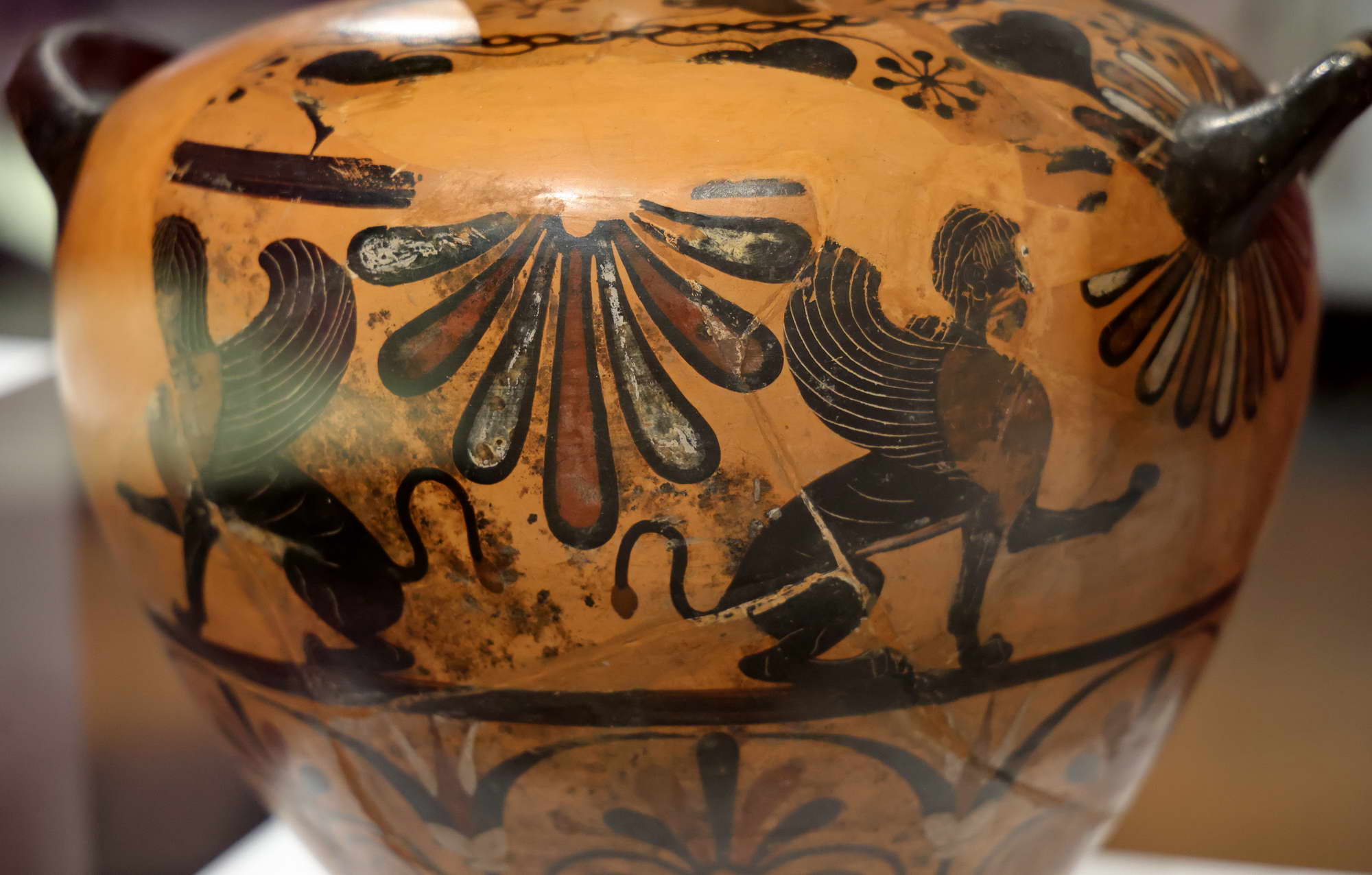
The principal purpose of the hydriae and dinos vessels produced in Caere was to serve at banquets, both in a practical sense—mixing wine with water—and as a way of displaying the host’s prestige. Their painted scenes therefore depict banquets, drinking and dancing on the one hand, and amusing stories on the other, which could serve as conversation starters during the feast, much as Plato’s dialogues often begin with a story of this kind.
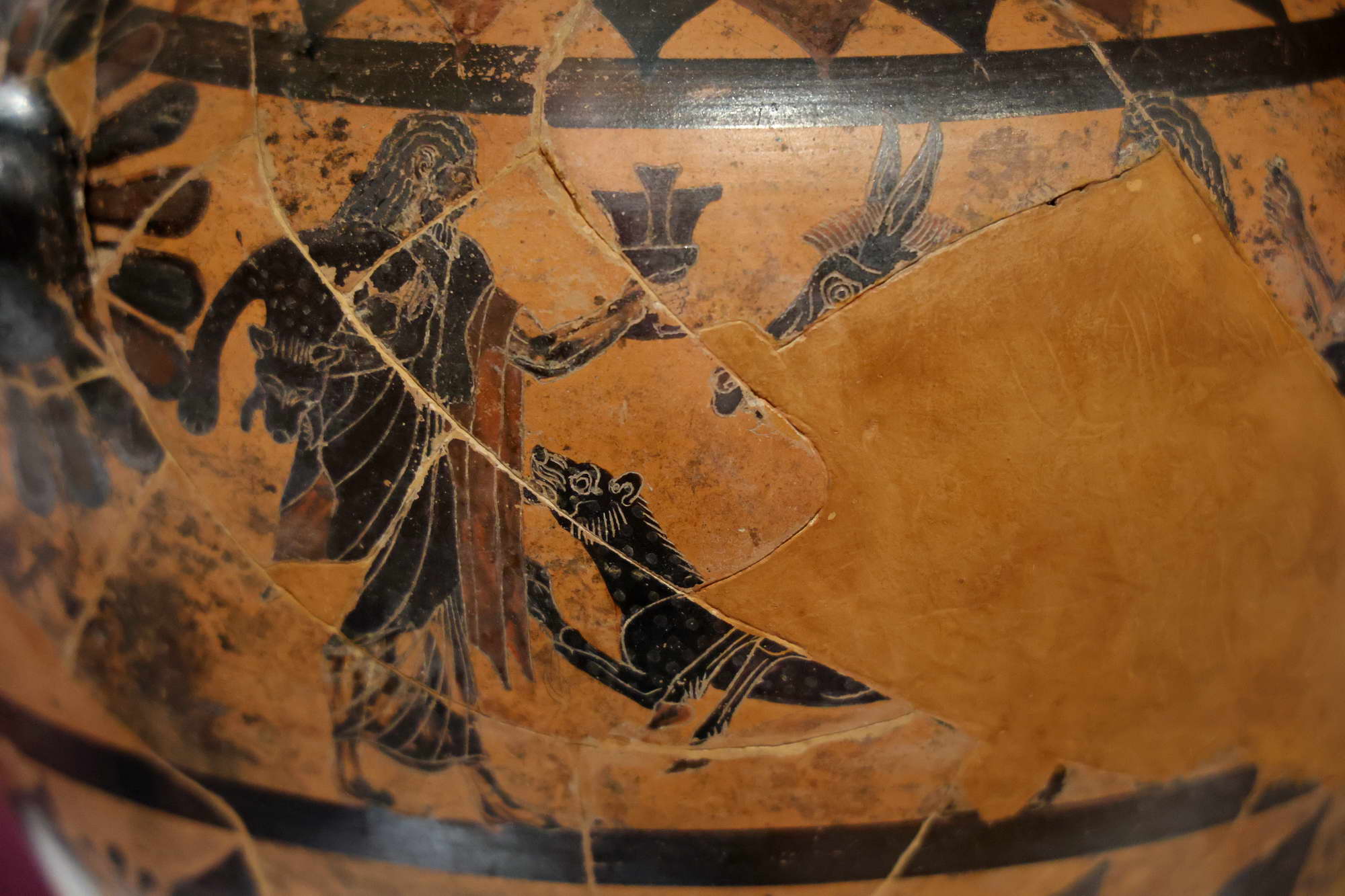
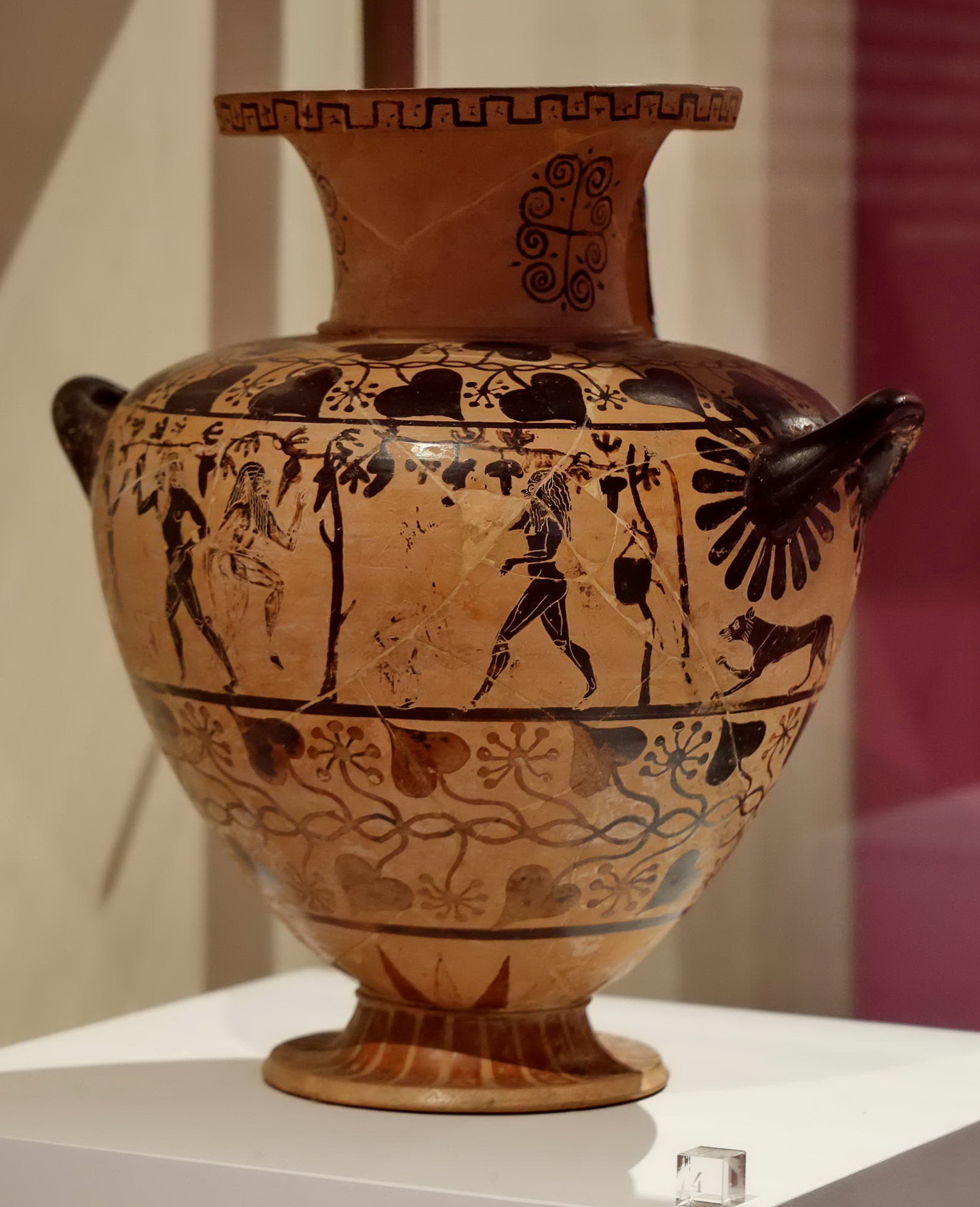
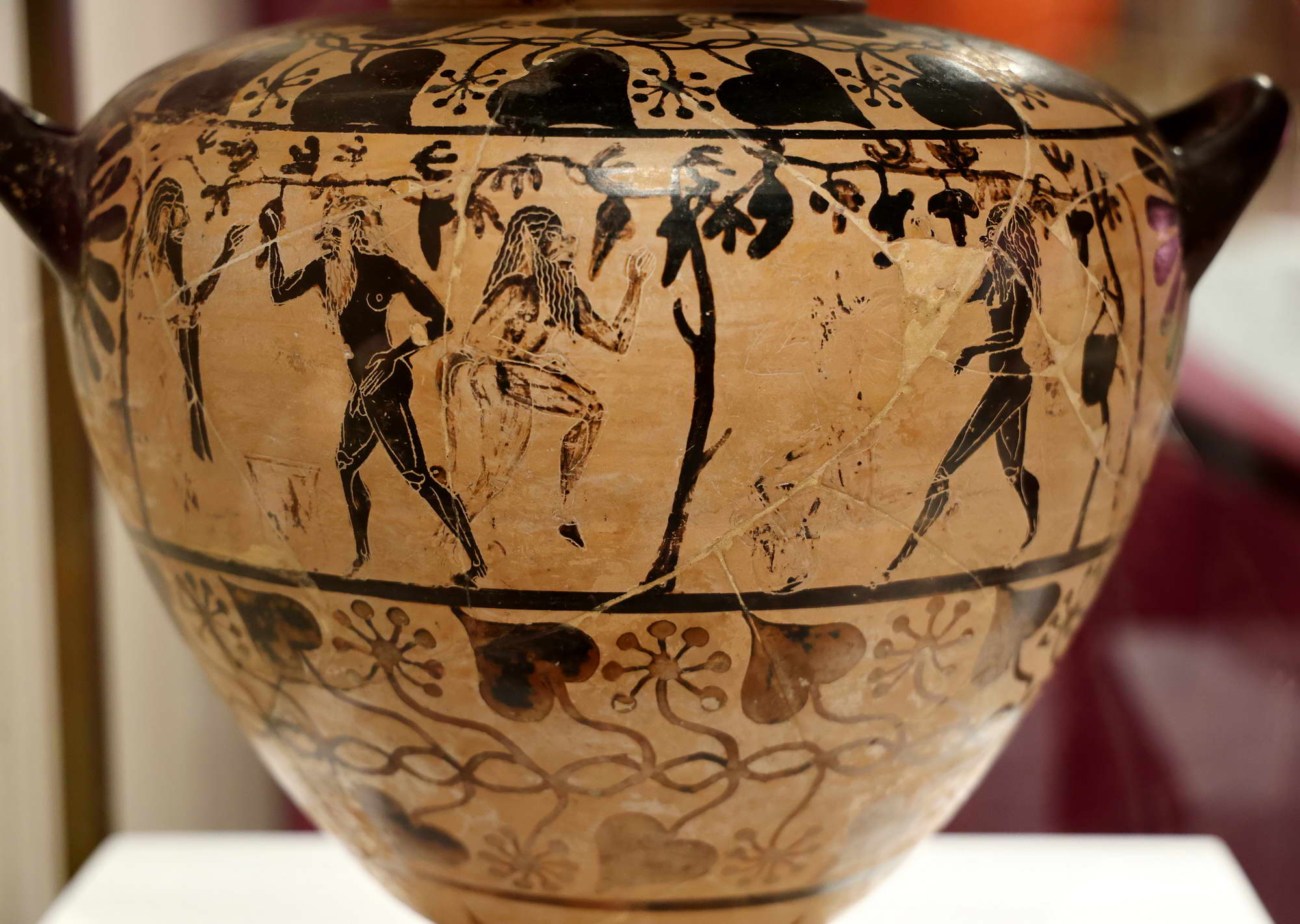
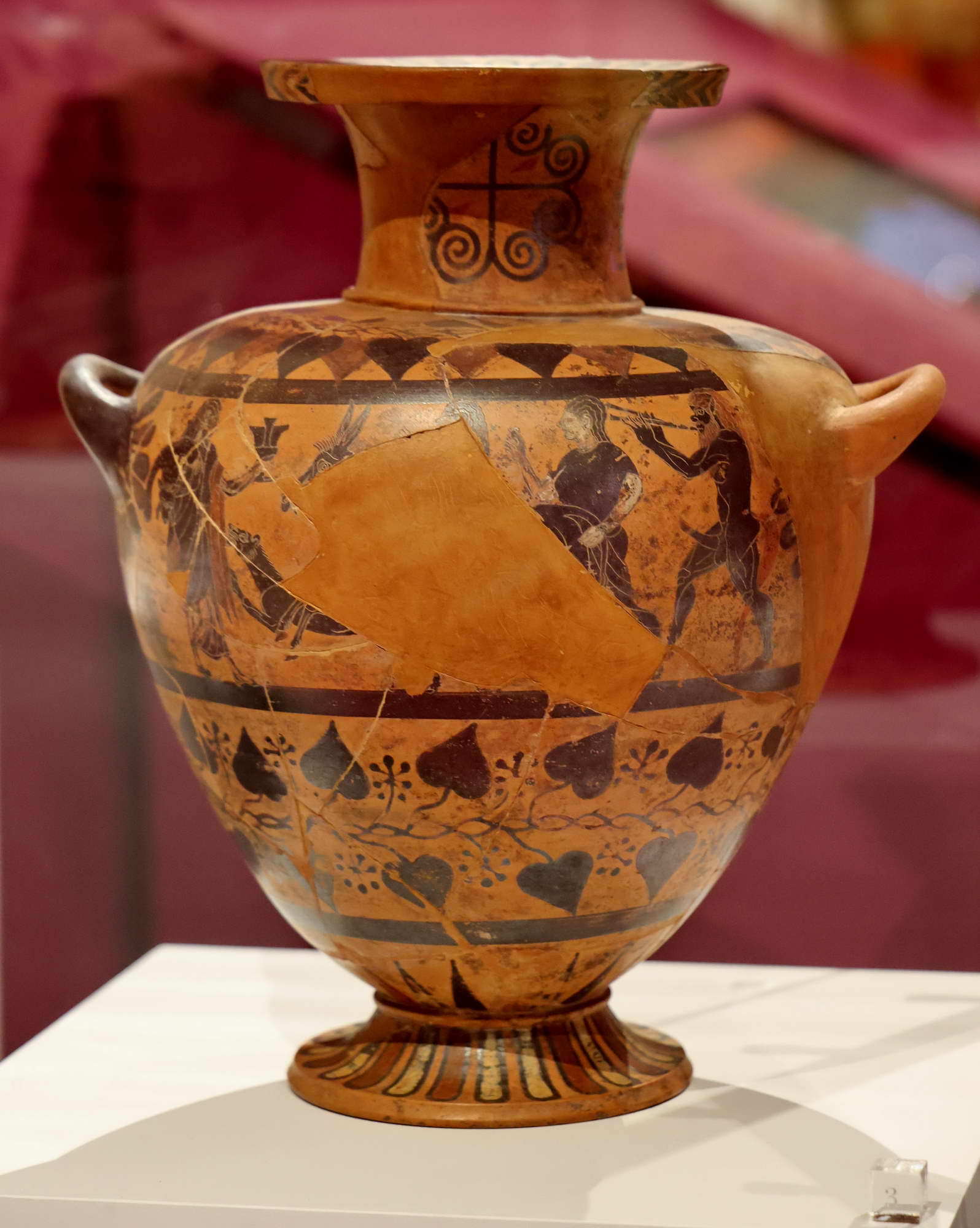 Villa Giulia CH 9. A favorite scene on banquet vessels: Dionysus brings the drunken Hephaestus home to Olympus. A big cat rubs against Dionysus’s leg, an indispensable wild presence in his procession. On the reverse, satyrs are harvesting grapes, accompanied once again by a leopard.
Luxury hydriae often accompanied their owners into the tomb as well. These are precisely the vessels that have survived and can be seen in the exhibition. Here, too, they served to display the prestige of the deceased and their family to relatives who came on great feast days to share a banquet with their departed ancestors.
Ritual purification with water was also an important part of the funeral ceremony. It was performed using an especially ornate vessel, which was then left in the tomb.
Thirdly, on Etruscan sarcophagi, placed in the tomb on the same raised ledge where the living participants sat during communal banquets, the deceased is always shown reclining or seated in a banquet pose, a wine cup in hand. This was not because the Etruscans imagined the afterlife as one endless symposium, as was once believed and as Antal Szerb suggests in Journey by Moonlight. Rather, when family members came to see them, the dead had to assume the role of participants in the communal feast. But what did they do when the banquet was over and the family had gone home? No doubt they spent eternity attending to the amusing and spine-chilling tales painted on their hydriae and dinos vessels.
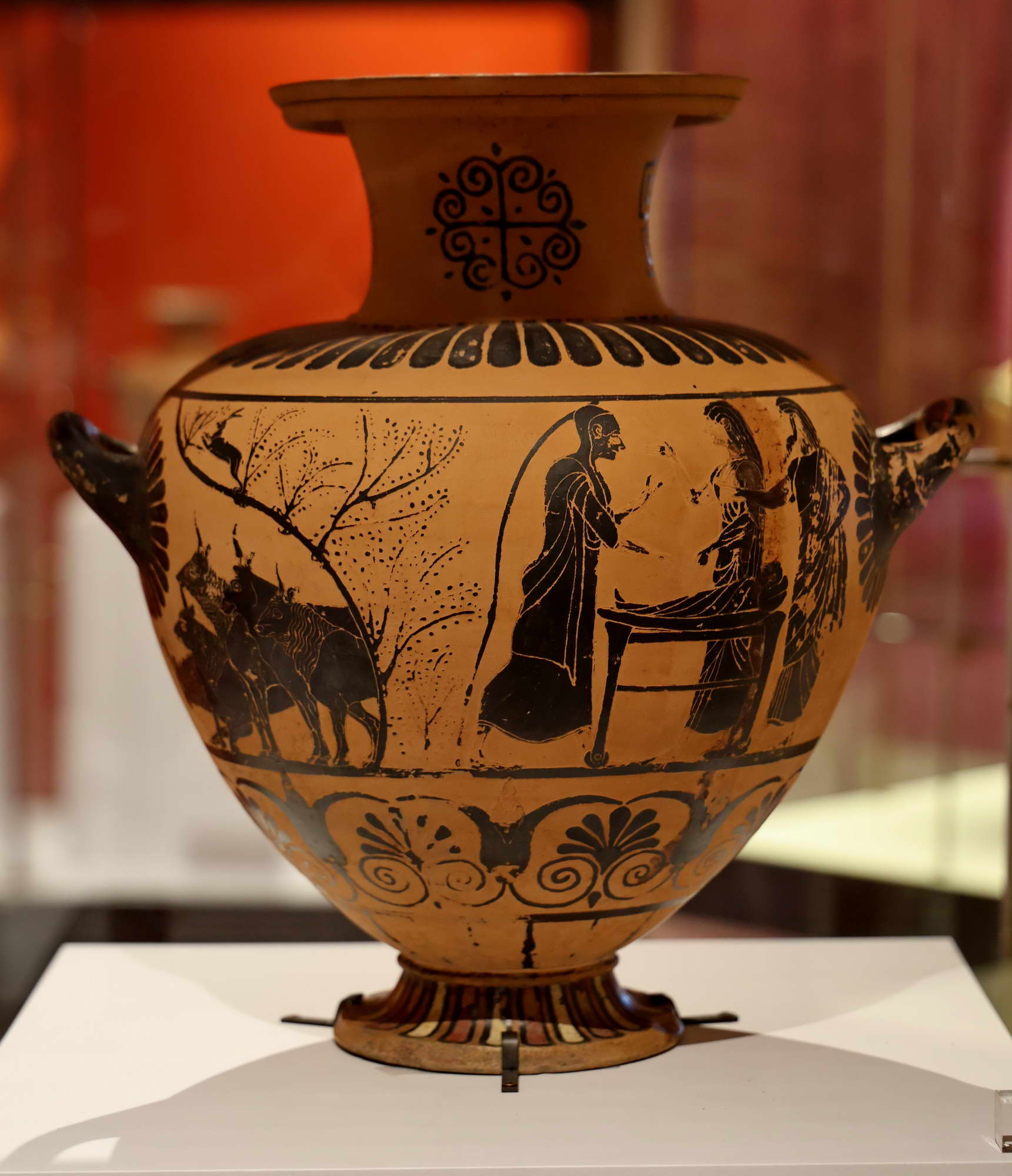 Basel, Antikenmuseum CH 2. The infant Hermes, wrapped in swaddling clothes, hides in a cave after stealing the cattle of his half-brother Apollo. Apollo arrives in a fury to demand an explanation, but Hermes appeases him with the lyre he has invented, as I recounted earlier. The stolen cattle, hidden in the cave, can also be seen at the far left of the scene.
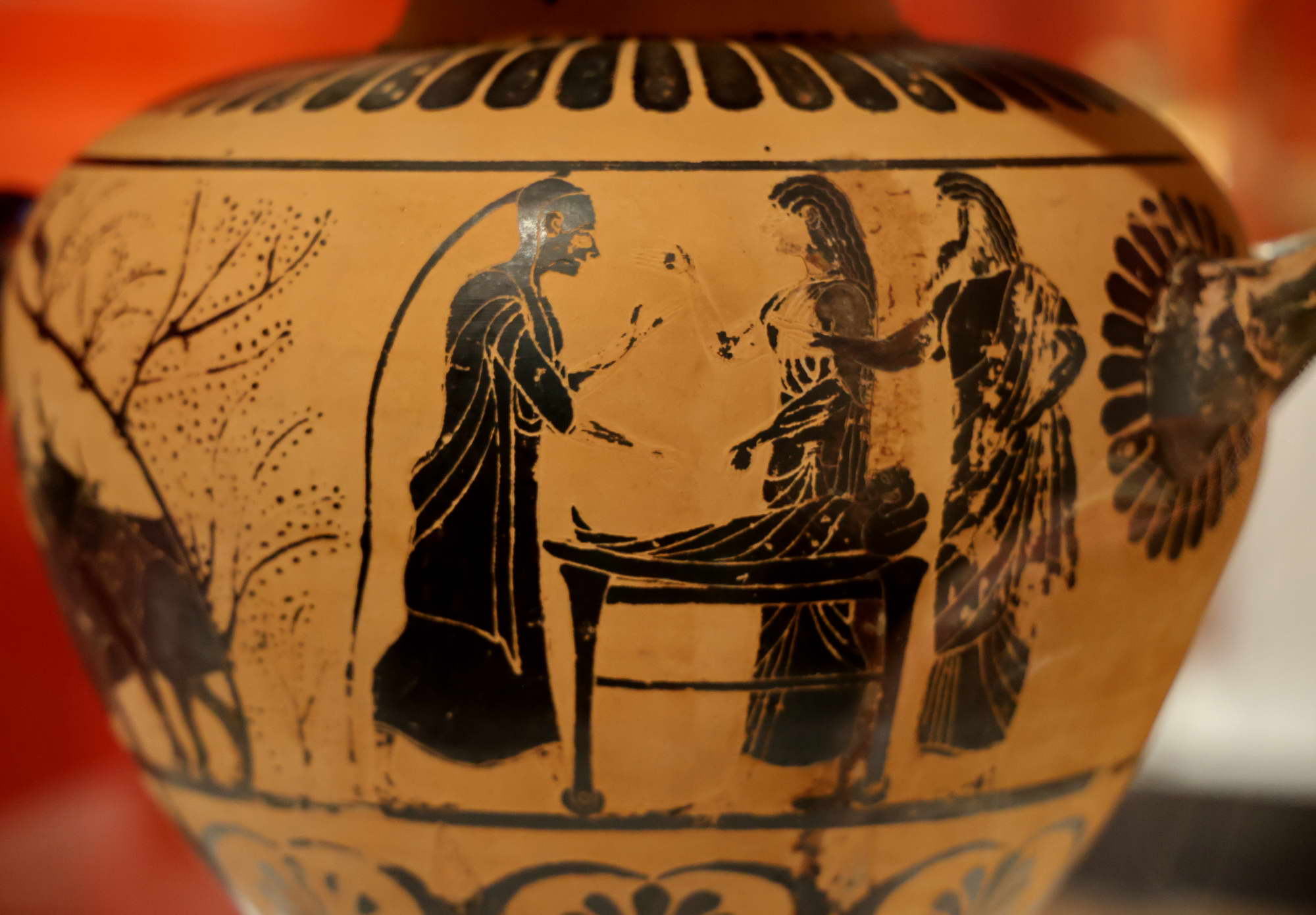
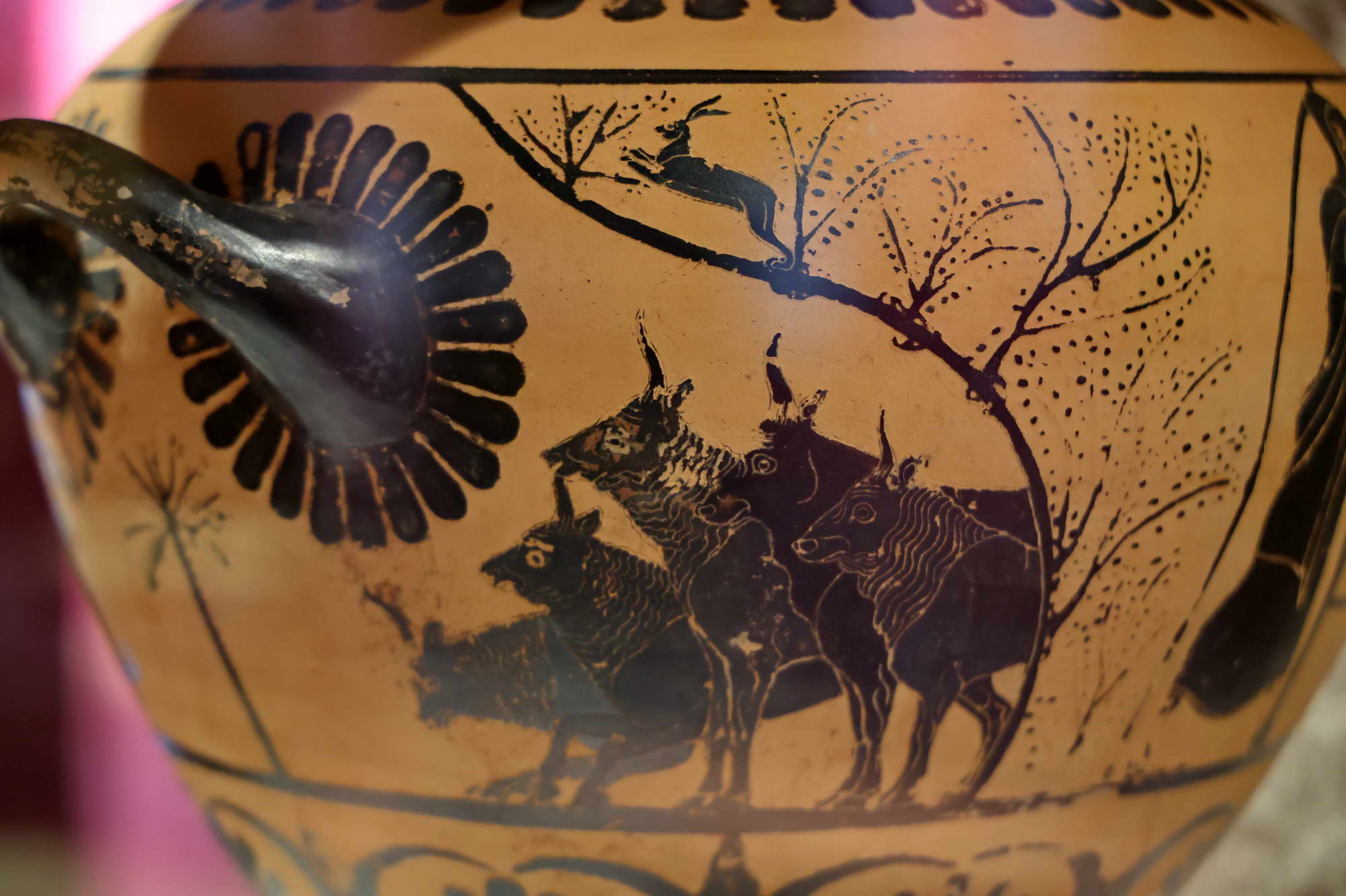
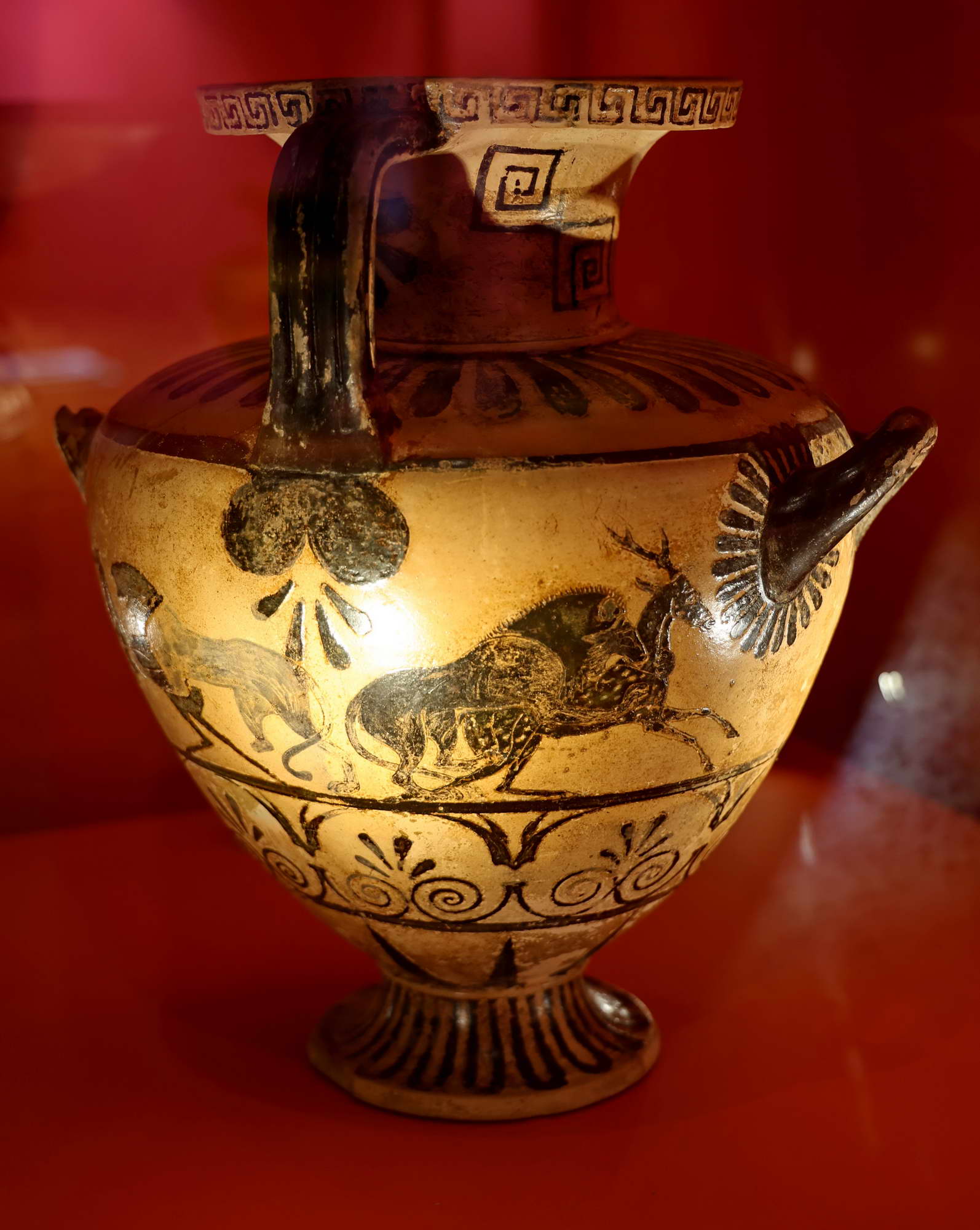 On the back of the vase, two lions bring down a deer each. The two sides are linked, on the one hand, by a play with space (the front: inside the cave; the back: outside it), and on the other, by the motif of stealth — embodied both by the thieving Hermes and by the lions. Taken together, the two scenes suggest that in nature, as in the world of the gods, the stronger and more cunning prevail over the weaker and unwary.
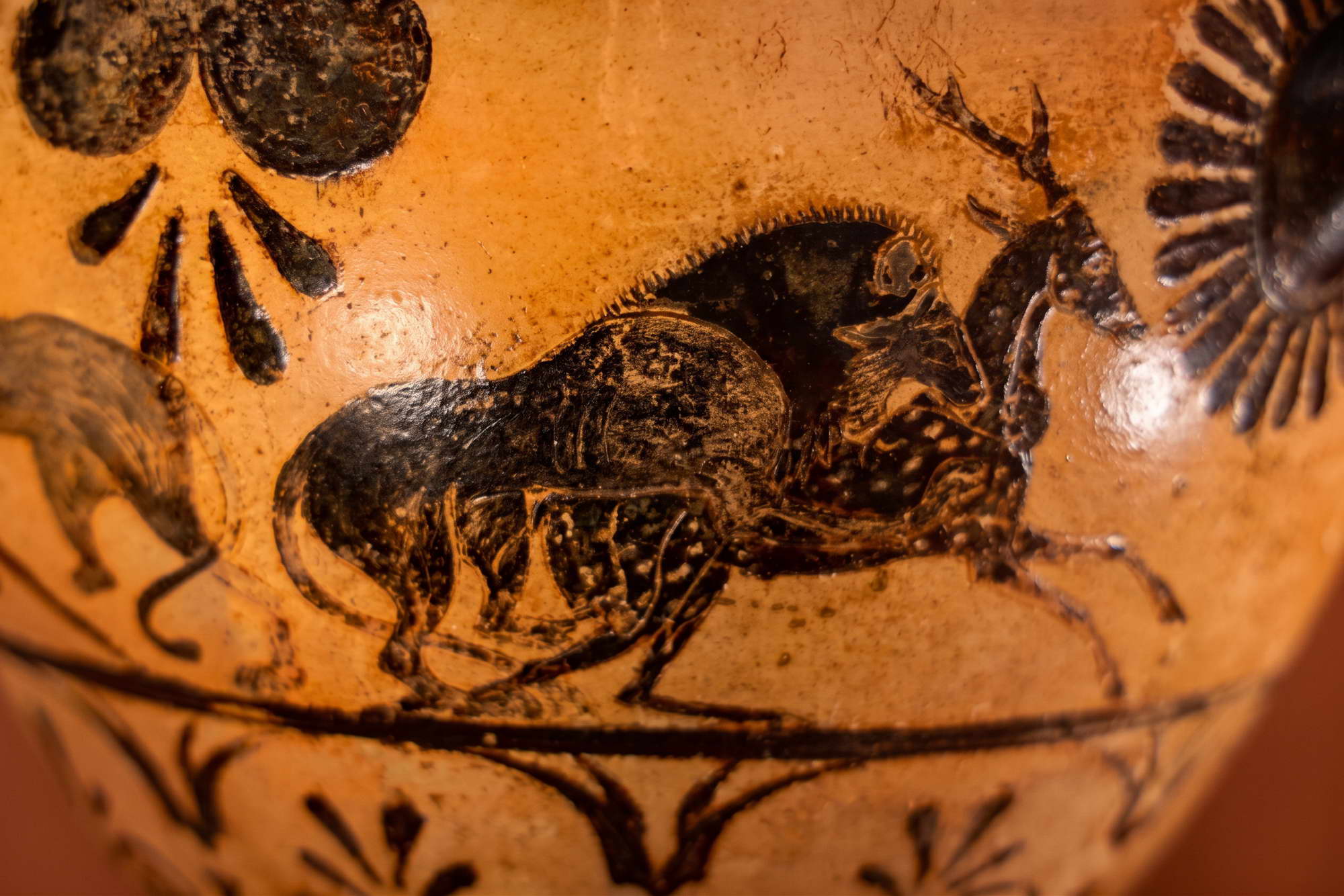
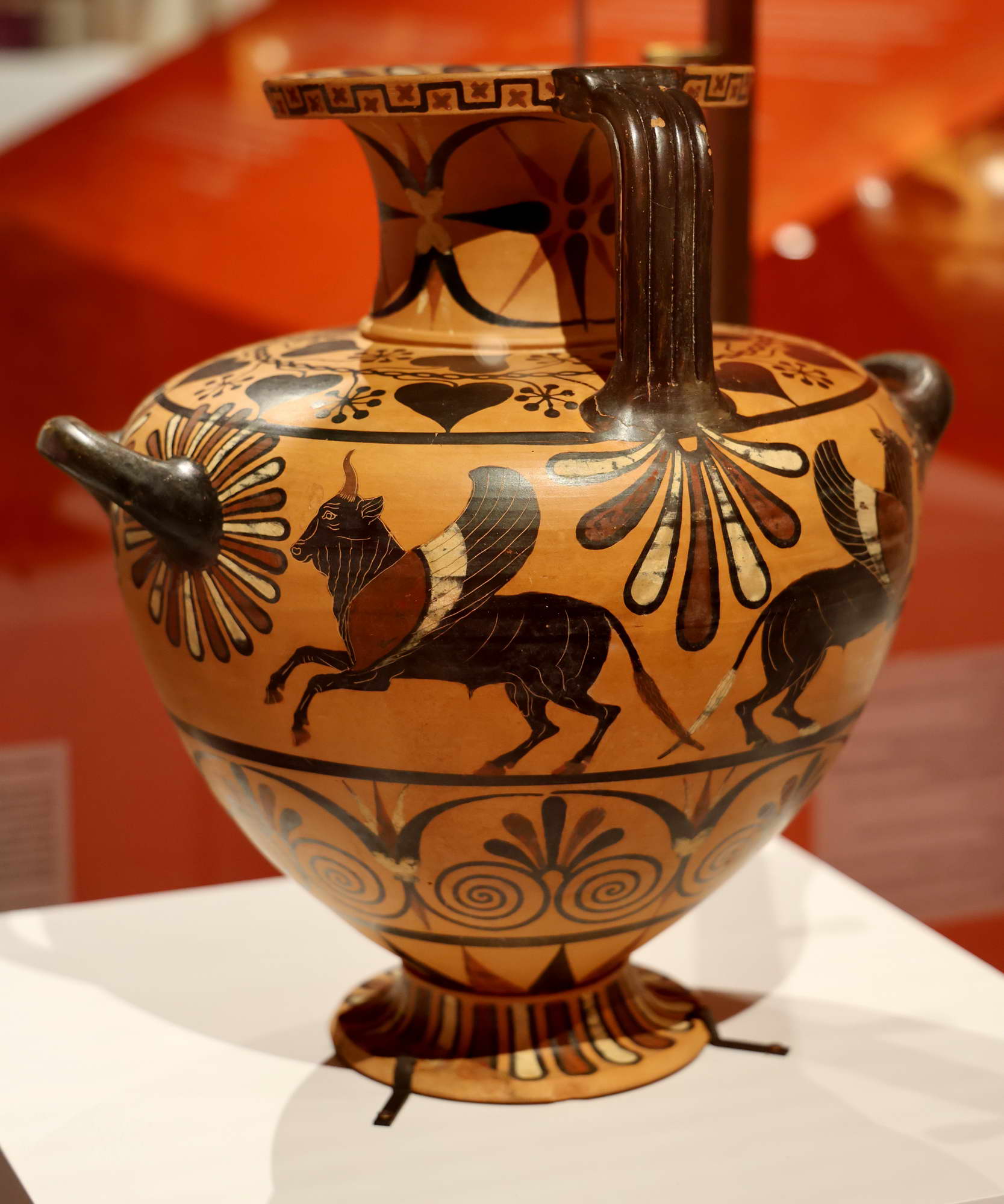
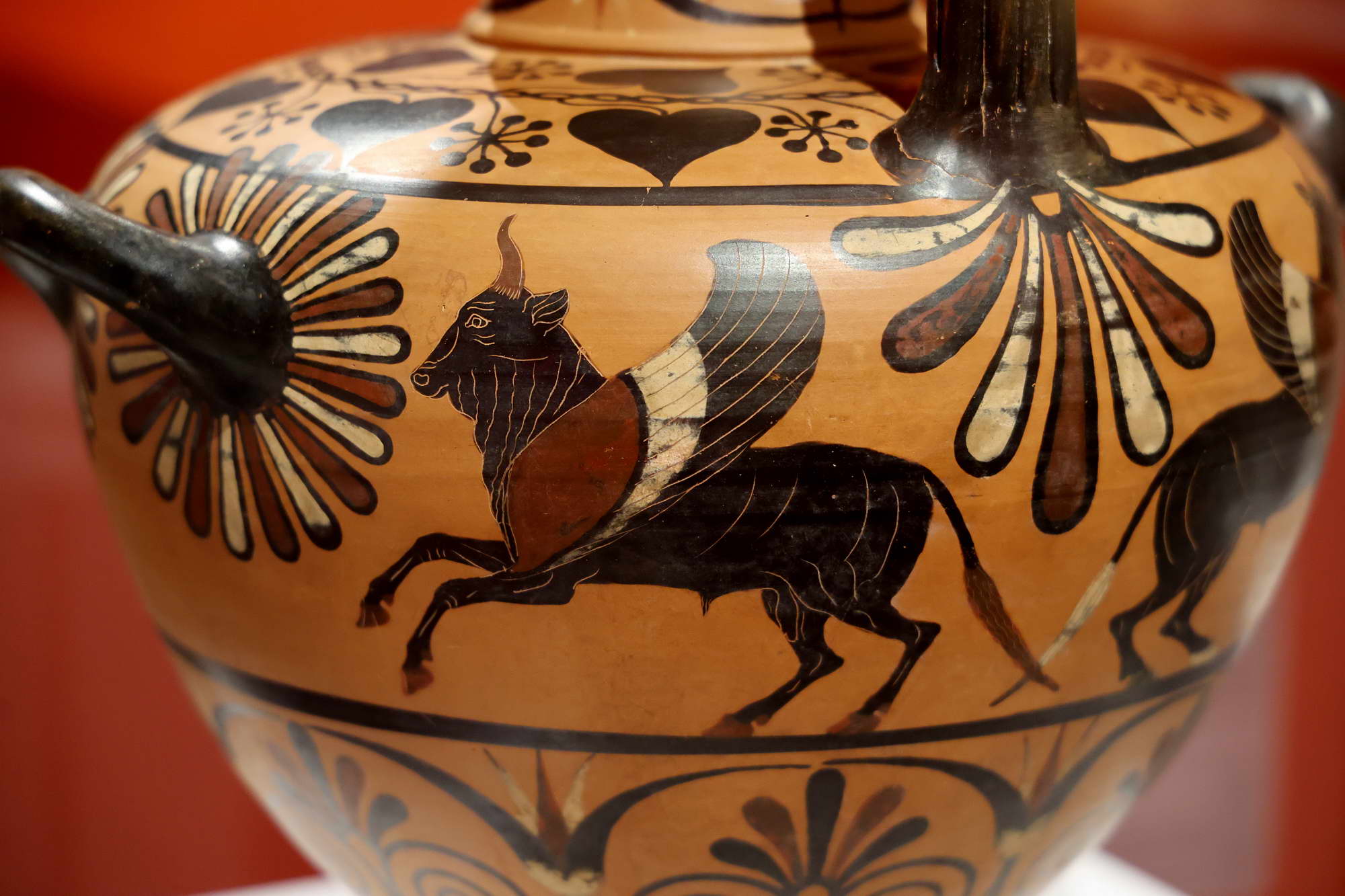
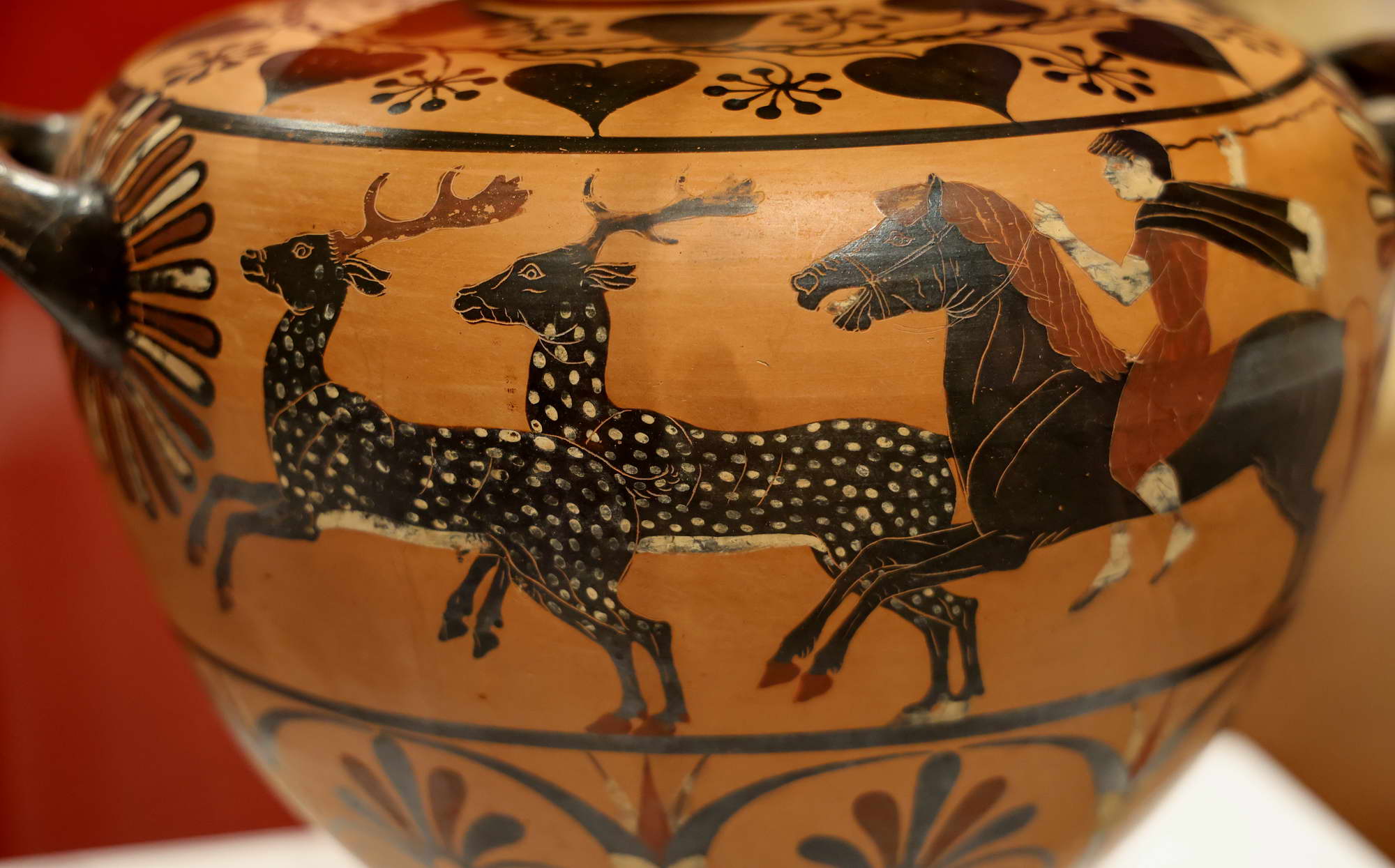 Louvre E 699. The life and death of an Etruscan aristocrat. On the front, he indulges in the pleasures of deer hunting; on the back, winged bulls stand ready to receive him as guardians of the gates to the afterlife.


Recent comments