


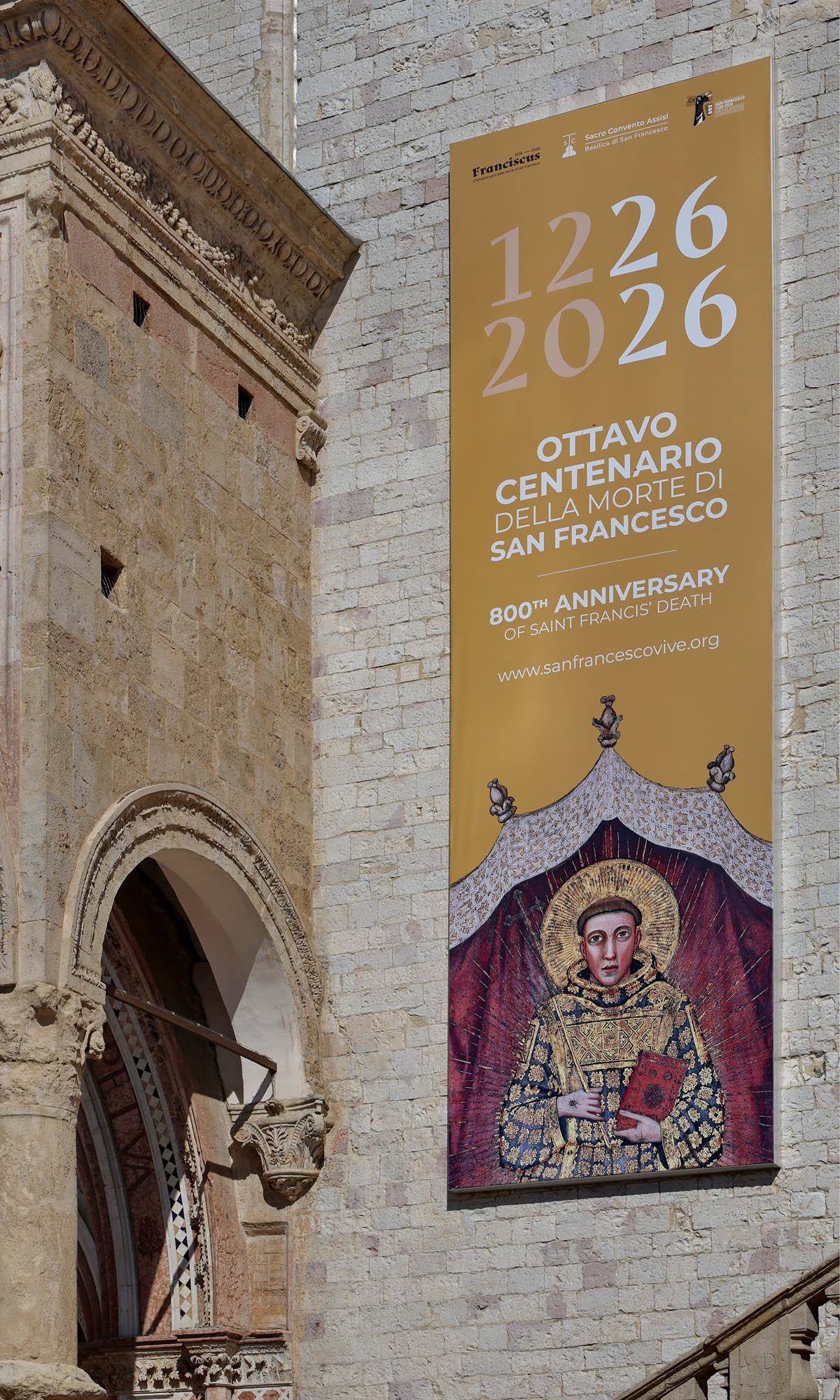
On October 3 this year, the Catholic Church commemorated the 800th anniversary of the death of Saint Francis of Assisi. The day of death, the heavenly birthday, is the greatest event in the life of every saint – indeed, of every Christian believer. Celebrations are being held throughout Italy in memory of the “Jester of God,” as Francis called himself. These include exhibitions as well. In Arezzo, where Margarito, one of the earliest and most prolific painters of Francis's likeness, was active, an exhibition traces depictions of the saint from the thirteenth to the twentieth century.
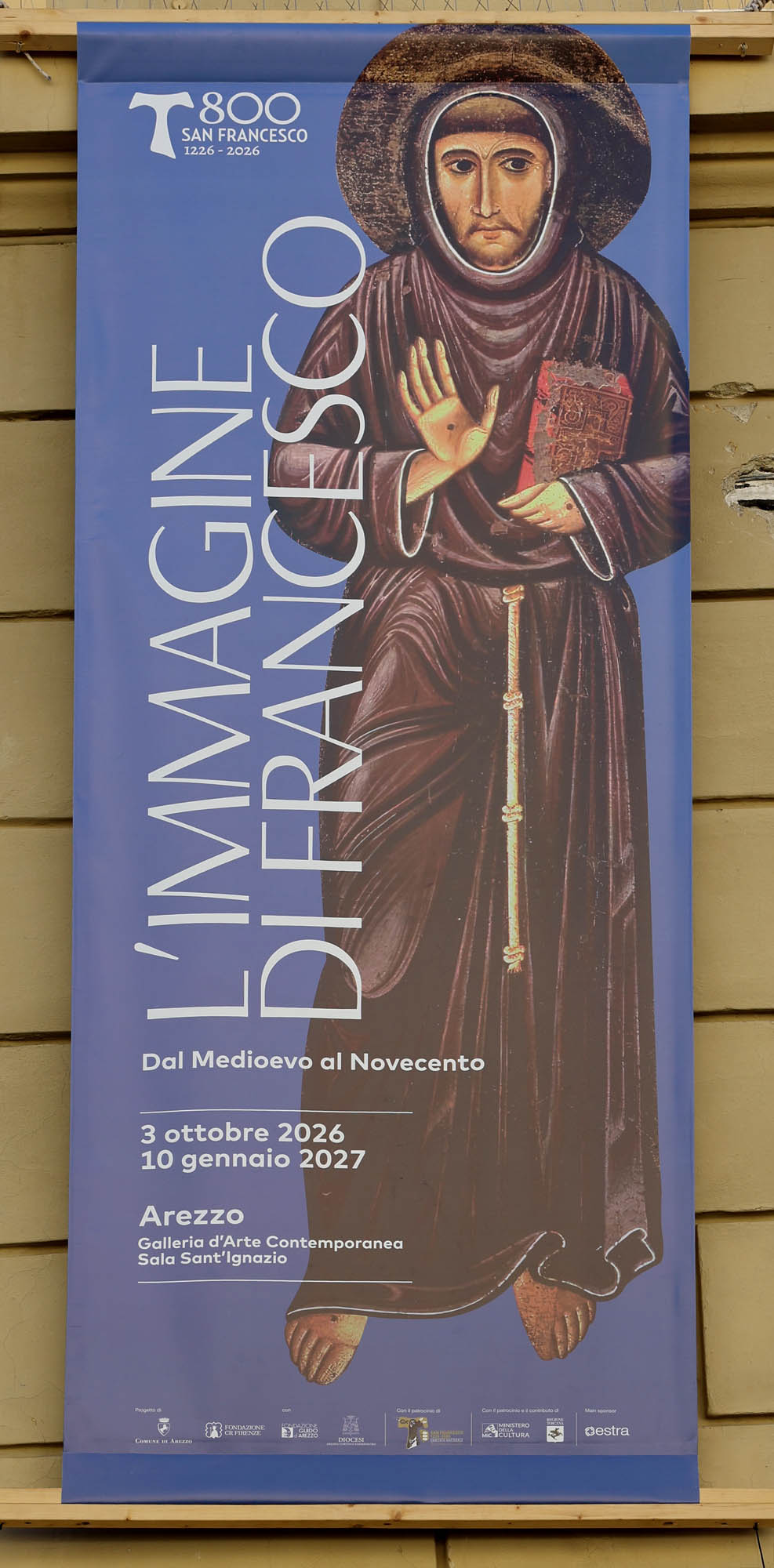
Images of Saint Francis perhaps played a more important role in the Catholic Church than those of any other saint, especially during the early years of the order.
Francis was canonized with record-breaking speed, just two years after his death, on July 16, 1228, by Pope Gregory IX. But even before his canonization, on April 29, he had ordered the construction of the Basilica of Saint Francis in Assisi, and the day after the canonization he personally laid its foundation stone.
Even saints benefit from having friends. Gregory IX was a true friend of Francis. He had recognized Francis's genius already when he was still Cardinal Ugolino di Conti di Segni. The highly educated aristocratic canon lawyer was deeply impressed by Francis's radical purity, absolute sincerity, and charisma. Francis regarded the cardinal as his spiritual father and the official protector of the order, while the latter often asked him to pray for him and offer him advice.
At the beginning of the thirteenth century, the Catholic Church was in a profound crisis. The urban proletariat, streaming into the cities and losing the communal networks of their rural origins, turned away from the secular clergy and joined radical movements preaching poverty in great numbers, such as the Cathars and the Waldensians. Cardinal Ugolino realized that Francis's movement – which also preached radical poverty – was not a threat but a solution. If integrated into the Church, its members could become the papacy's foremost allies in the spiritual struggle against heresy.
Although Ugolino sincerely admired Francis, he understood that Francis's anarchic, rule-free, itinerant way of life was not sustainable in the long run for an organization numbering several thousand members. He therefore took an active part in drafting the Franciscan Rule. In effect, he saved the order from disintegration and from being declared heretical, but in return he also reshaped it to some extent: Francis's original radical, anti-institutional vision was transformed into a well-organized religious order obedient to the papal court.
As quickly as the Franciscan order began to take institutional shape, Francis's first dossal panels also appeared: quasi-life-size images of the saint placed behind side altars.
In thirteenth-century Italy, the altarpiece was not yet an established feature. In sanctuaries, there was usually just a croce dipinta, a huge painted crucifix hanging above the altar, depicting Christ and often accompanied by subsidiary scenes from the Passion.
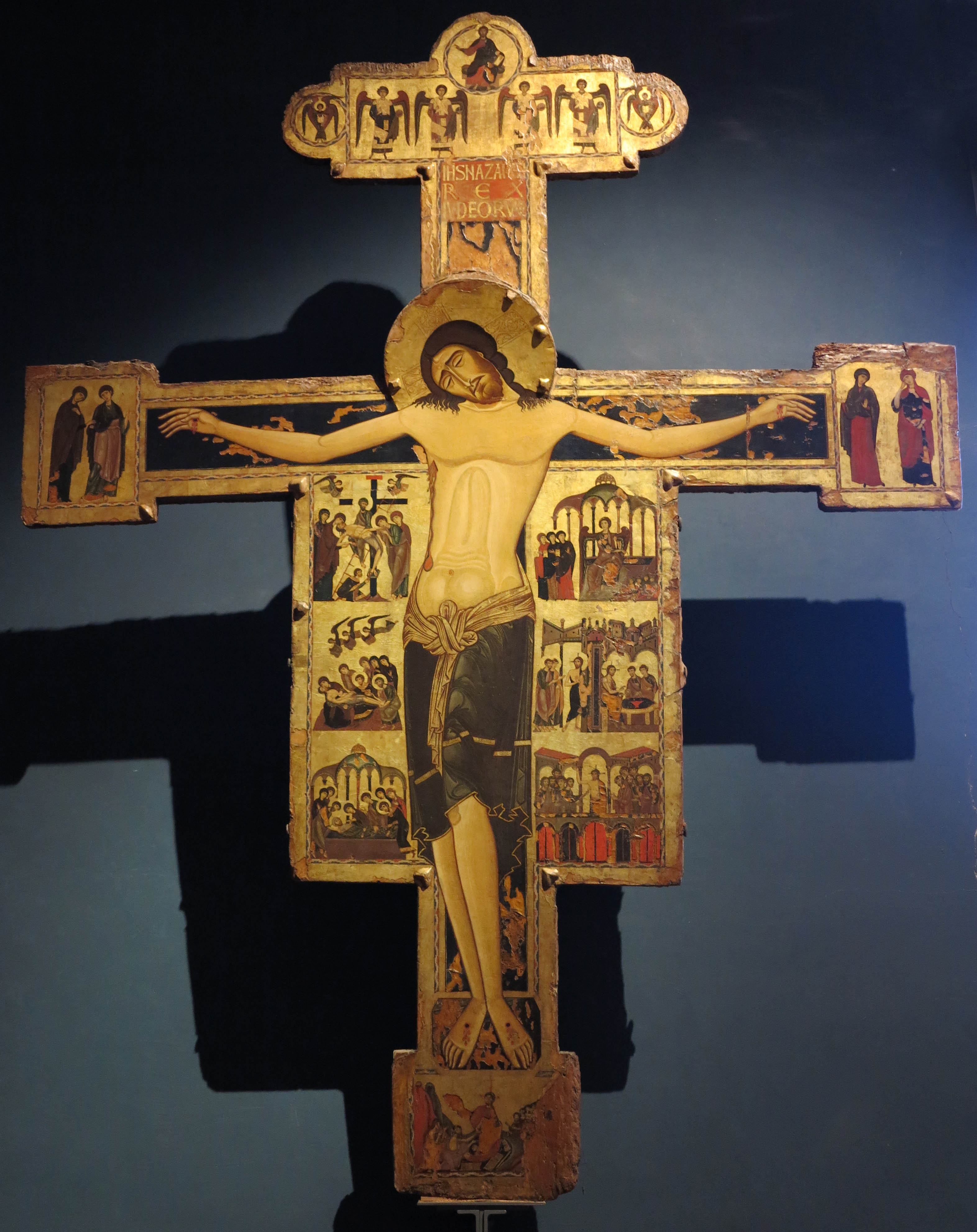 A croce dipinta, the work of a Byzantine painter, dating from around 1210, in the Picture Gallery of Pisa. I will have to write a separate post about these crosses.
But this was also the period when, thanks to increasingly lively contacts with Byzantium, large numbers of icons began to flow into Italy. With their golden backgrounds, refined palette and elegant forms, they brought an artistic standard of a previously unimaginable level. At the centre of these icons sits the Mother of God with the Christ Child, or stand Saint Nicholas, Saint John the Baptist, and the Greek Church Fathers, flanked on either side by small scenes from their lives.
The quickest way to ensure the spectacular heavenly ascent of the penniless jester from Assisi was to place him at the centre of such an icon, portraying him in the maniera graeca style. Contrary to Vasari’s later disparagement, in the thirteenth century this still represented the most sophisticated form of art. Since the schism of 1054, this was the first icon to depict a Western saint.
Unlike the monastic orders that had preceded it, the Franciscan Order was a mass movement. Its founder therefore had to be presented to the people of the suburbs, where the vast Franciscan churches were being built, in large and lavish altarpieces that made his sanctity, stigmata and miracles unmistakable. At the same time, it was important to preserve the appearance of poverty: the commission had to come not from the friars themselves, but from a wealthy outside patron.
The breakthrough seems to have come in Pescia, where the influential Mainardi family commissioned a Saint Francis dossal for their chapel in 1235, just seven years after the saint’s canonisation. They entrusted the painting to Bonaventura Berlinghieri of Lucca, who, together with his father, was one of the leading Tuscan masters of the maniera graeca.
The precise programme was devised by the Franciscans, who calibrated every single detail with the utmost care.
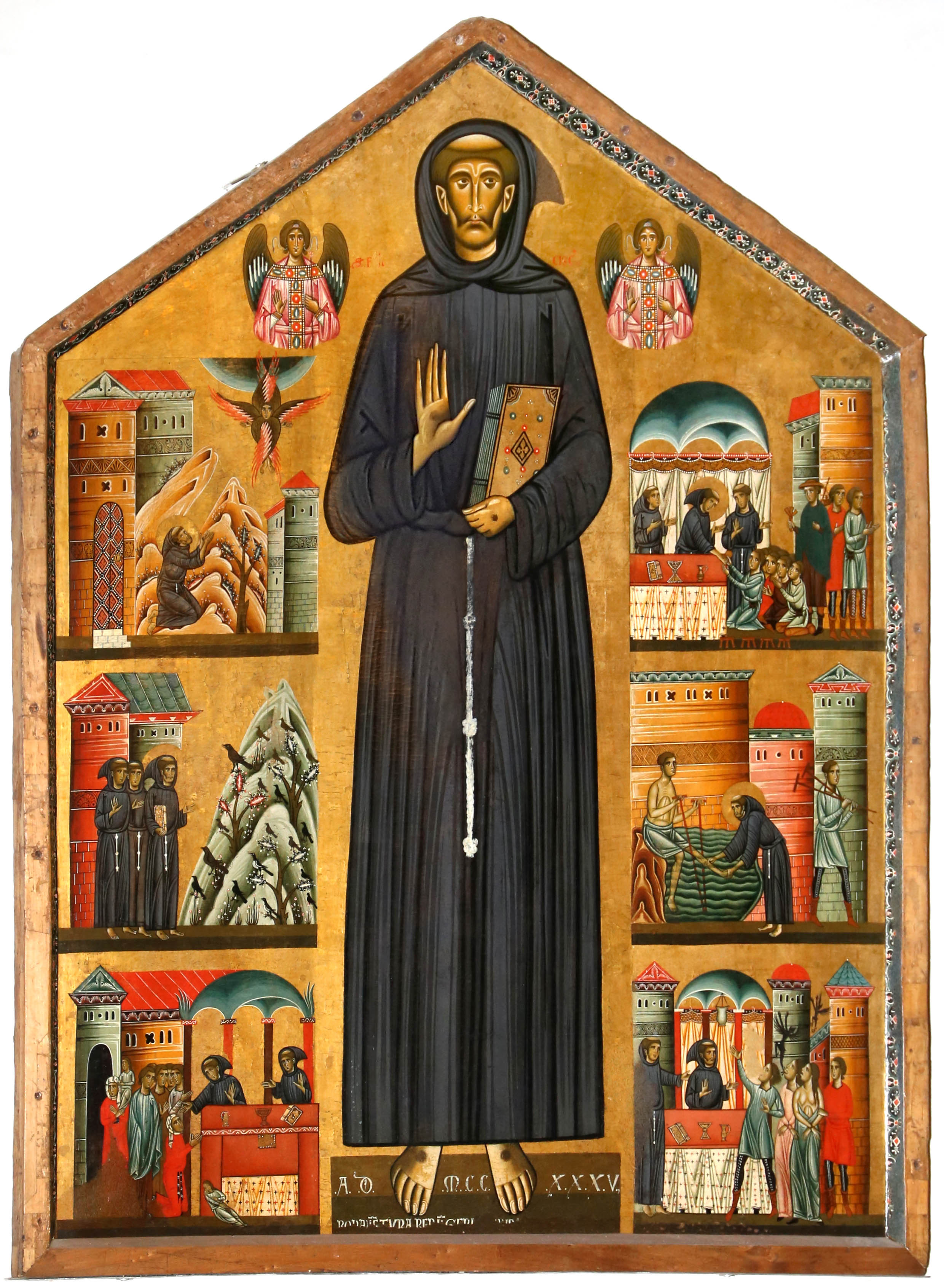
At the centre of the icon stands Saint Francis, a tall, gaunt, ascetic figure, dressed in the simple woollen habit that he himself designed “in the shape of a cross”, as his biographer Tommaso da Celano emphasises.
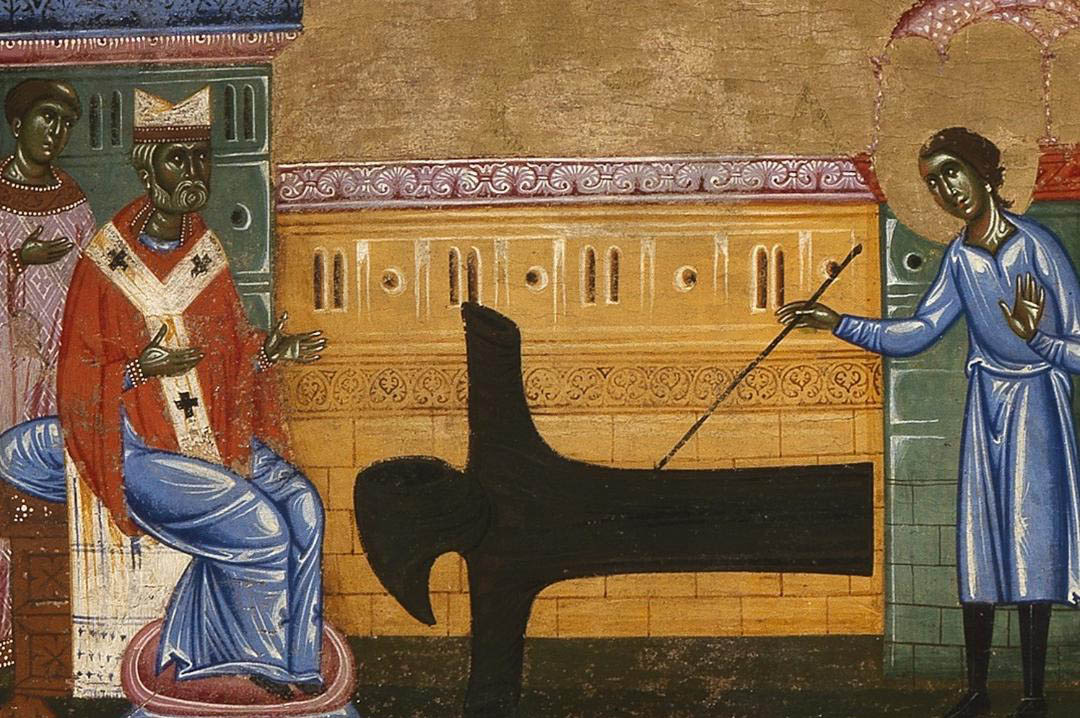 Saint Francis draws on the ground before the Bishop of Assisi the outline of the cross-shaped habit he designed. The third biographical scene on the Bardi Altarpiece, Florence, Santa Croce.
The two angels beside the saint’s head have been transferred from the familiar “painted crucifixes” of the period, where they flank the figure of the ascended Christ enthroned at the top of the cross (see above). In this way, they signal that Francis now occupies the same place.
The six scenes were carefully selected from Tommaso da Celano’s Life of Francis, which he compiled at the command of Pope Gregory IX immediately after the canonisation. The scenes, like the habit itself, demonstrate that Saint Francis was “alter Christus”, a second Christ, as the order proclaimed. The first two panels depict miracles performed during his lifetime; the remaining four show precisely the four miracles that took place at his tomb, and which Gregory IX’s bull also lists as proof of Francis’s sanctity. These four miracles effectively mirror the Gospel proofs of Christ’s saving power: “the blind receive sight, the lame walk, those with leprosy are cleansed, and the poor have the good news proclaimed to them” (Luke 7:22). They, too, were composed using established formulas from depictions of Jesus, such as the washing of the feet.
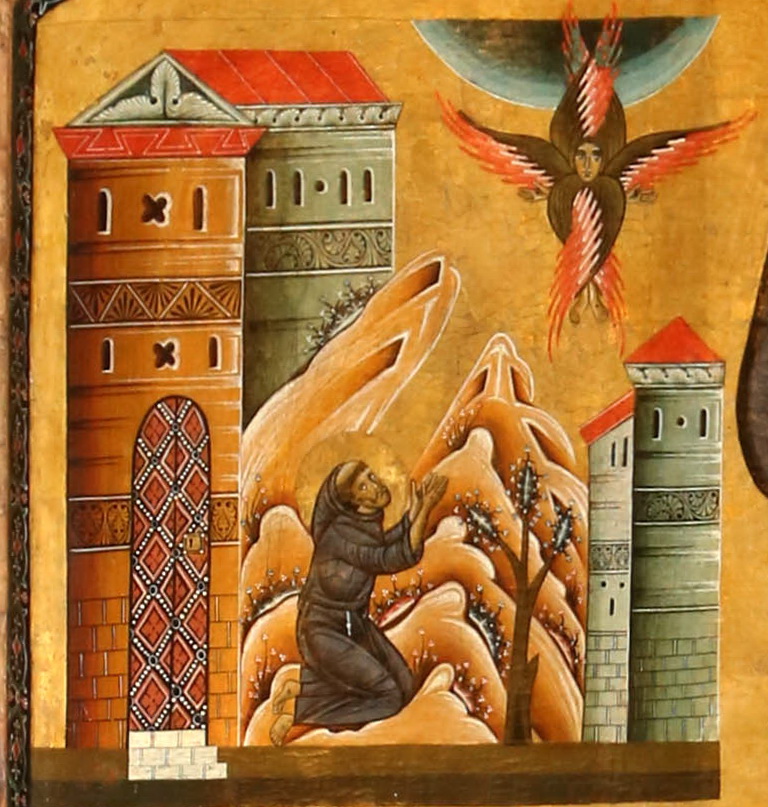 Francis receives the stigmata of Christ. This was the most extraordinary and spectacular miracle of his life, and at the same time proof of his intimate union with Christ.
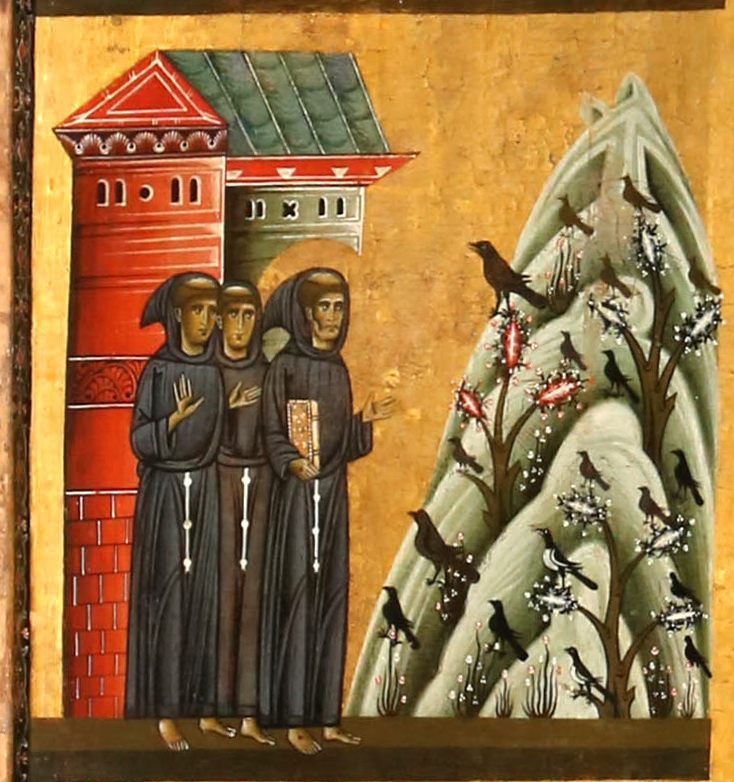 Francis preaches to the birds. The story demonstrates that Francis was as pure in spirit as Adam before the Fall, living in the divine harmony of the state of Paradise.
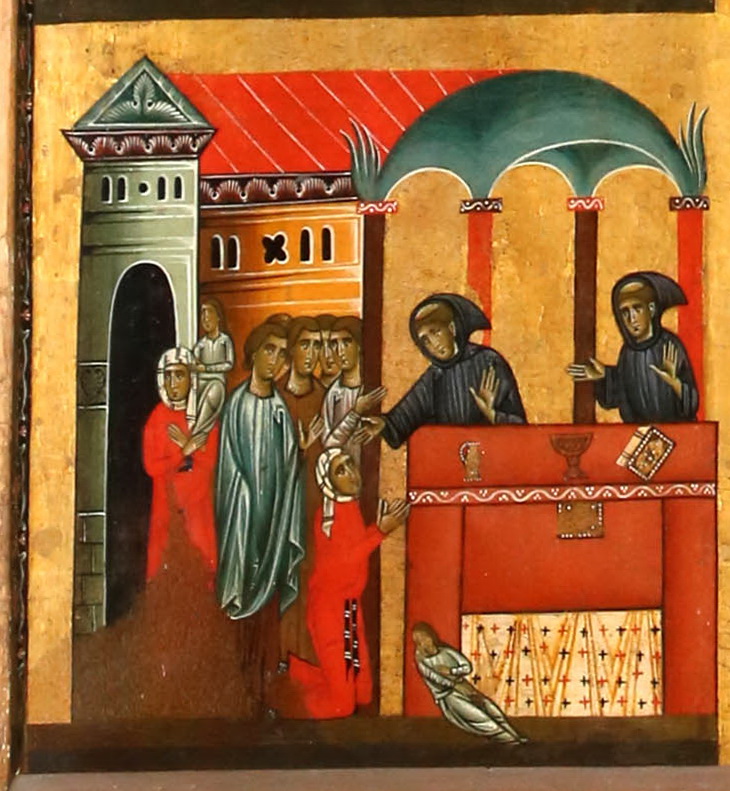 The healing of a crippled little girl at Francis’s tomb
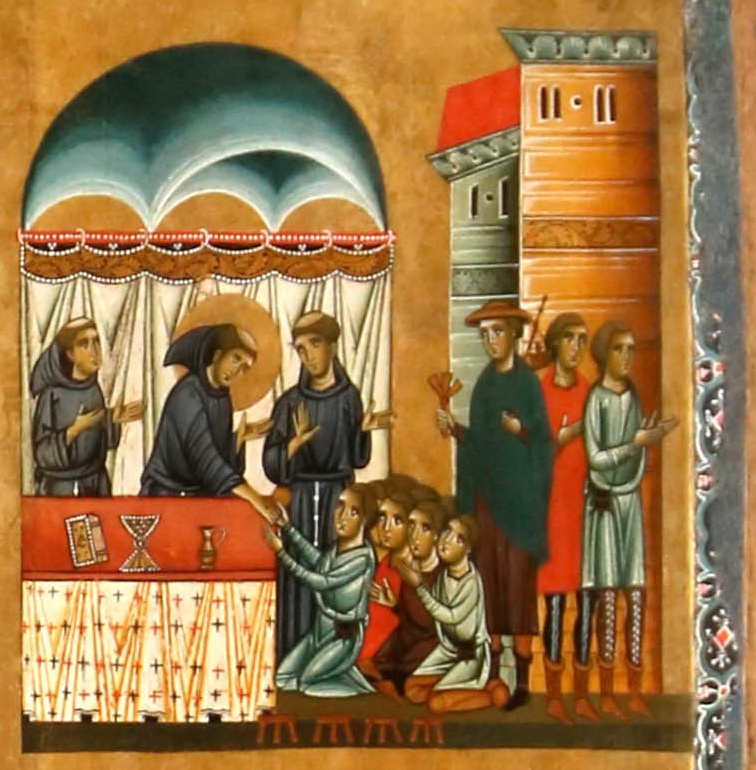 The healing of eight lame people and a leper
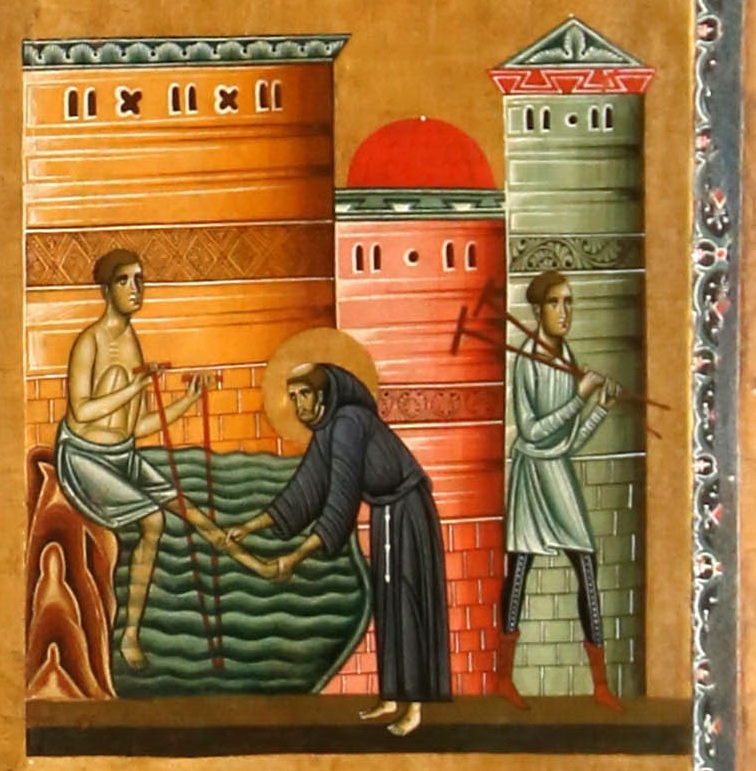 The healing of Bartolomeo of Narni, who was lame
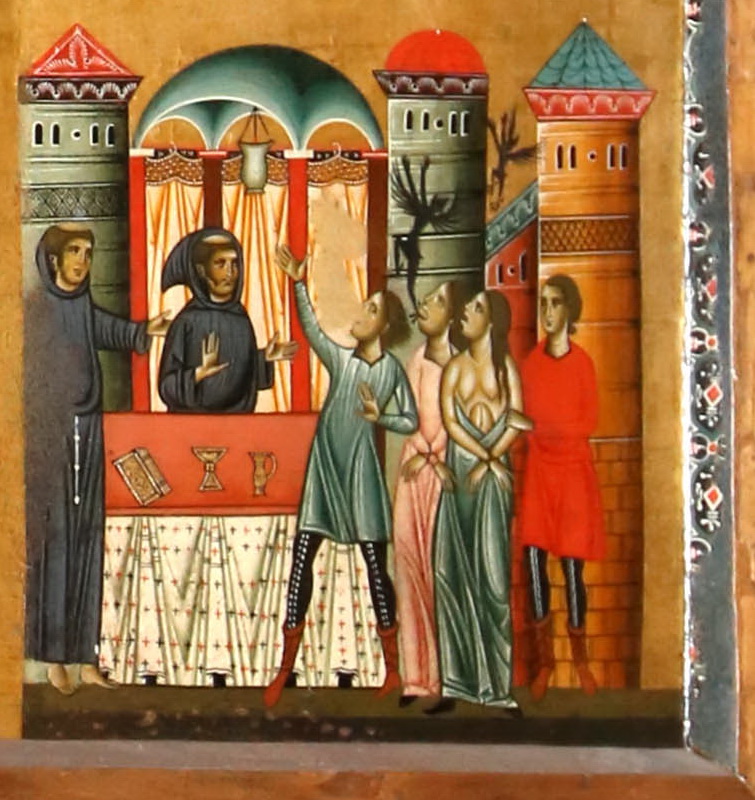 The deliverance, at Francis’s tomb, of three people possessed by demons – among them Pietro of Foligno and a woman from Narni
The formula spread throughout Italy at lightning speed. This particular painting was not brought to the exhibition in Arezzo, but some of its descendants were. This is the dossal from a Franciscan church in Pistoia (Santa Maria Maddalena al Prato or San Francesco), painted between 1230 and 1260 by the artist known as the “Master of the Uffizi 434 Crucifix”. The master increased the number of subsidiary scenes to eight, adding the appearance of Francis and his companions before Pope Innocent III, who approved the order, as well as Francis’s death and mourning – both of which reinforce the legitimacy of the order and its founder.
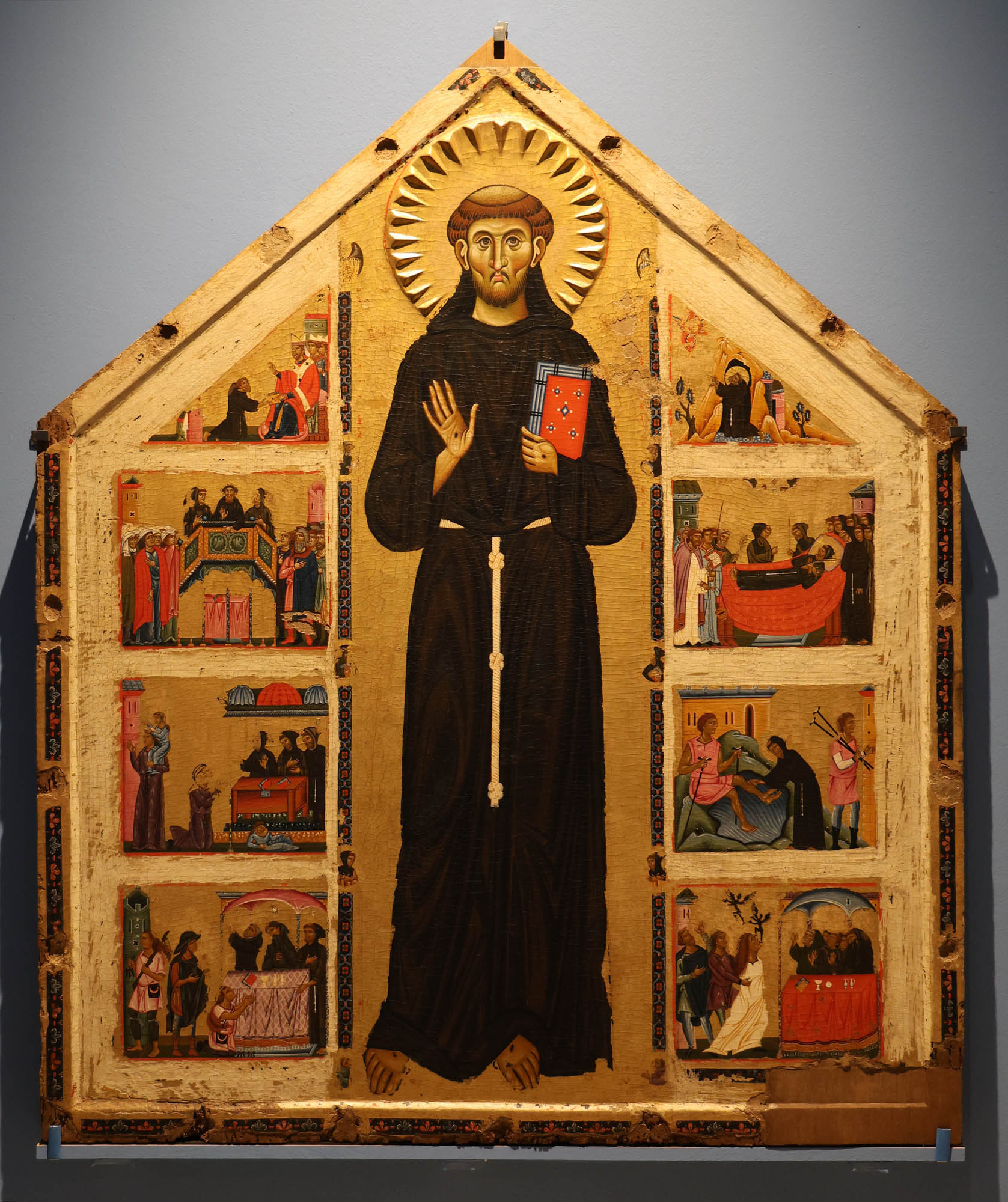
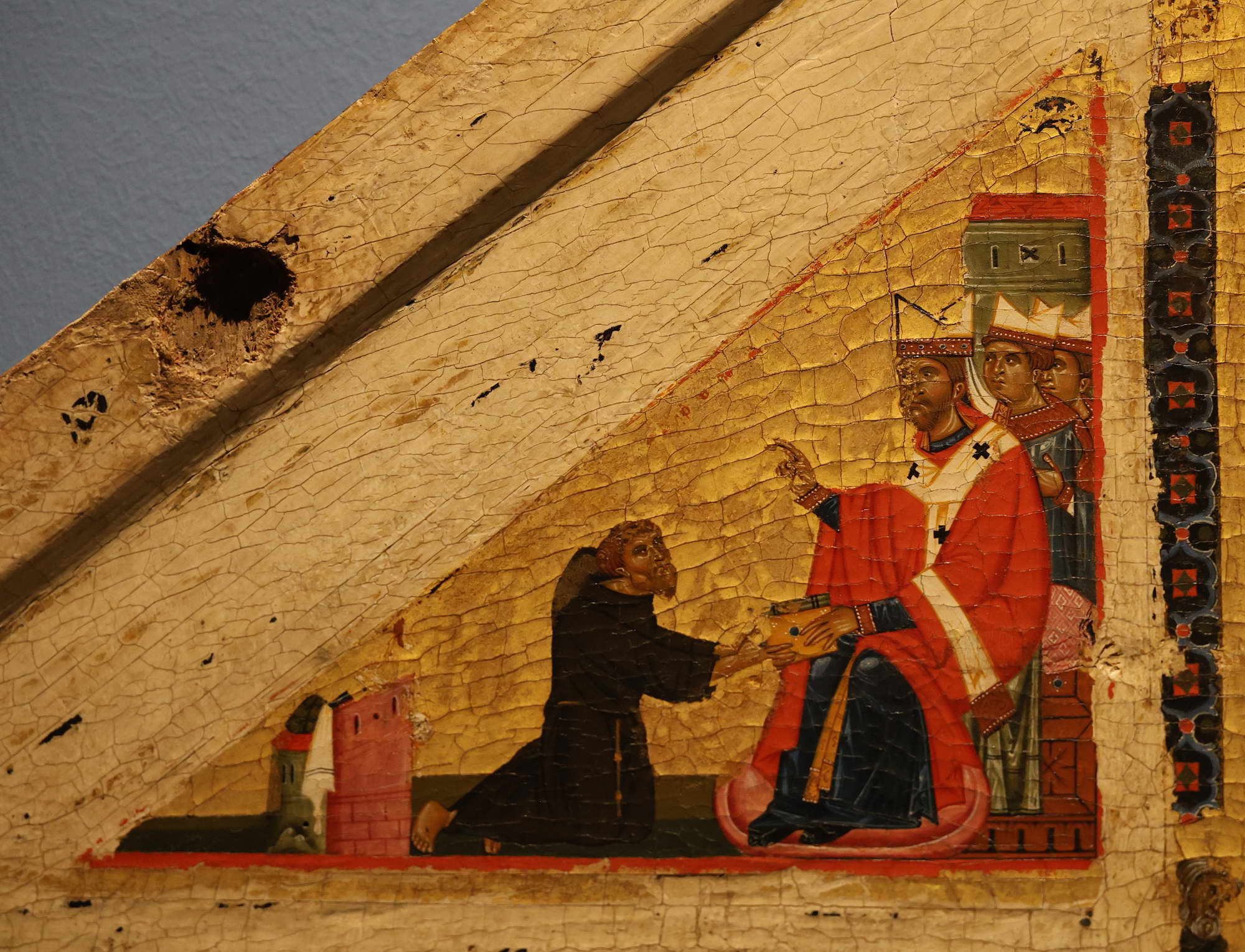
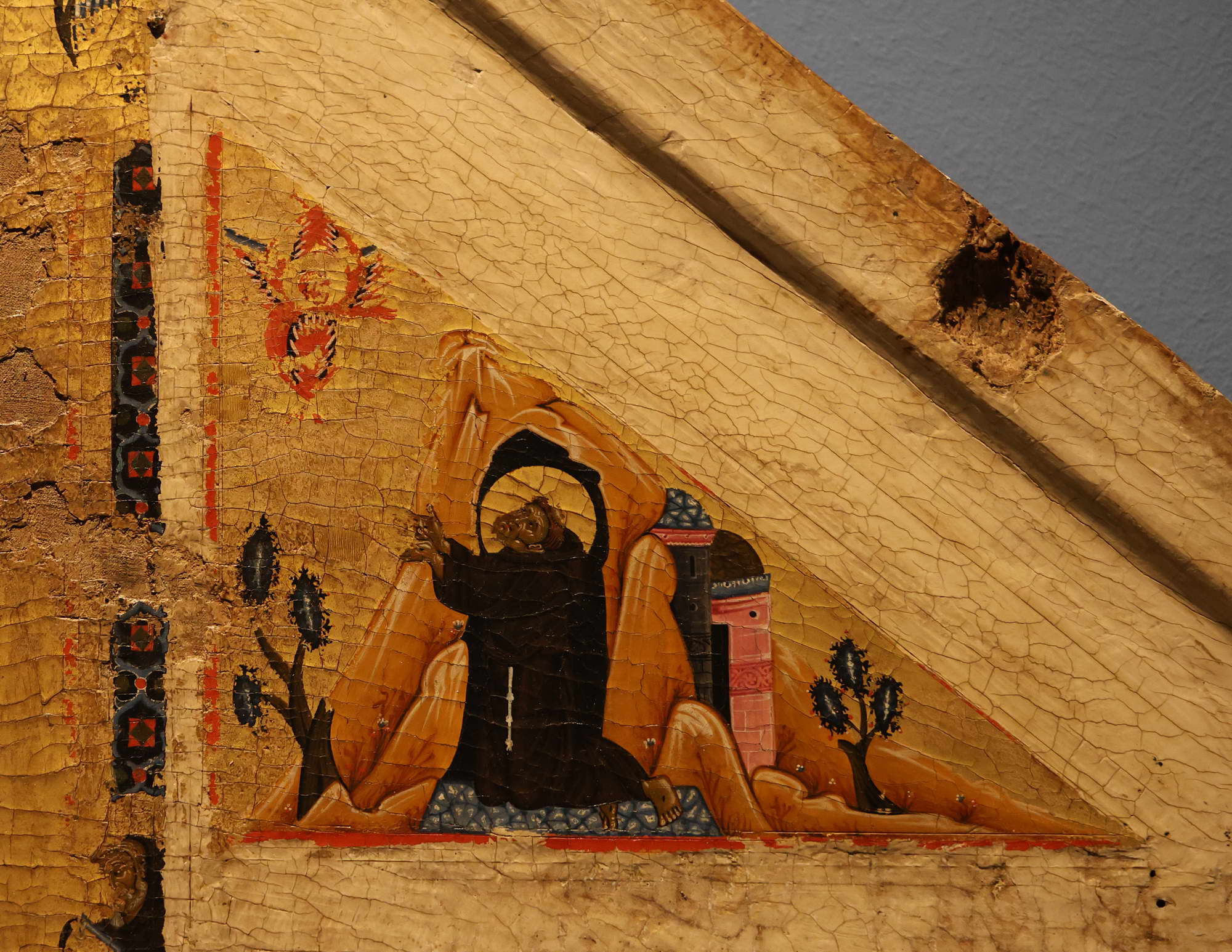
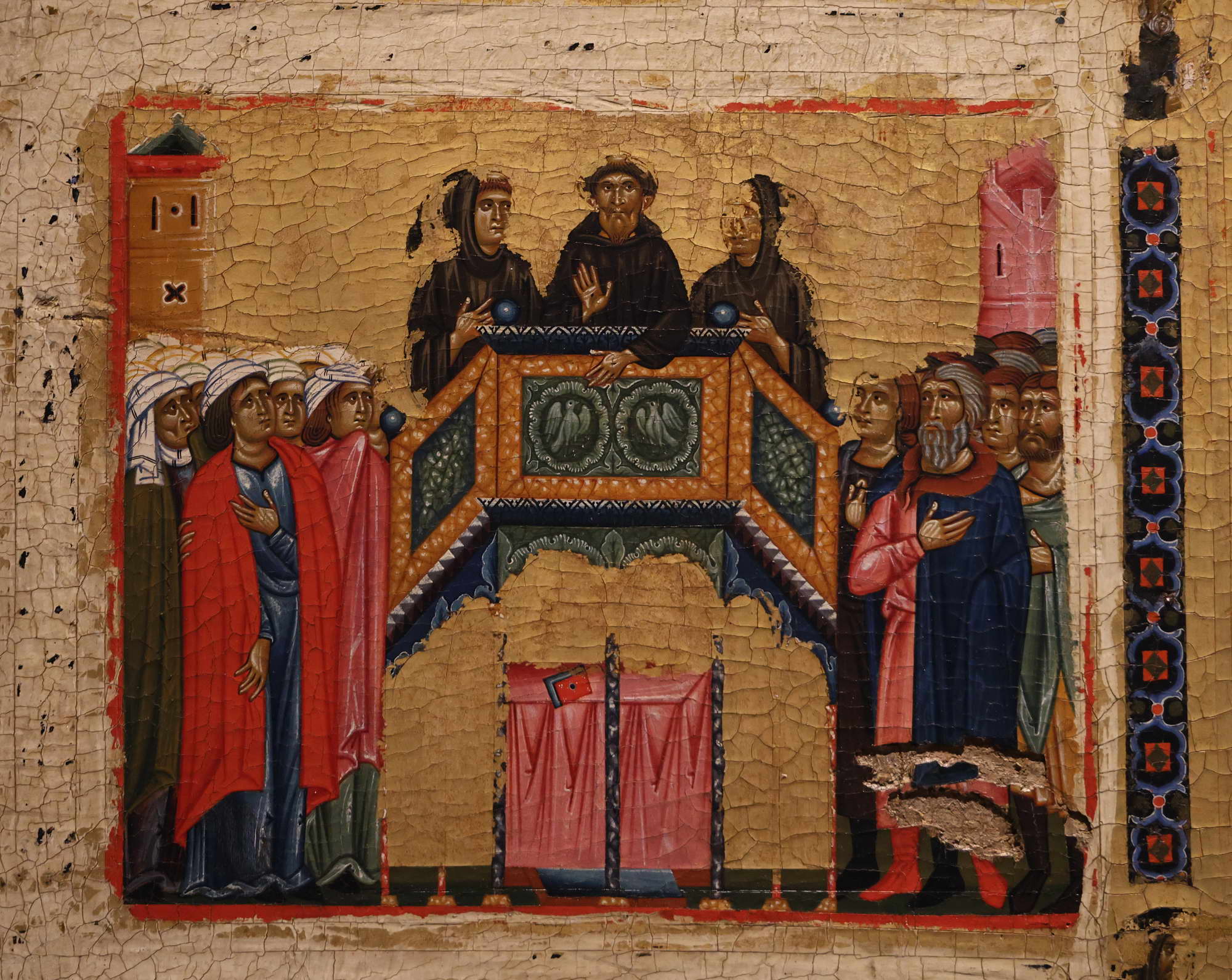
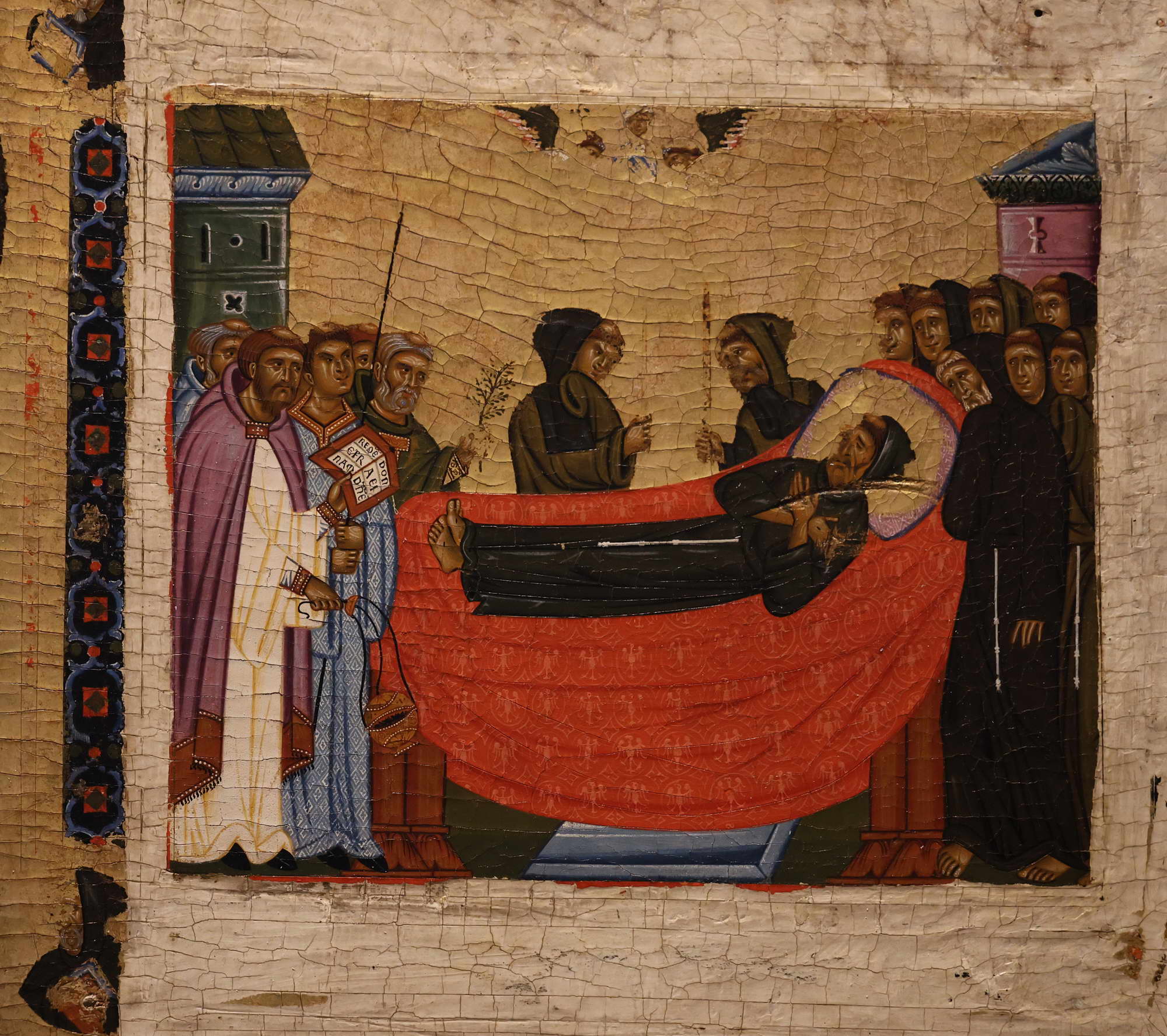
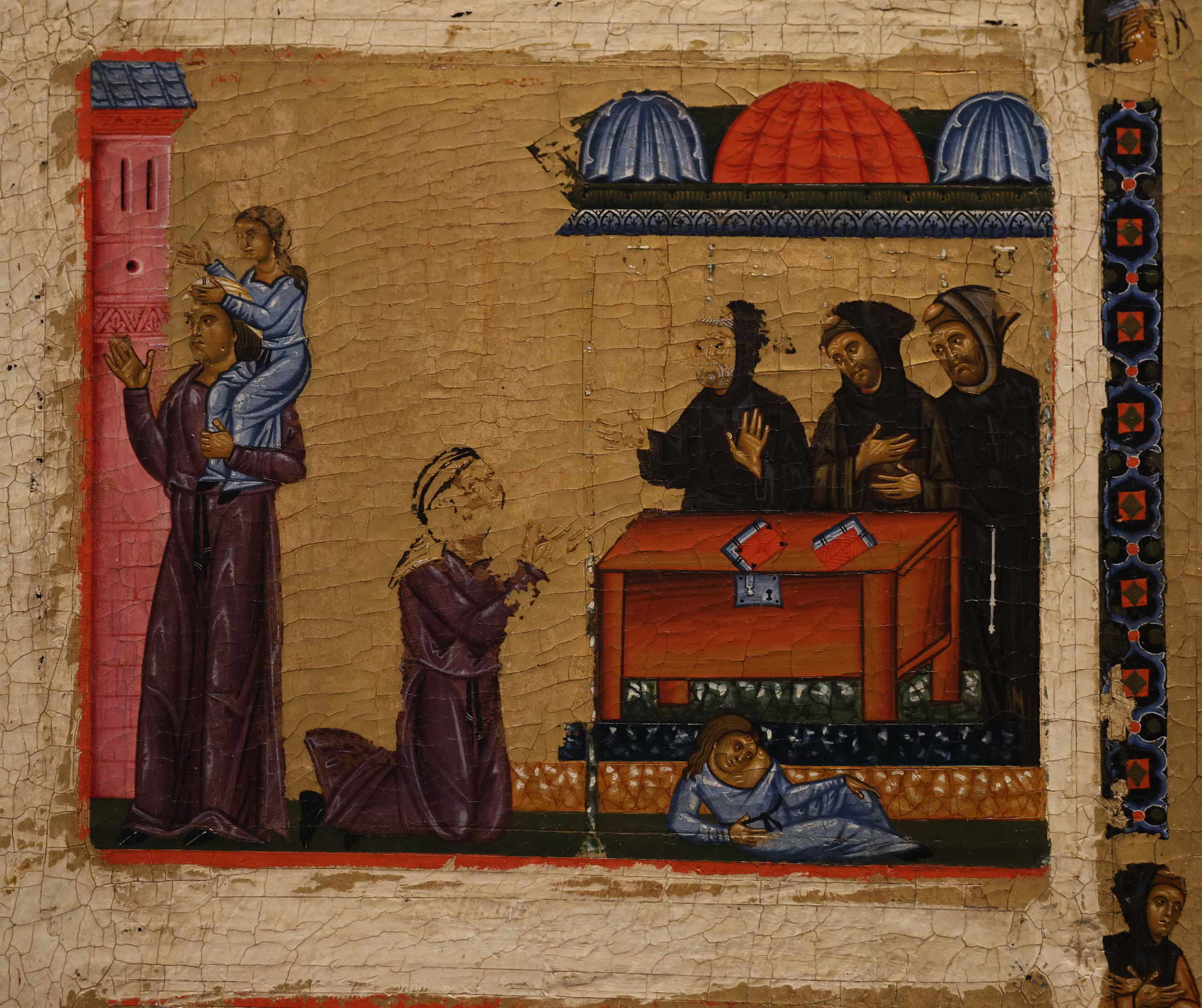
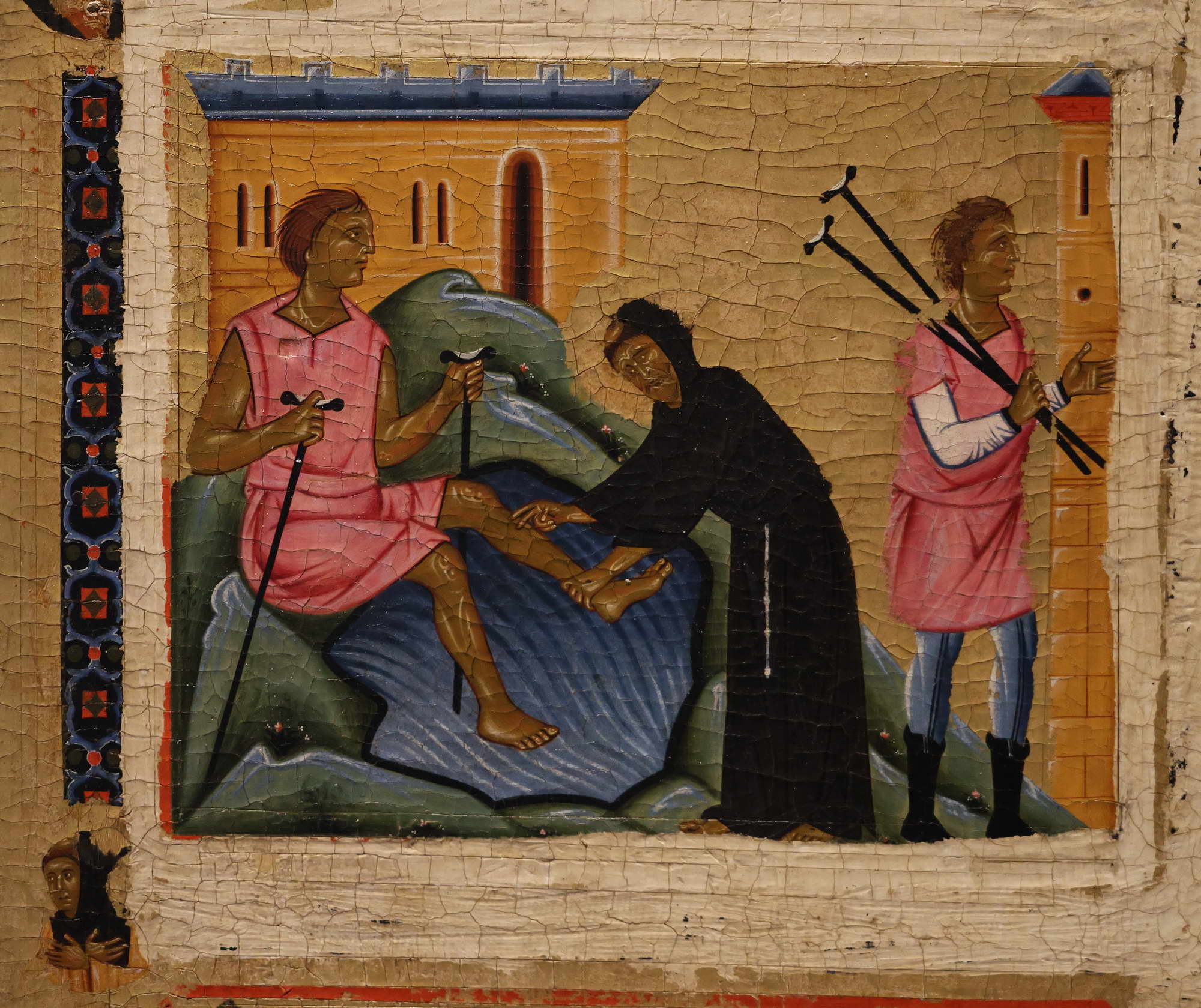
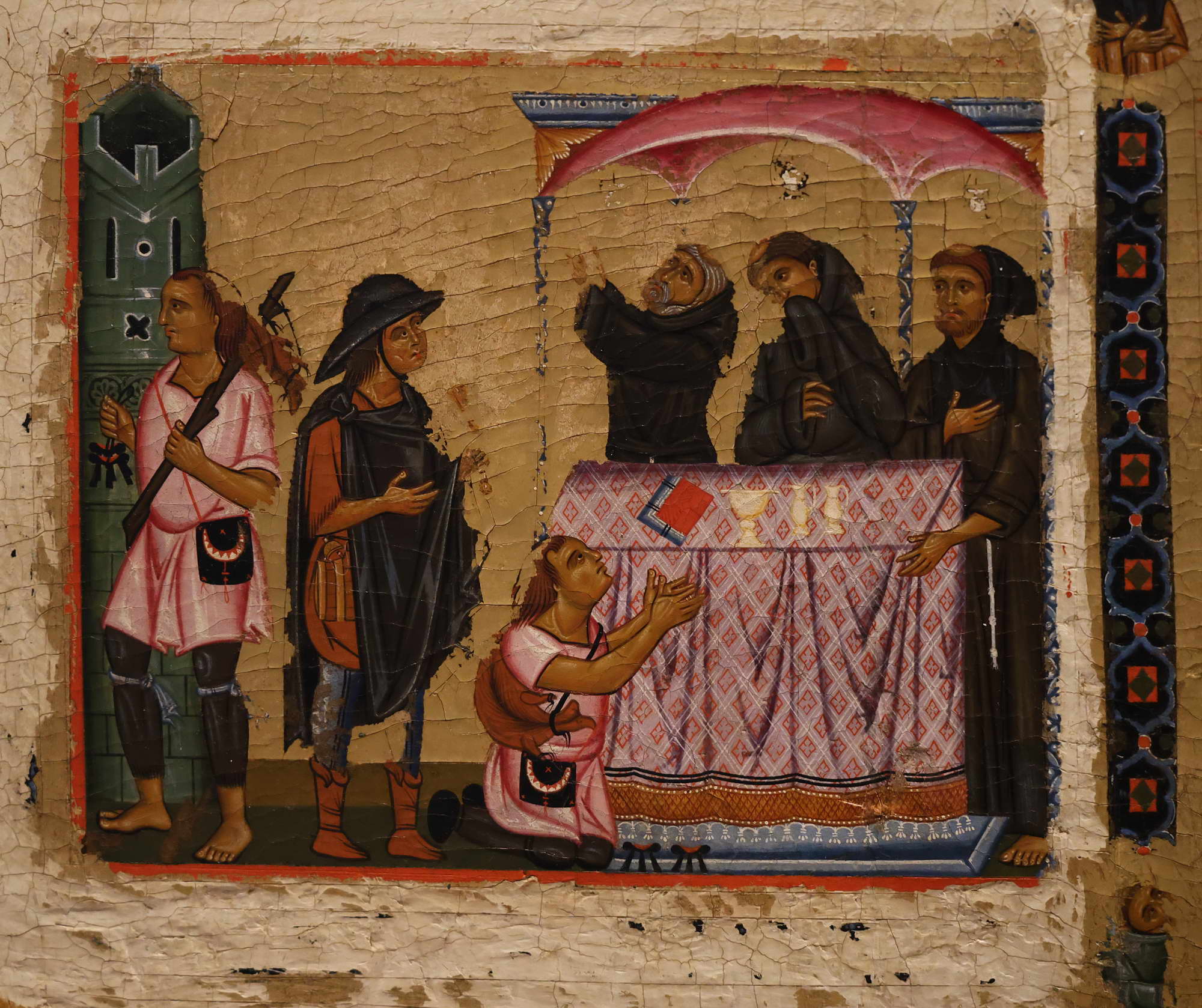
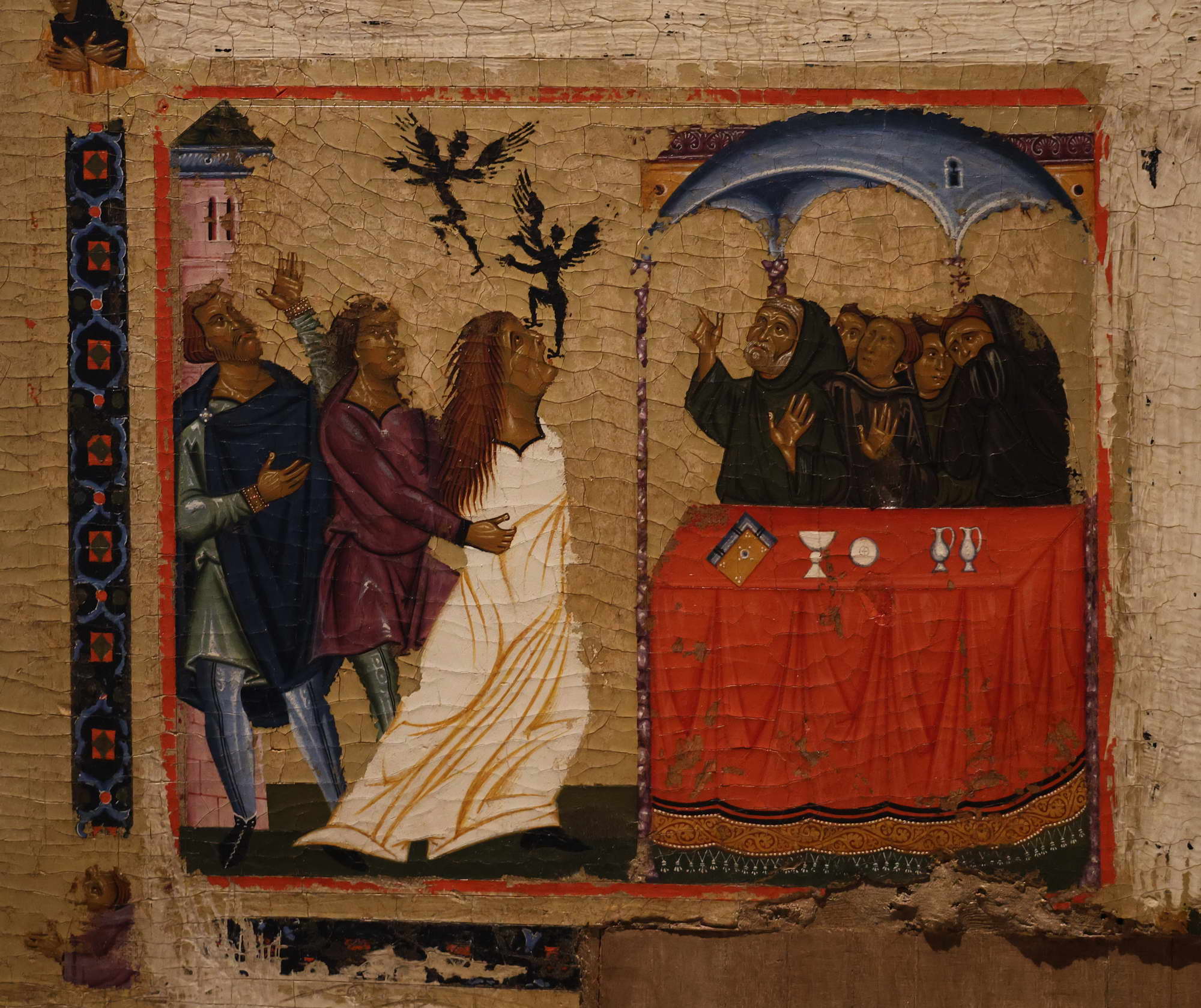
And here is the dossal from the church of San Francesco in Orte (now in the Diocesan Museum of Orte), dating from the early 1260s and attributed to the Master of the Uffizi Baptism of Saint John dossal.
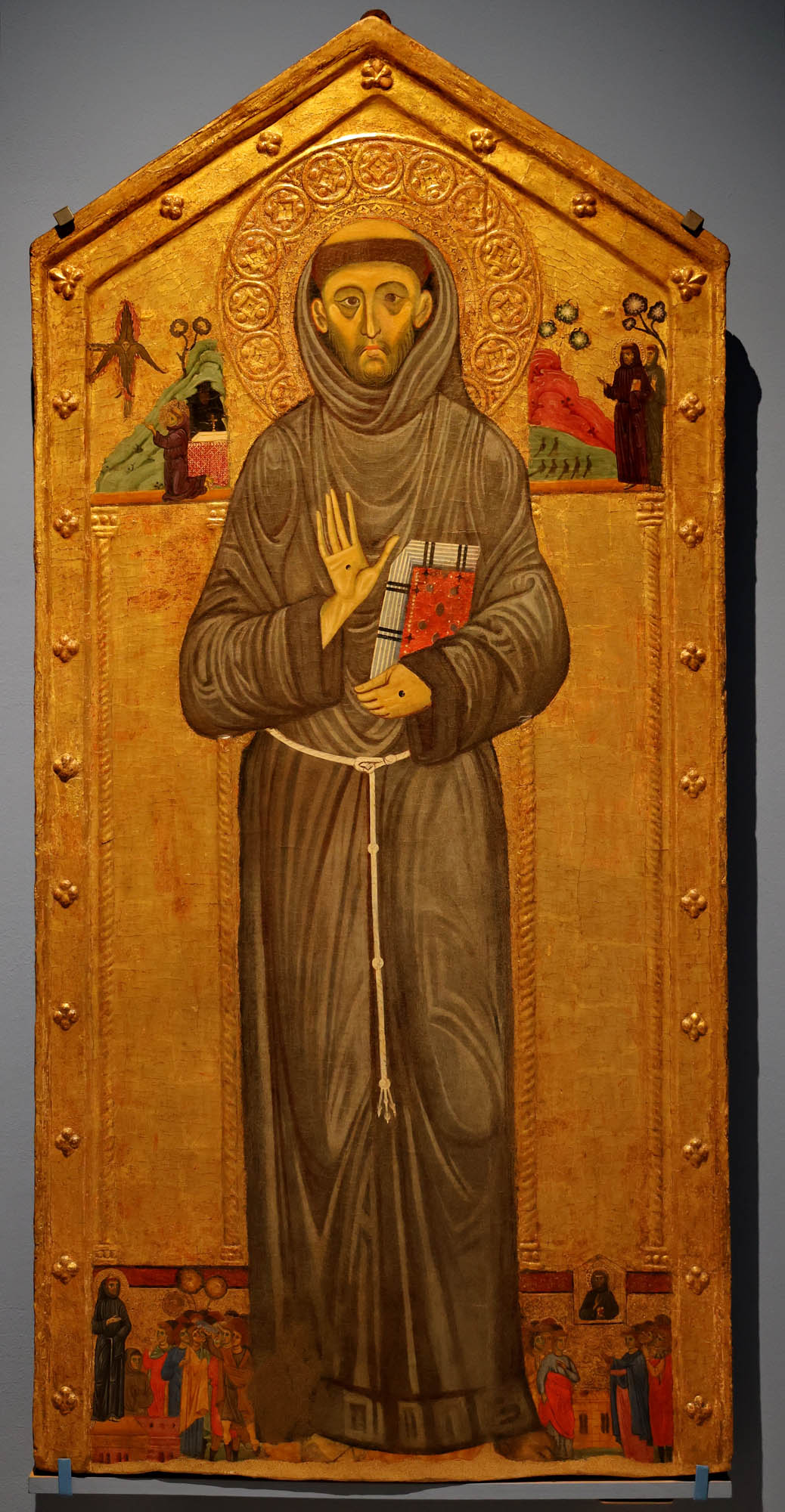
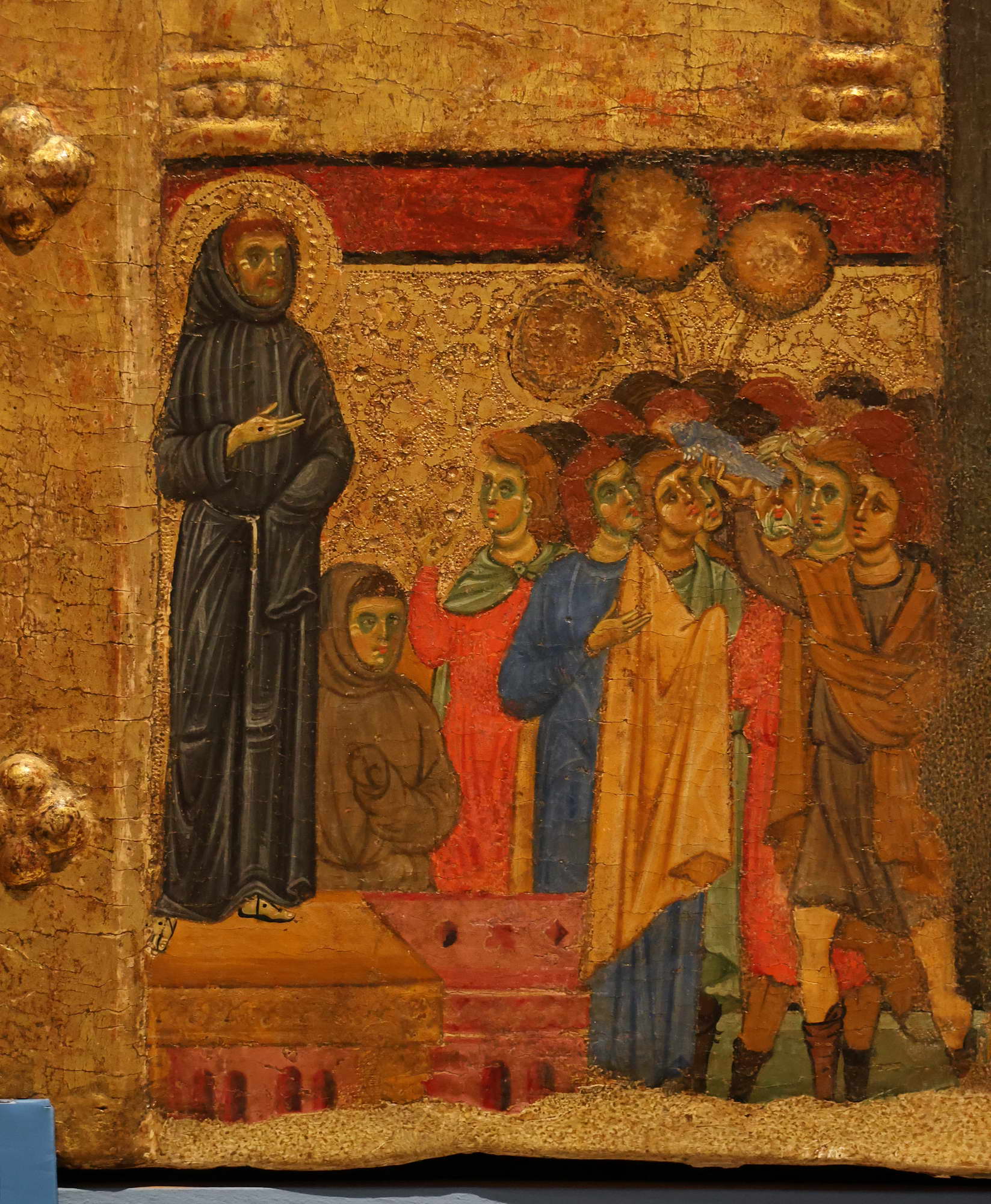
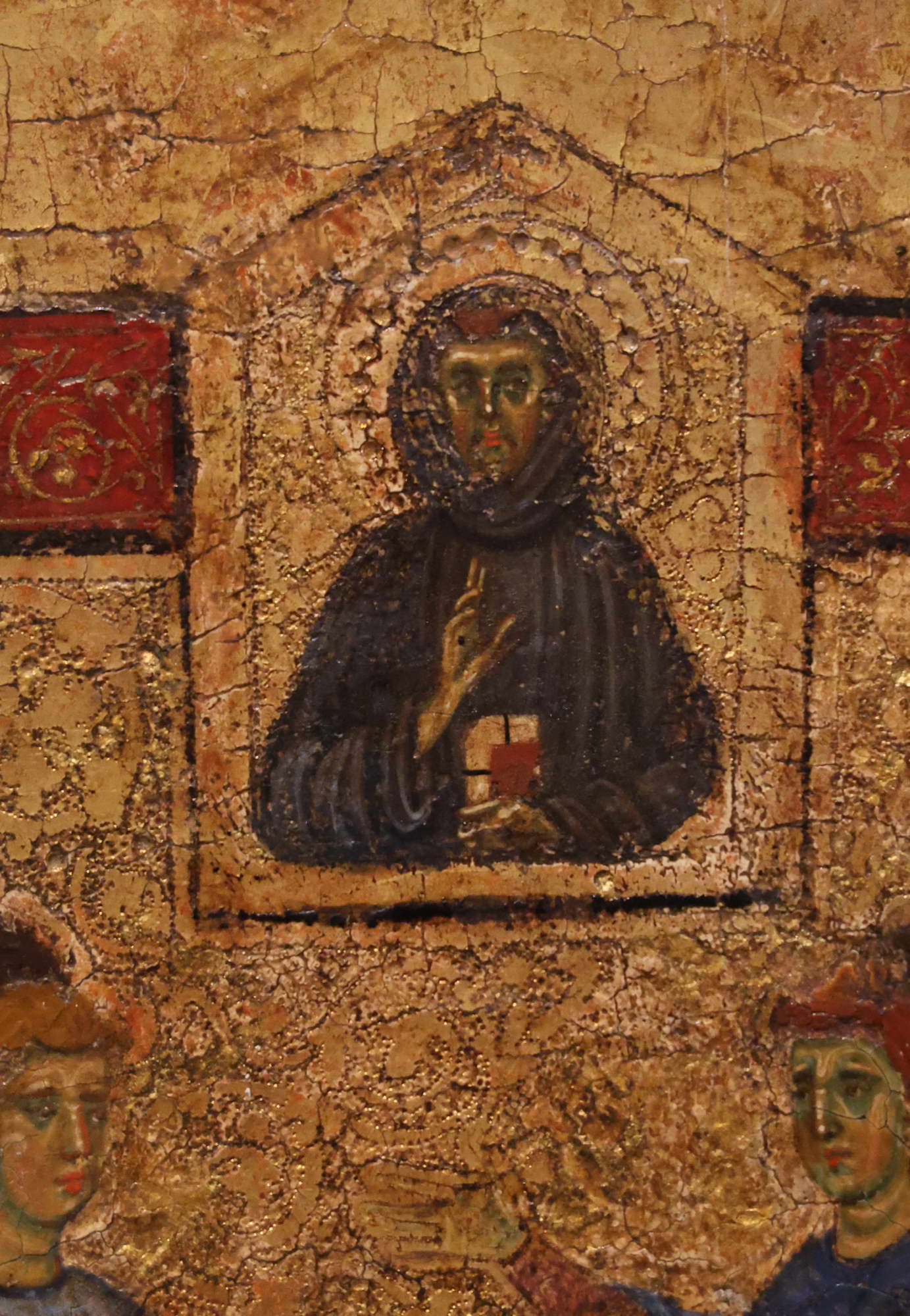
This dossal contains only four biographical scenes: two of the saint’s now familiar miracles, a third miracle that is rarely depicted, and a miraculous healing that took place after his death and is particularly interesting because of its unusual context.
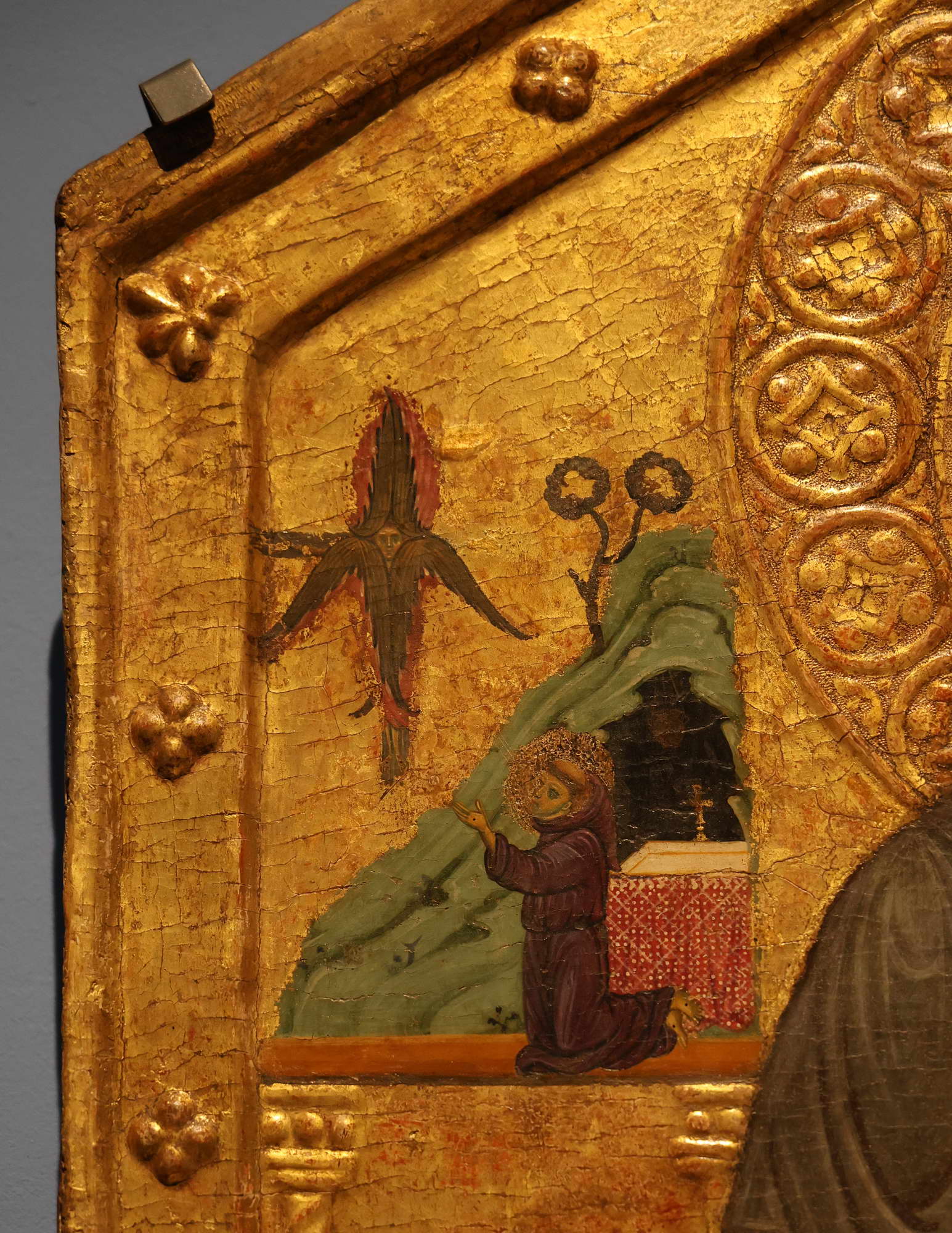 Francis receives the stigmata
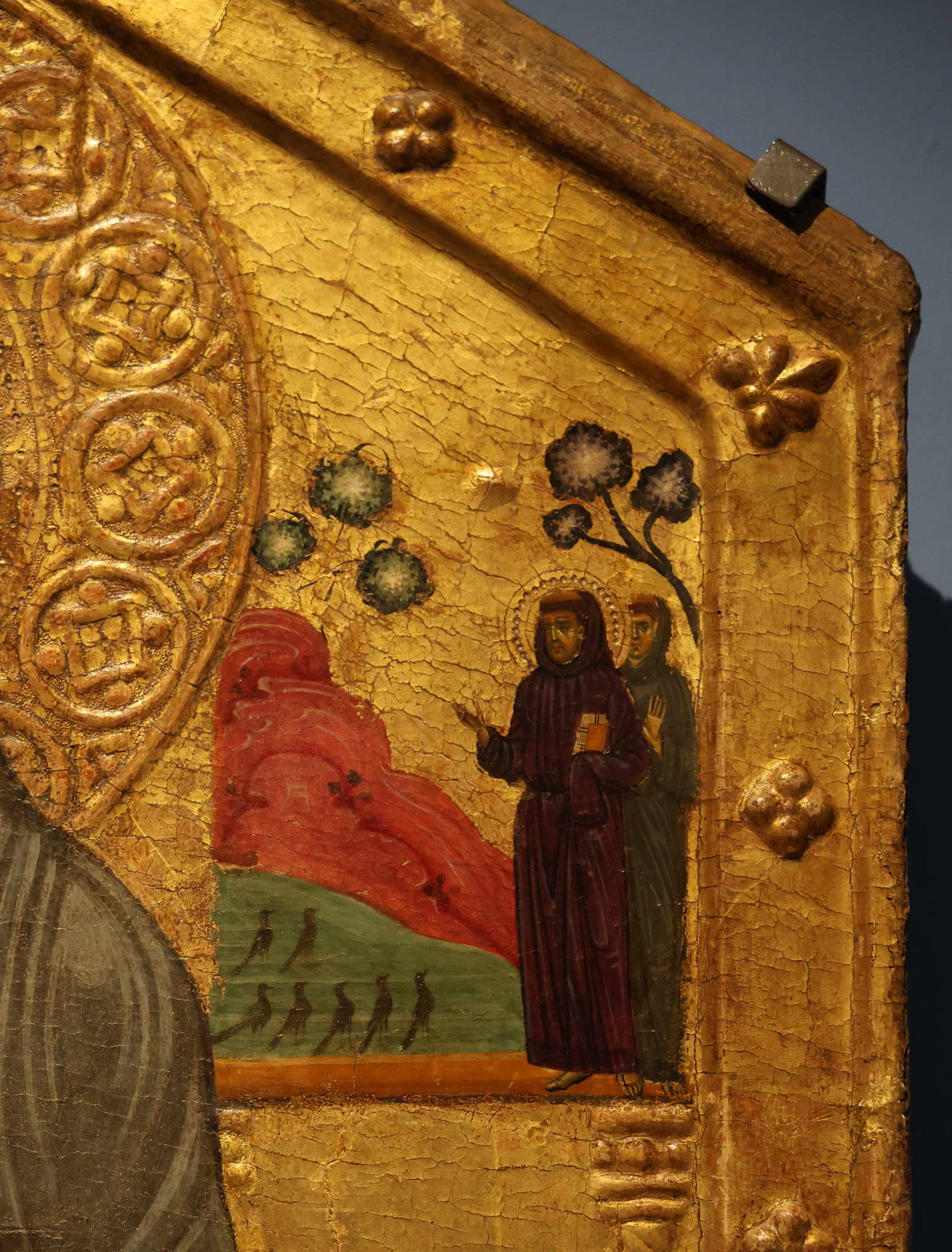 Francis preaches to the birds
 Francis levitates while praying
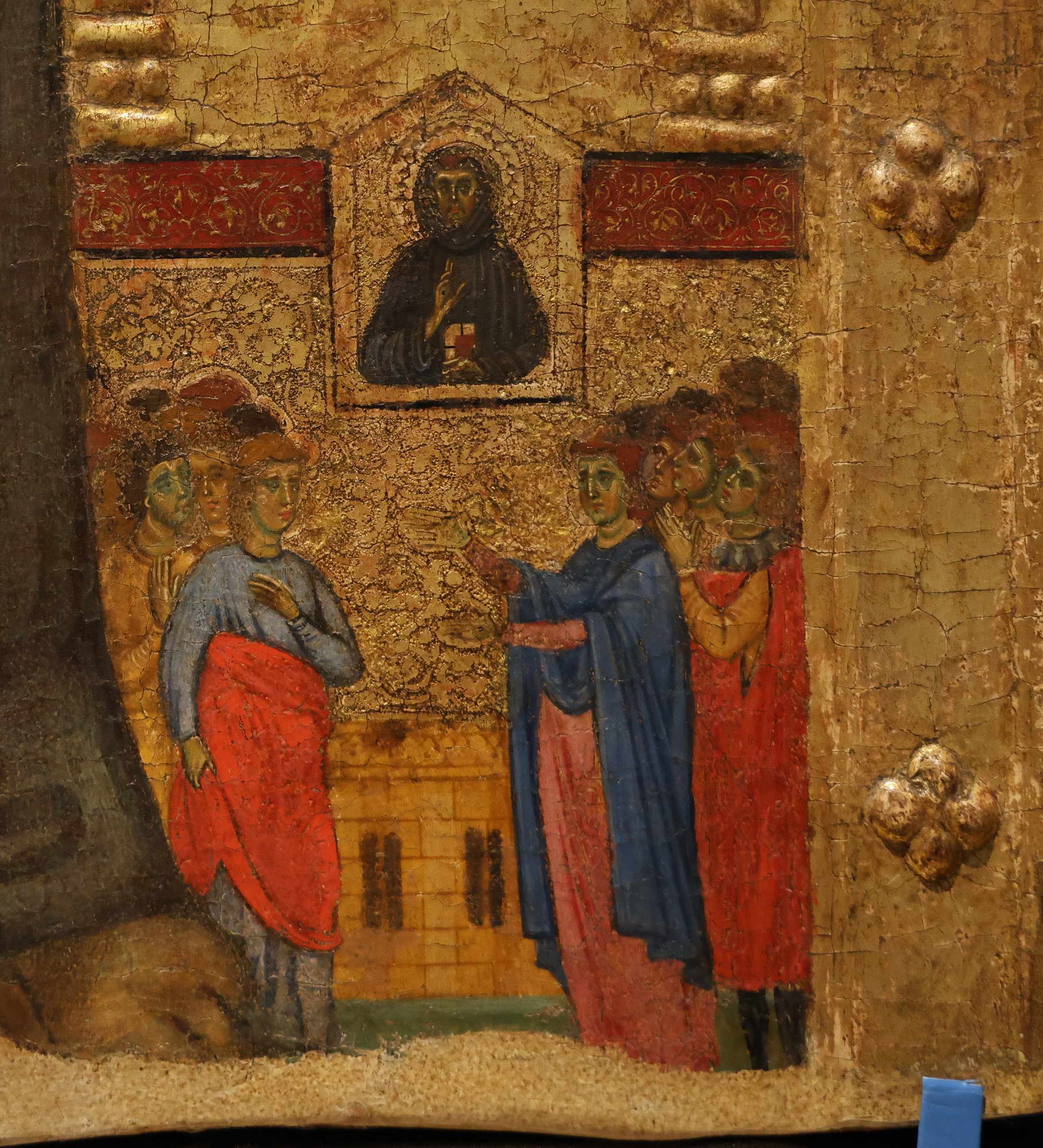 A healing before an image of Saint Francis
The final subsidiary scene is unusual because it conveys a deliberate message from the leadership of the order: there is no need to make a pilgrimage to Francis’s tomb in Assisi in search of healing. A prayer offered in a local Franciscan church, before an image of Francis like this one, can be just as effective. This move may have considerably enhanced the importance of local Franciscan communities and their ability to attract donations.
At the same time, the image serves as a visual vindication, demonstrating that these costly icons with their gold backgrounds are neither luxury objects nor idols, but sacred instruments accepted by God and endowed with real power. The Spirituals, the radical branch of the Franciscan order, argued that the Conventuals—the branch that accepted generous support from the Roman ecclesiastical hierarchy—were betraying Francis’s legacy and accumulating forbidden wealth through their splendid churches and icons. The Spirituals were eventually condemned as heretics by the Avignon popes and sent to the stake.
The most detailed vita icon, the Bardi altarpiece, was painted around 1260 by Marco da Coppovaldo for the Franciscan church of Santa Croce in Florence. He was the greatest master of Florentine painting before Cimabue. Here, the figure of the saint is already surrounded by twenty scenes. This expansion was prompted by the appearance of Tommaso da Celano’s second, much more detailed biography of Francis (1247), which placed far greater emphasis on Francis’s human side, the difficulties involved in founding the order, and specific historical events, such as his meeting with the Sultan.
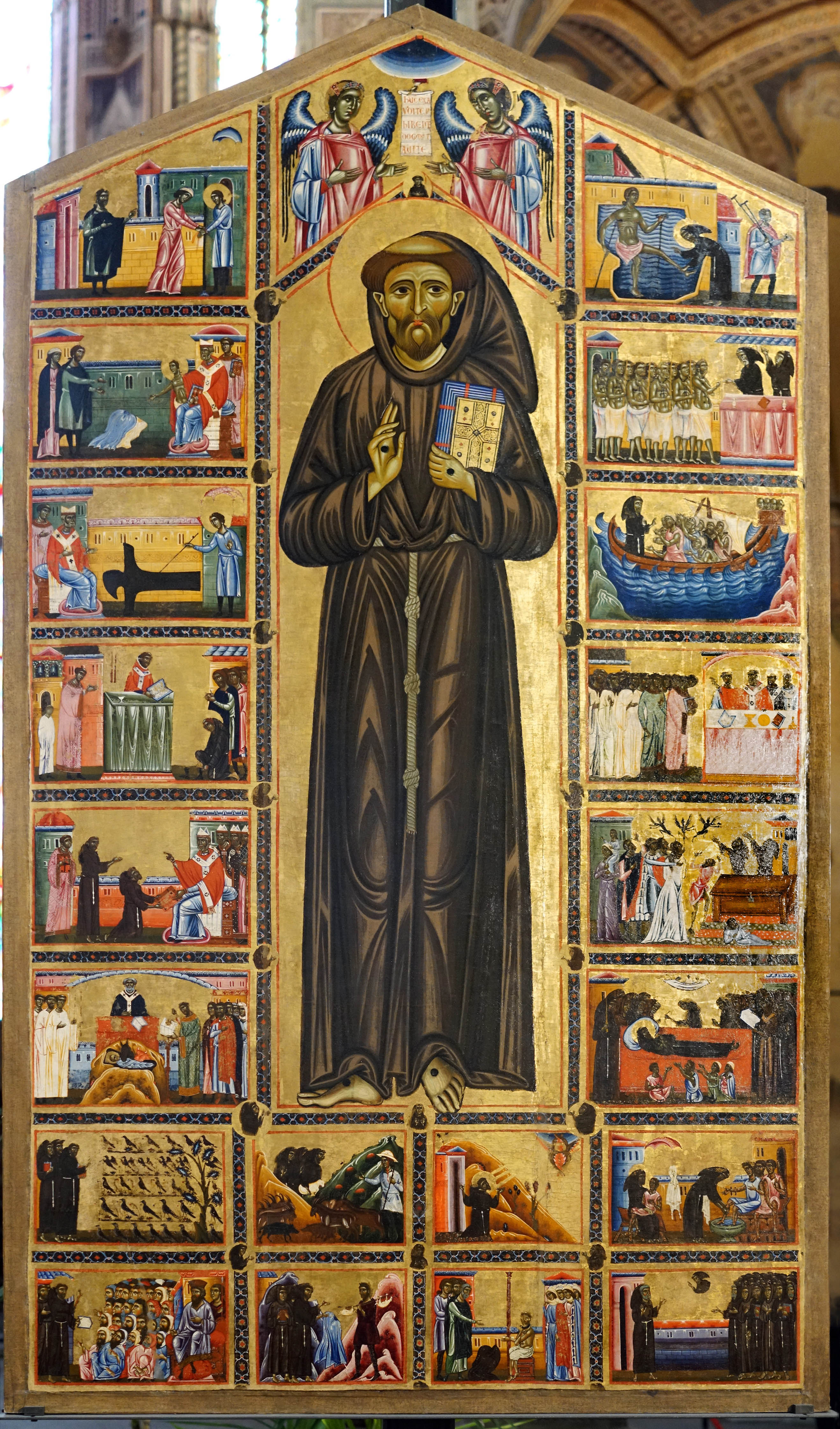
The new image functioned as a kind of biblia pauperum for the crowds flocking to the Franciscans, providing them with a basis for recounting the founder’s life in detail. This and similar cycles would later serve as the model for the twenty-eight scenes of the Life of St Francis painted by Giotto and his workshop across the two entire walls of the Upper Church in Assisi, where the golden background gives way to blue skies and white rocks, and the maniera graeca begins to open towards the Renaissance.
At the same time, however, this painting is also one of the last witnesses to a pre-censorship era. In 1257, Saint Bonaventure, born in Bagnoregio, was elected Minister General of the order. He is also revered as its “second founder”. This “second foundation” involved a complete rewriting, in retrospect, of the history of Francis and his order, in order to preserve the unity of the order and its loyalty to the Church. Bonaventure wrote the Legenda Maior, the official biography of Francis, presenting a theologically carefully constructed portrait of the founder, purged of every controversial and radical element.
• He transformed the radical barefoot lay beggar, who challenged both the ecclesiastical hierarchy and social conventions, into a figure of profound obedience to the Church, placing papal authority above all else.
• Whereas Francis had warned his brothers against intellectual arrogance, Bonaventure reduced this to mere “holy simplicity”, thereby legitimising the Franciscans’ occupation of university chairs and their ownership of libraries.
• To divert attention from the burning social controversies surrounding poverty, he placed Francis’s stigmata and mystical experiences at the centre. In his account, Francis was no longer a champion of social justice, but the Seraphic Doctor, directly chosen and marked by God: an angelic, infallible figure without contradictions.
Giotto’s Assisi cycle, based on the Legenda Maior, accordingly omits such radical elements of the Bardi altarpiece as Francis personally tending lepers or his uncompromising renunciation of property.
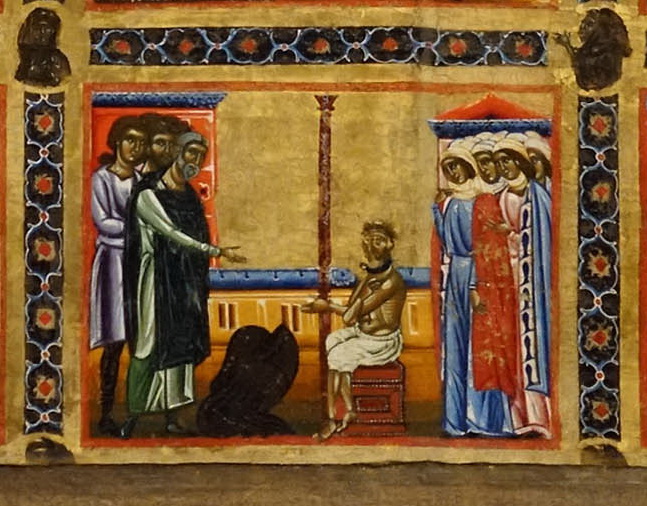 Bardi altarpiece: When illness forced Saint Francis to break his fast, he ordered Brother Peter to drag him naked through the streets of Assisi on a rope, shouting: “Look at the hypocrite, who eats meat while preaching fasting to you!” An enormous, institutionalised religious order could hardly afford to portray its founder as a madman who accused himself while being dragged along by the neck. This and other similarly radical scenes were left out of Giotto’s balanced and harmonious cycle.
From a structural point of view, the Bardi altarpiece is also the swan song of the vita icon. It was precisely the emergence of new genres that made this kind of combination of a cult image and a narrative cycle redundant. Giotto’s cycle, along with the smaller fresco cycles imitating it in other Franciscan churches, told the story of the founder’s life in vivid detail, while his story was becoming increasingly familiar through Franciscan preaching as well. By the end of the thirteenth century, therefore, Franciscan dossals stripped of biographical scenes had become the norm. The panel depicts Francis alone, in his habit and cord, holding a book in one hand – either the Bible or the Rule – while raising the other in blessing and displaying his stigmata. The type became more or less standardized, so that from one church to another the founder would appear in the same guise, like a kind of vera icon, emphasizing the unity and indivisibility of the order.
The mass demand for these standardized dossals was met by painters such as Margarito of Arezzo, two of whose works are included in the exhibition.
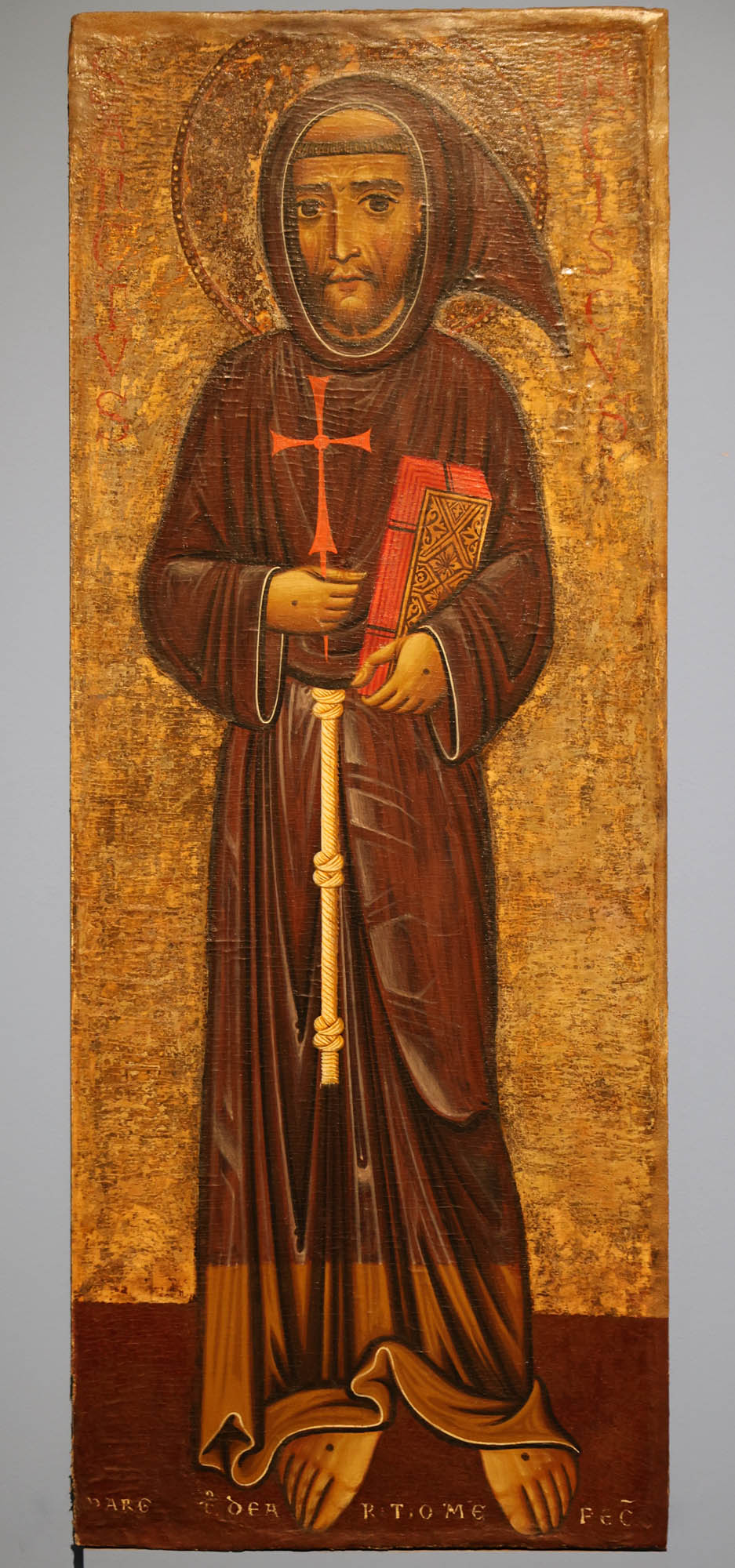 Panel from the Franciscan church in Castiglion Fiorentino, now in the local museum, c. 1250–60
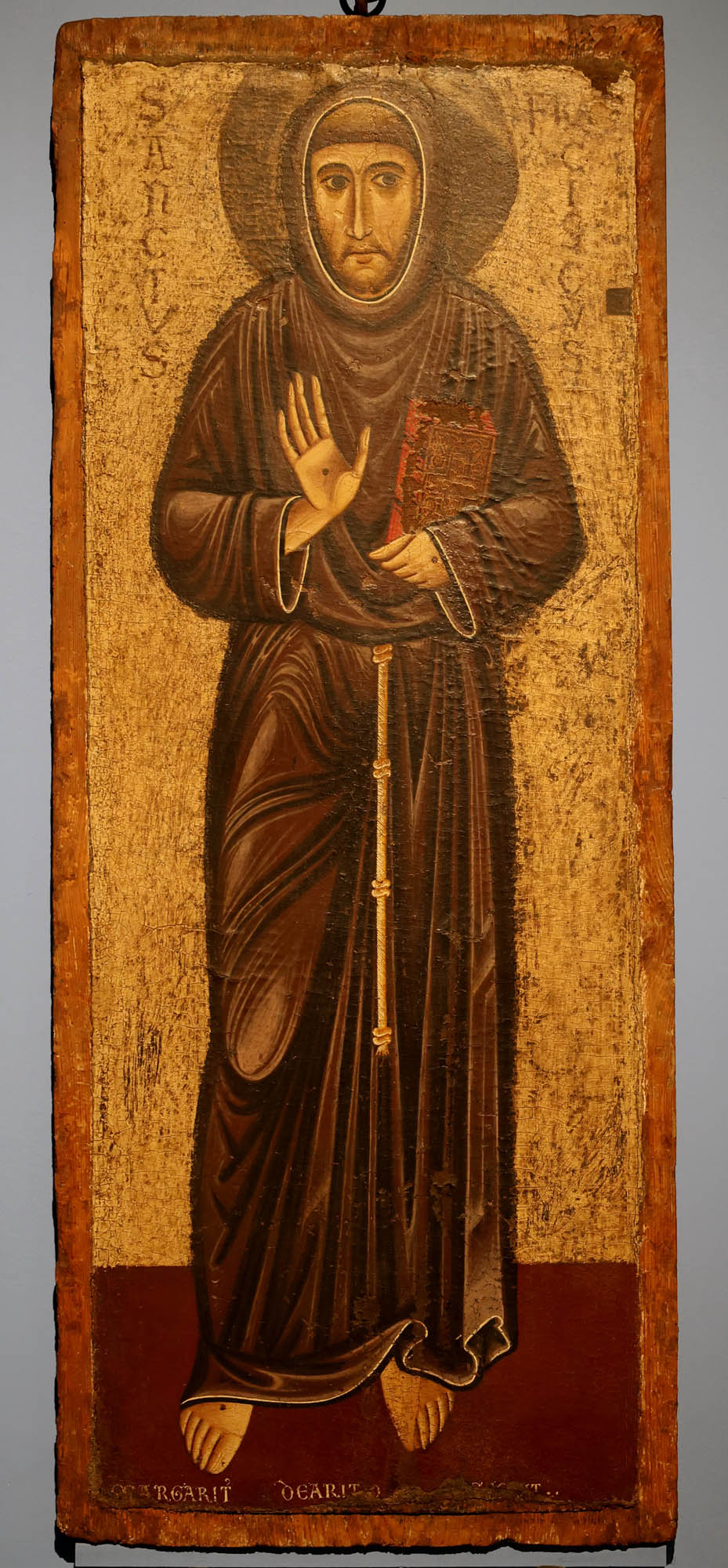 Former panel from San Francesco in Arezzo, now in the Arezzo Museum, c. 1270–80
This type would also become the standard panel image of Francis in the Trecento, as many works in the exhibition illustrate. In the hands of successive generations, ascetic Franciscan propaganda was transformed into a spiritual, meditative, lyrical portrait.
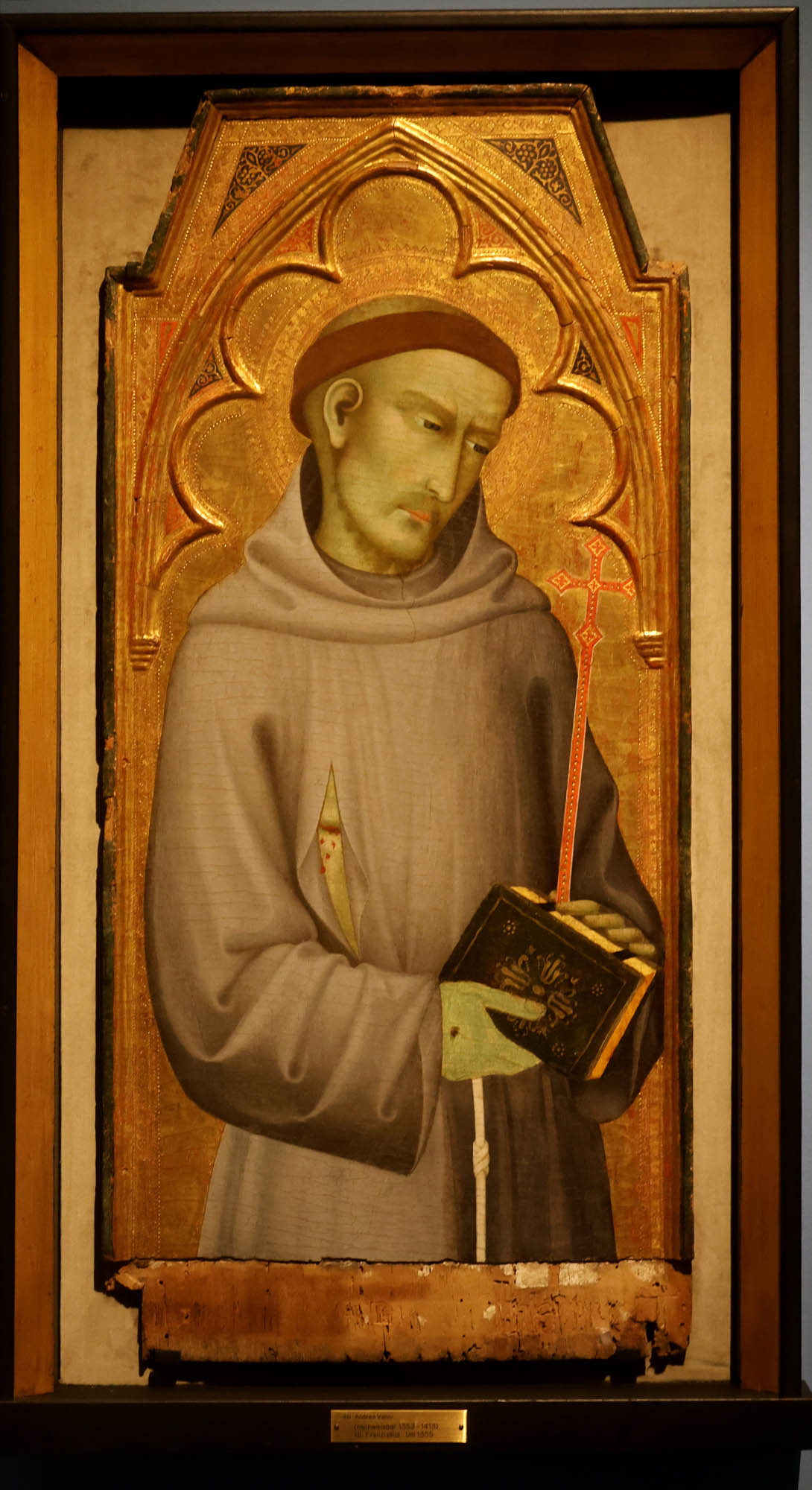 Andrea Vanni (Siena), c. 1355–60. Altenburg, Lindenau Museum
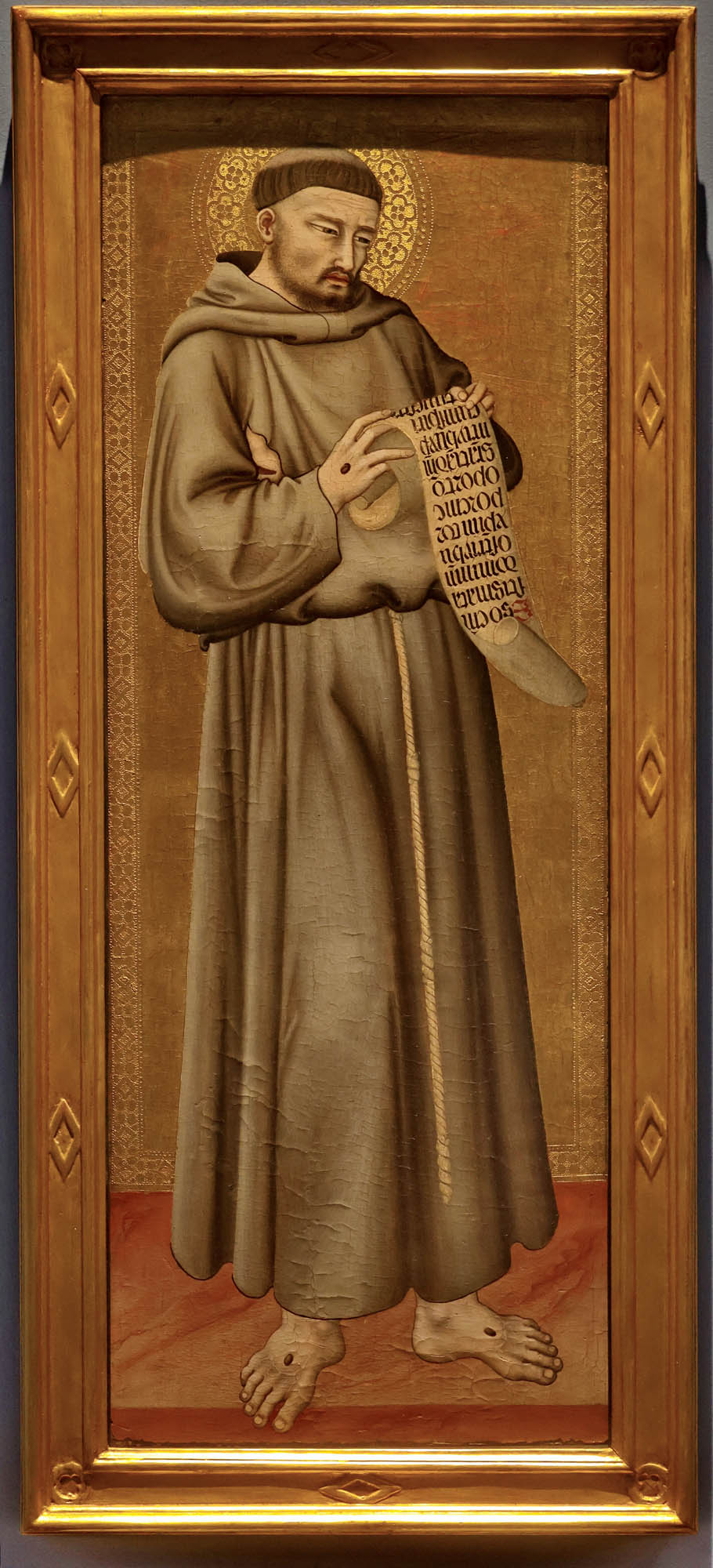 Master of the Fogg Pietà (Tuscany), c. 1340. Worcester Art Museum, Massachusetts
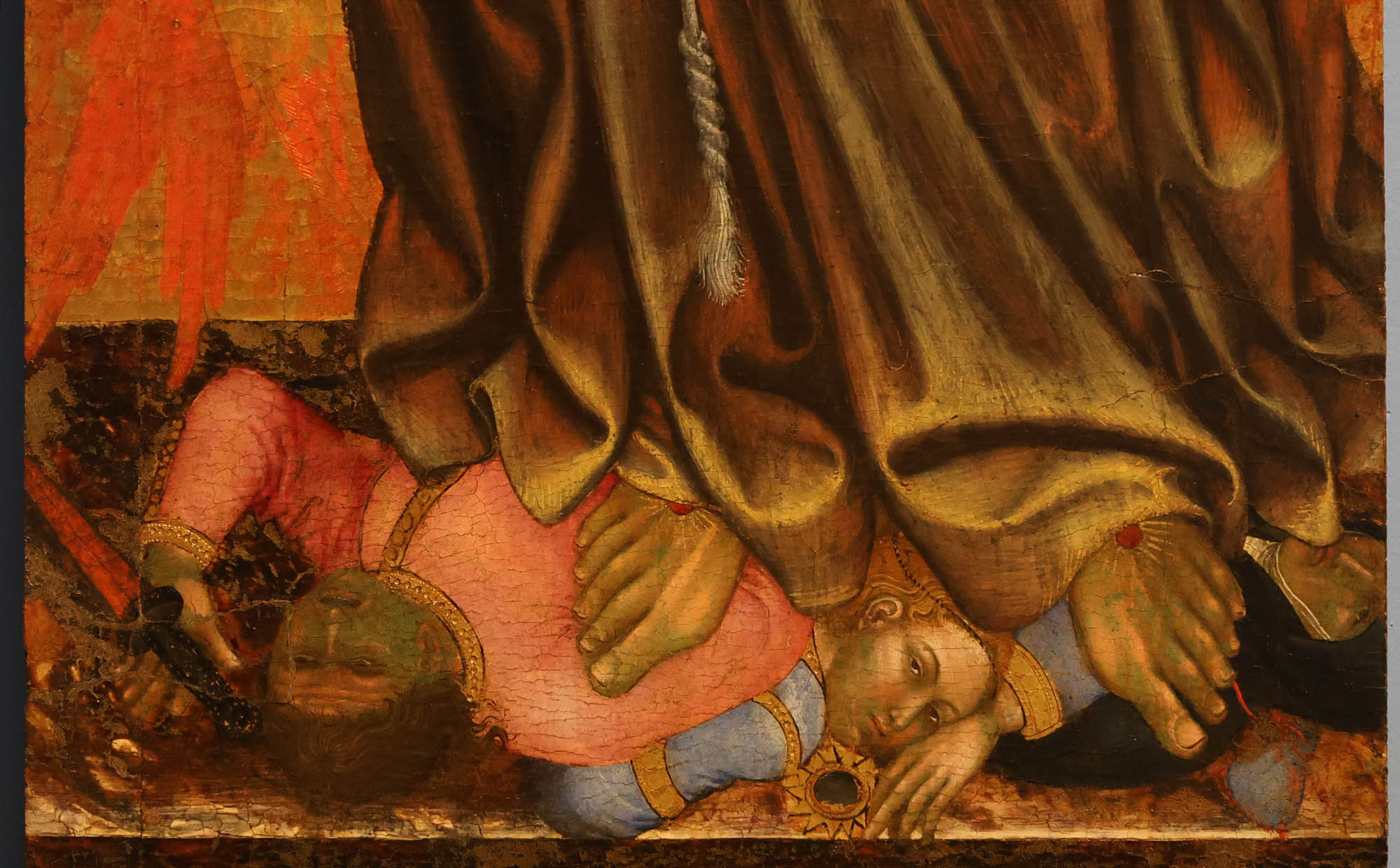
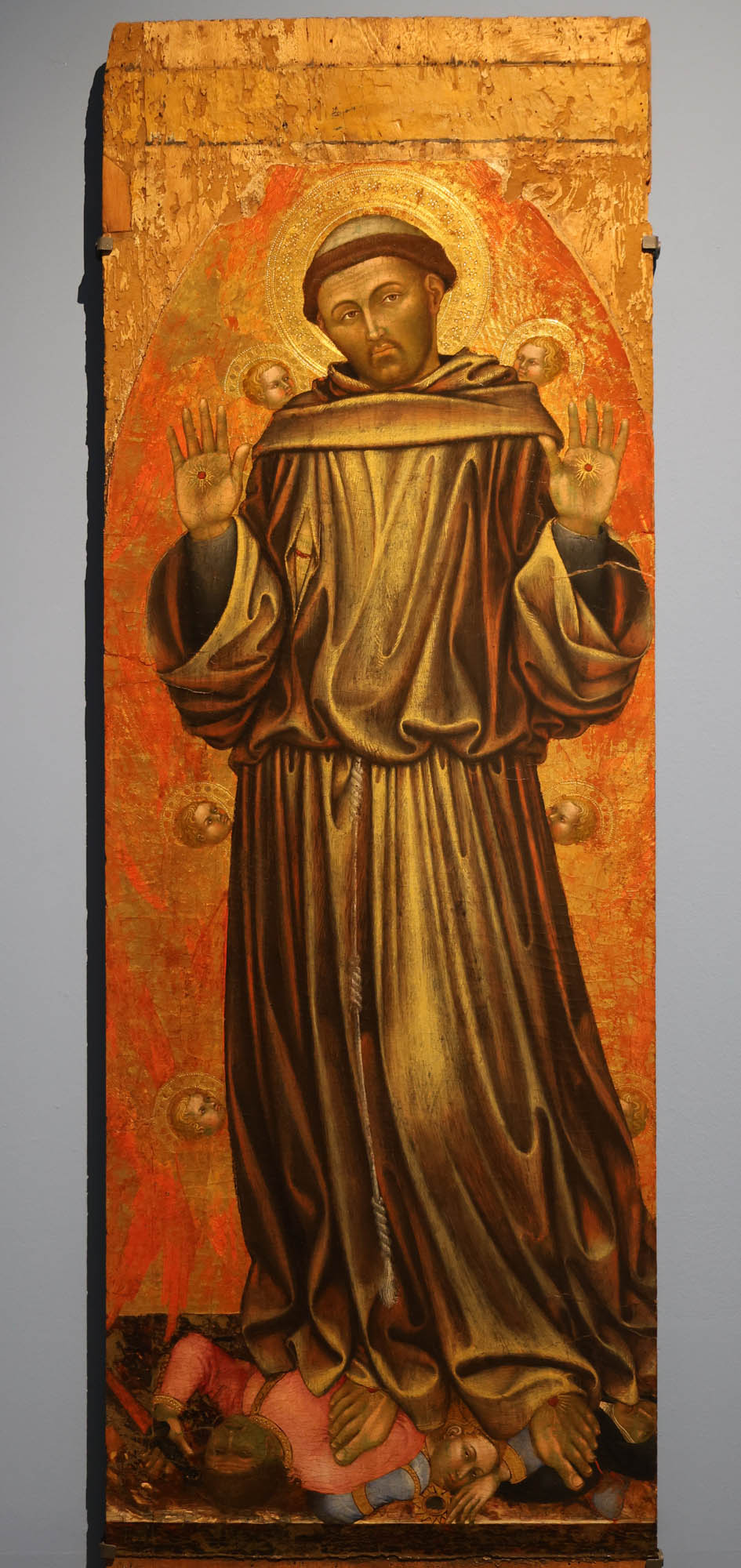 Taddeo di Bartolo (Siena), 1403: Francis tramples on Pride, Arrogance, Greed and Sloth. Perugia, Galleria Nazionale dell’Umbria
In the Quattrocento, this full-length panel type gave way to another, set within a landscape. But that is a subject for another post.
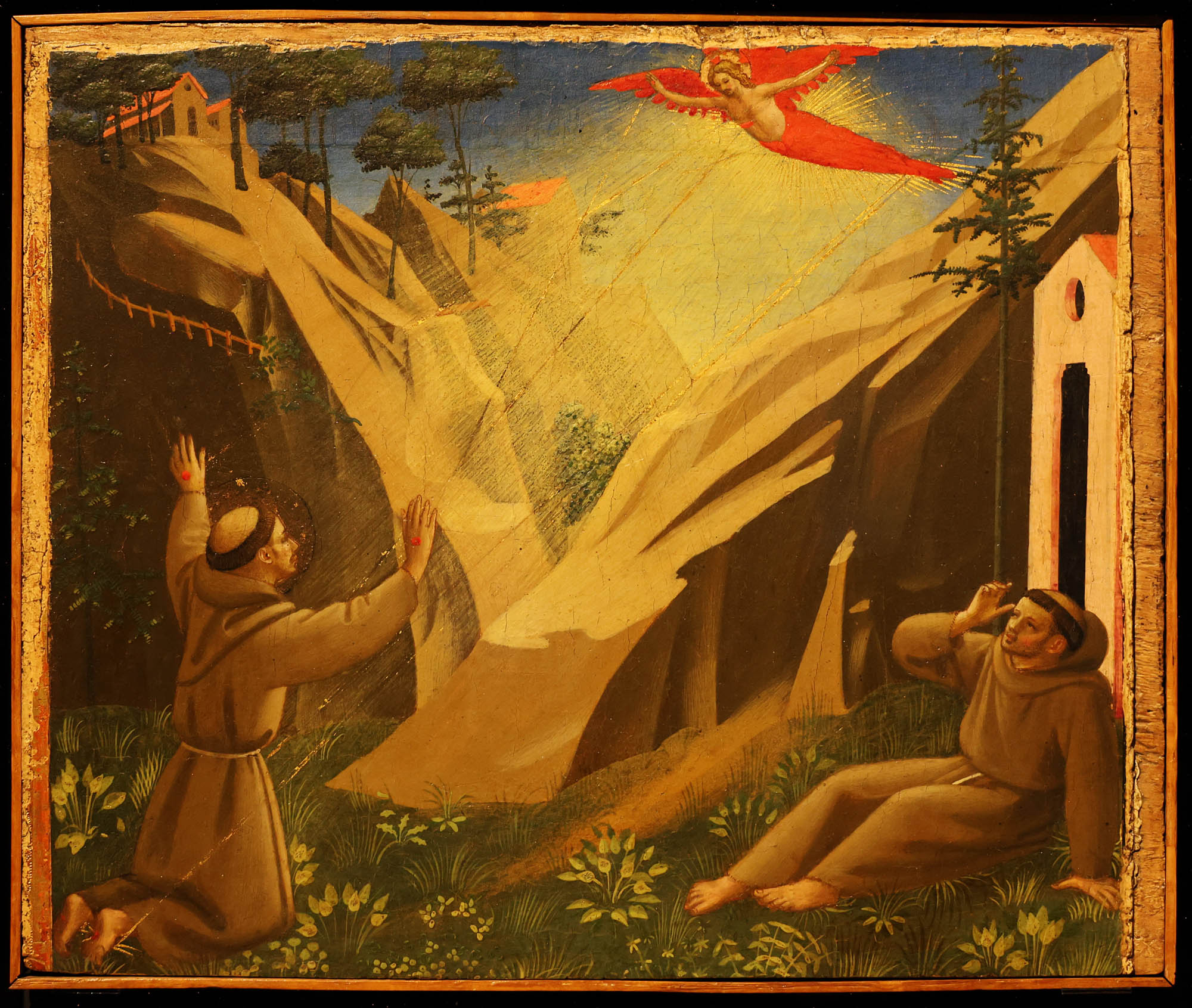 Fra Angelico: Francis receives the stigmata, c. 1428–29. Vatican Pinacoteca


Add comment