


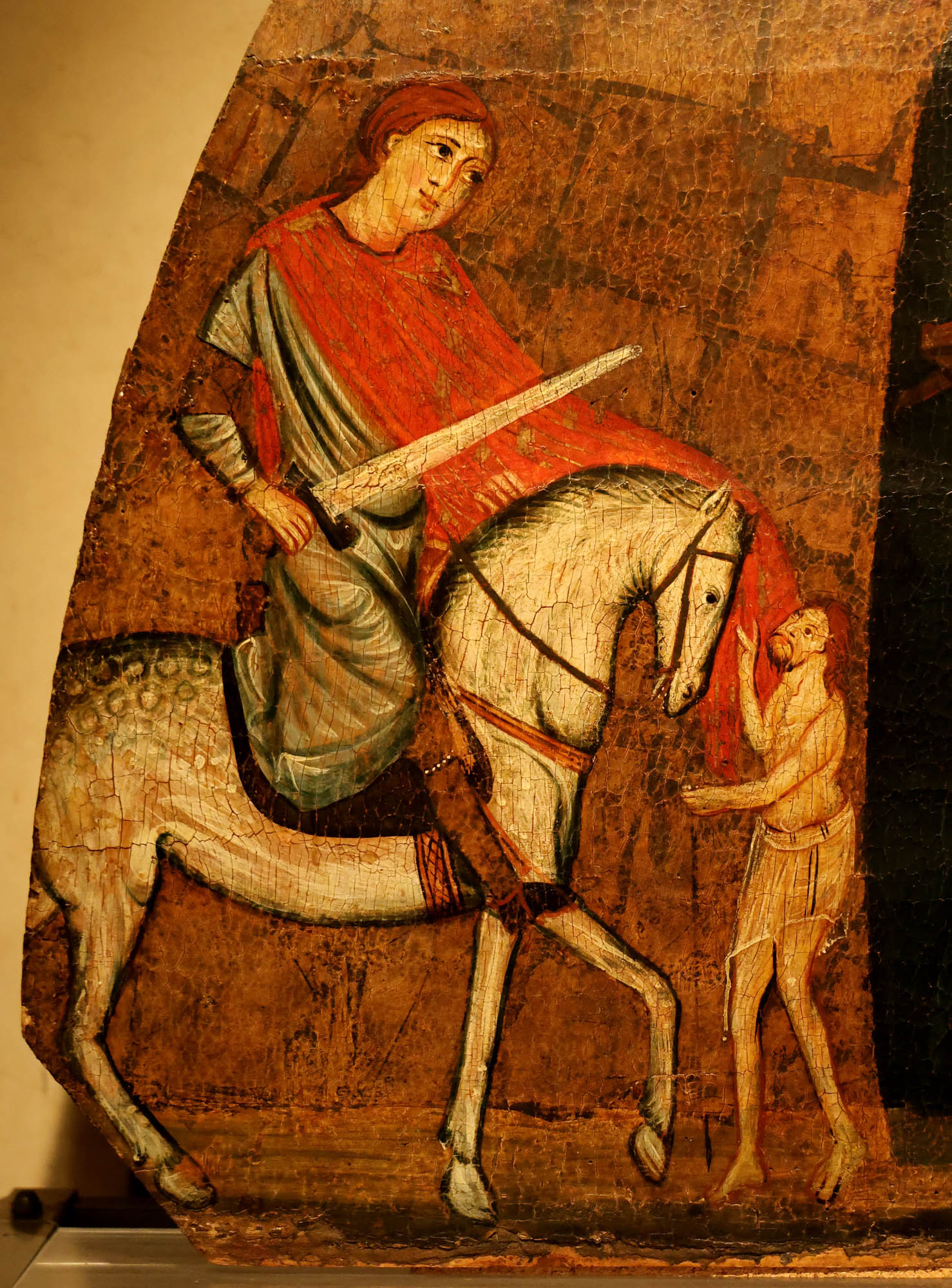
Exactly ten years ago, I began working on a book about the cult of Saint Martin and the places associated with it across Europe, to mark the 1,700th anniversary of his birth in Savaria—modern-day Szombathely—in 2017. I visited the most important of these sites and created a photographic database documenting them. But the database collapsed, and so did life, and the book was never completed. Saint Martin, however, has continued to accompany me ever since, sometimes appearing before me in the most unexpected places. And now I am gradually becoming glad that I never wrote the book, because at the time it would have been no more than an iconographic survey. Since then, I have become increasingly fascinated by a question of social history: what Saint Martin meant to different periods and regions, and how, among his many identities—soldier, pilgrim, hermit, abbot—one or another became a symbol for a particular community, and why.
Among the oldest medieval panel paintings in the picture gallery in Pisa are two that depict Saint Martin—or, perhaps more accurately, two in which Saint Martin also makes an appearance. Both portray the Madonna and Child, yet both also include Saint Martin on horseback, sharing his cloak with a beggar. The reason is that both paintings were made for the church of San Martino in Pisa. Although their patrons could not place their patron saint at the centre of the composition, they could secure a prominent place for him in the heavenly court of the Mother of God.
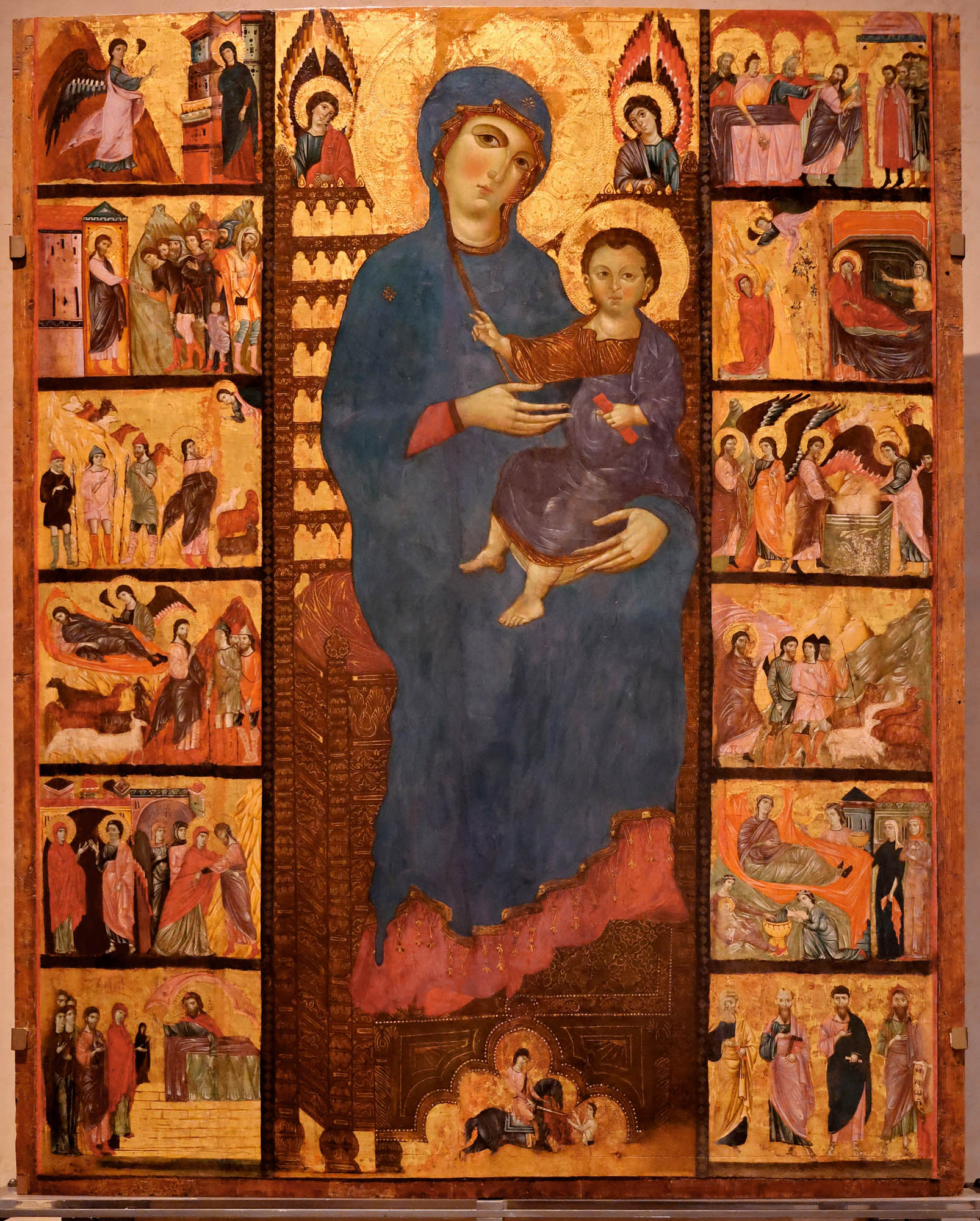 Madonna of Saint Martin, with scenes from the lives of Saints Anne and Joachim, c. 1250–1260
In thirteenth-century Italy, only Christ could occupy the high altar, either alone or as a child in Mary’s lap, as a testament to the Incarnation. The saints, who served merely as intercessors between humanity and God, could appear only in visually subordinate positions. Patrons found a way to give their own patron saints a place of prominence by expanding the altarpiece into a heavenly court, a Maestà, or by placing additional panels beside the central image, thus creating the polyptych. In this way, patron saints were given VIP seats in the throne room of Christ and his mother. Such was the case with Saint Martin in the two paintings from the church of San Martino in Pisa: in one, he stands directly before the throne; in the other, beside it, on an equal footing with Saint John the Evangelist, who is just writing down in his book the words “In the beginning was the Word…” as testimony to the Incarnation.
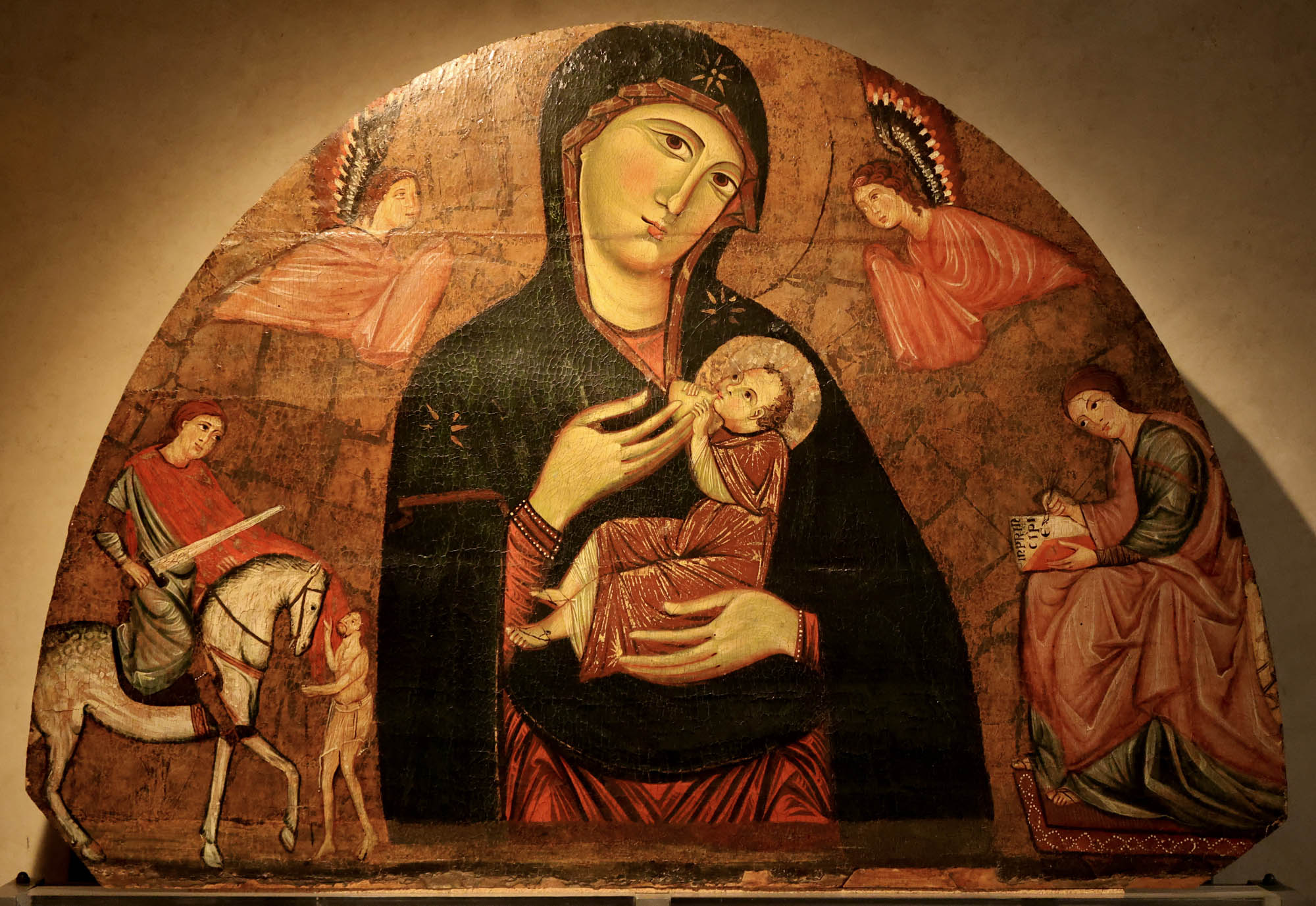 Madonna Lactans with Saint Martin and Saint John the Evangelist, second half of the thirteenth century
Why was Saint Martin so important to the people of Pisa?
Early medieval Pisa developed on the northern side of the River Arno. The area south of the river was initially a rural, marshy suburb, and it was only in the twelfth century that it began to grow into Pisa's artisan quarter. At first, the entire district was known as Chinzica; in the fourteenth century, it was divided into the quarters of Sant'Antonio and San Martino, each centred on a church bearing the same name.
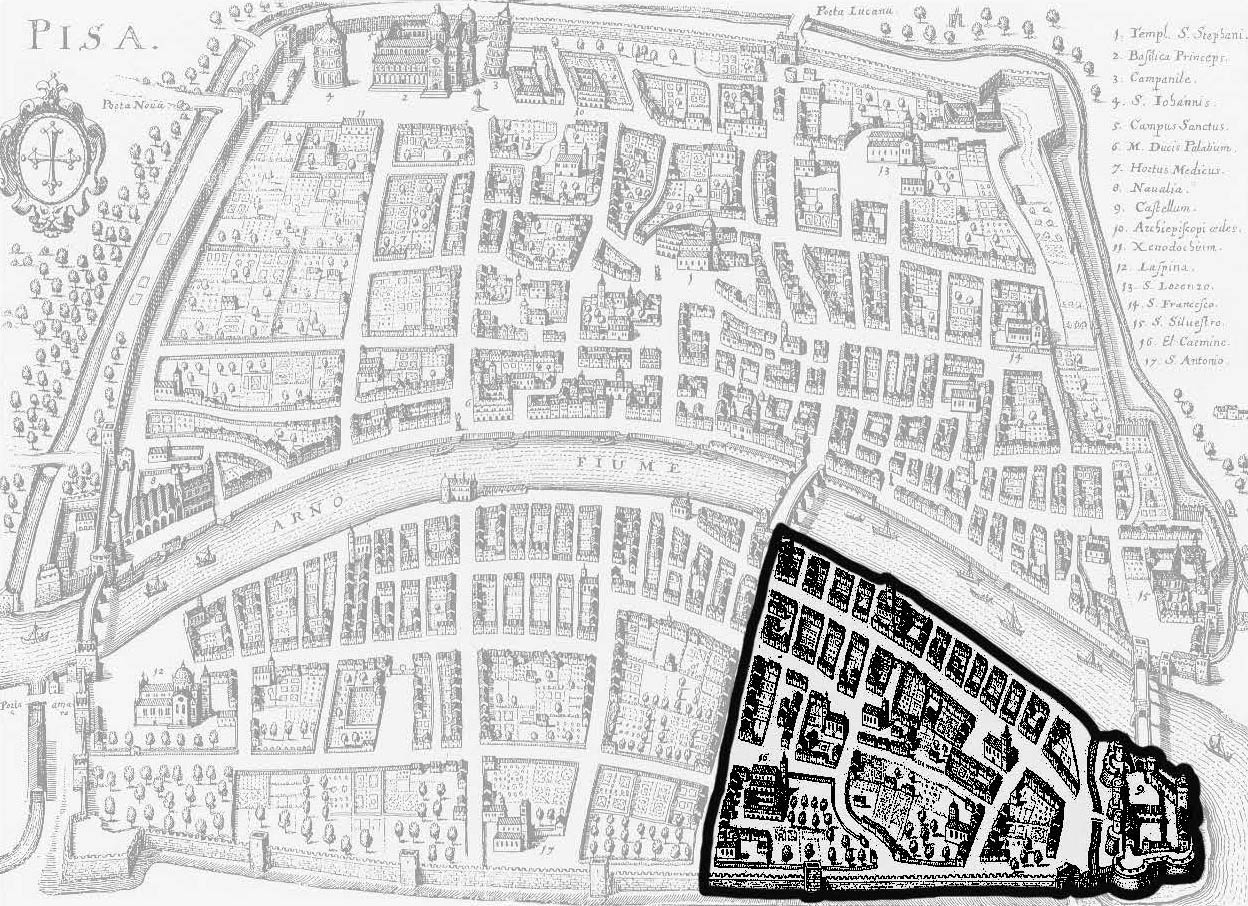
The district was crossed by the road known as the Carraia Maiore, along which pilgrims entered the city. An infirmary was built beside the church of their patron saint, Saint Martin, where pilgrims could find accommodation, food, and, when necessary, medical care. One of its caregivers was Saint Bona (1156–1207), the district's most illustrious native. Her father had gone to fight in the Holy Land and never returned. As a religious sister, Bona herself made pilgrimages to the Holy Land and then to Compostela, travelling there nine times in all; she also journeyed to Rome and to San Gargano. After her canonisation, her relics further enhanced the prestige of the church of San Martino.
By the thirteenth century, families who had grown wealthy through maritime trade—the Della Gherardescas, the Gambacortas, and others—had also moved into the district. Their generous donations supported the church and its hospital, which thus became a source of assistance not only for pilgrims but also for the proletariat of this artisans’ quarter, lending renewed relevance to Saint Martin sharing his cloak with a beggar.
Patrons of this kind may also have commissioned the two panels of the Madonna and Child featuring Saint Martin, entrusting them to one of the greatest painters working in Pisa at the time. We do not know his name, and it is from these very paintings that he takes the name by which he is known: the Master of Saint Martin. He was once identified with Cimabue and Giunta Pisano, two founding masters of the early Renaissance in Florence and Pisa respectively. In 1948, however, Roberto Longhi established that he was an independent artist. Longhi held him in such high regard that he identified him with the brilliant “Third Master of Anagni,” who worked in the crypt of Anagni Cathedral—a hypothesis later rejected by scholars. Today, following a suggestion made by Luciano Bellosi in 1998, the most widely accepted identification is with the Pisan painter Ugolino di Tedice, whose crucifix is preserved in the Hermitage and who was the father of the renowned painter Ranieri di Ugolino.
The painting of the Master of Saint Martin and that of Cimabue do indeed share common roots. Both learned much from Giunta Pisano (c. 1190–1260), who renewed the icon-painting tradition imported from Byzantium and thereby laid the foundations of Italian Renaissance painting. Pisano gave the flat figures of icons a more sculptural quality through strong contrasts of light and shadow, made them more human by emphasizing their emotions, and rendered them more naturalistic through the use of verdaccio—a greenish, olive-brown underpainting that gave the bodies a sense of volume.
Cimabue took these innovations further, intensifying the contrasts of light and shadow and giving his figures greater physical weight and solidity. The Master of Saint Martin, by contrast, followed the Byzantine tradition, creating a three-dimensional effect with strips of tin or silver laid beneath the painted surface of the garments. Later generations carried Cimabue’s technique forward, while the Master of Saint Martin remained the final great master of a brilliant era that was drawing to a close.
The difference between the two masters is clearly illustrated by the Maestà now in the Louvre, which Cimabue originally painted for the church of San Francesco in Pisa sometime between 1275 and 1300.
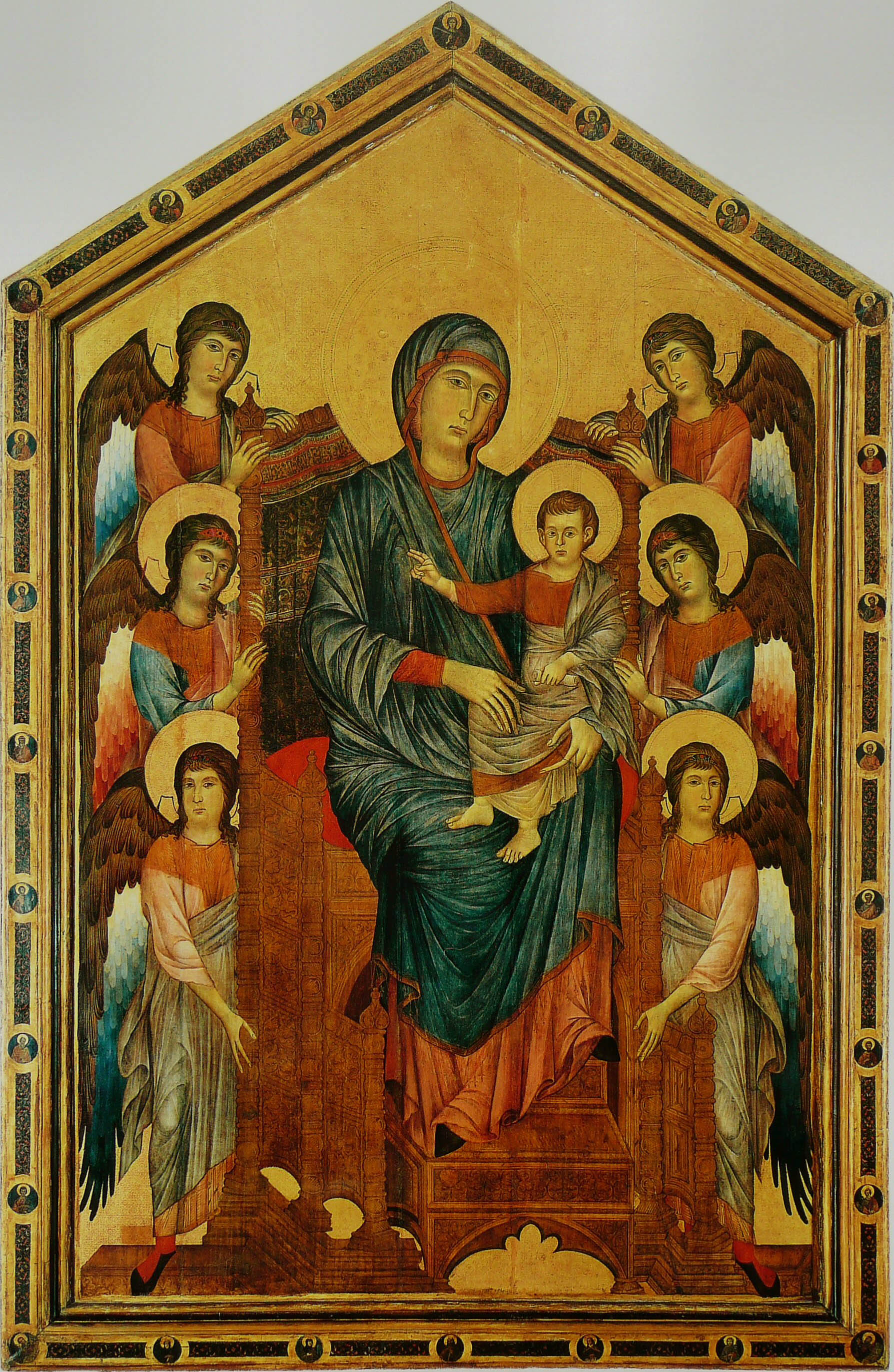
The arrangement of the principal figures is the same as in the Madonna panel by the Master of Saint Martin. Cimabue’s innovation, however, lies in replacing the narrative scenes found in the earlier work with angels standing on either side of the throne, almost as large as the central figures themselves. And because, unlike the Master of Saint Martin, Cimabue was no longer bound by an earlier model for his central Madonna, he rendered the angels with considerably greater volume and richer colour. In this way, he established a type of Maestà that Giotto and Duccio would later develop further in Florentine and Sienese painting.
The Master of Saint Martin follows the Byzantine vita icon, or biographical icon, in which the central figure is framed by the most important events of his life, his miracles, and his martyrdom. Here, however, we see something slightly different: the story leading up to the birth of Mary, as recounted in the so-called *Protoevangelium of James*, attributed to Saint James, and in the Legenda Aurea (Golden Legend). Both sources became immensely popular in the West during precisely these years: the former was brought back from the East by the Crusaders, while the latter was compiled by Jacobus de Voragine in 1260.
This account of Mary's origins reached the West at just the right moment, for the Franciscans were beginning to promote the doctrine of the Immaculate Conception at around this time. Contrary to popular belief, this does not mean that Mary conceived Jesus without a man; rather, it means that, through God's grace, she herself was conceived free from original sin, so that she could give birth to Christ without the stain of sin. Once this doctrine had turned attention towards Mary's conception and birth, a story recounting these events in detail, and backed by apostolic authority, proved particularly timely.
Six scenes on either side of Mary and the Child tell the story. The sequence begins with the Annunciation, which at first glance seems to disrupt the chronological order. In fact, however, it is the most important scene in the cycle: its visual and conceptual framework, the moment for which everything else takes place and towards which all the other scenes lead—the beginning of the story of Redemption.
One striking feature of these scenes is that, with the exception of the Annunciation, where Gabriel appears before Mary in accordance with tradition, every angel depicted in the other episodes bears the features of Christ. Such Christomorphic representations of angels are not uncommon in medieval Western and Byzantine painting. Christ is the Word of God; therefore, when God's messenger speaks in the Old Testament, it is through Christ—the Word before the Incarnation—that God makes himself heard. At the same time, the painter reminds the viewer that the heavenly voice comforting the devastated Joachim and Anna is the same divine power that will become human in Mary's womb, and that we see here resting in Mary's arms.
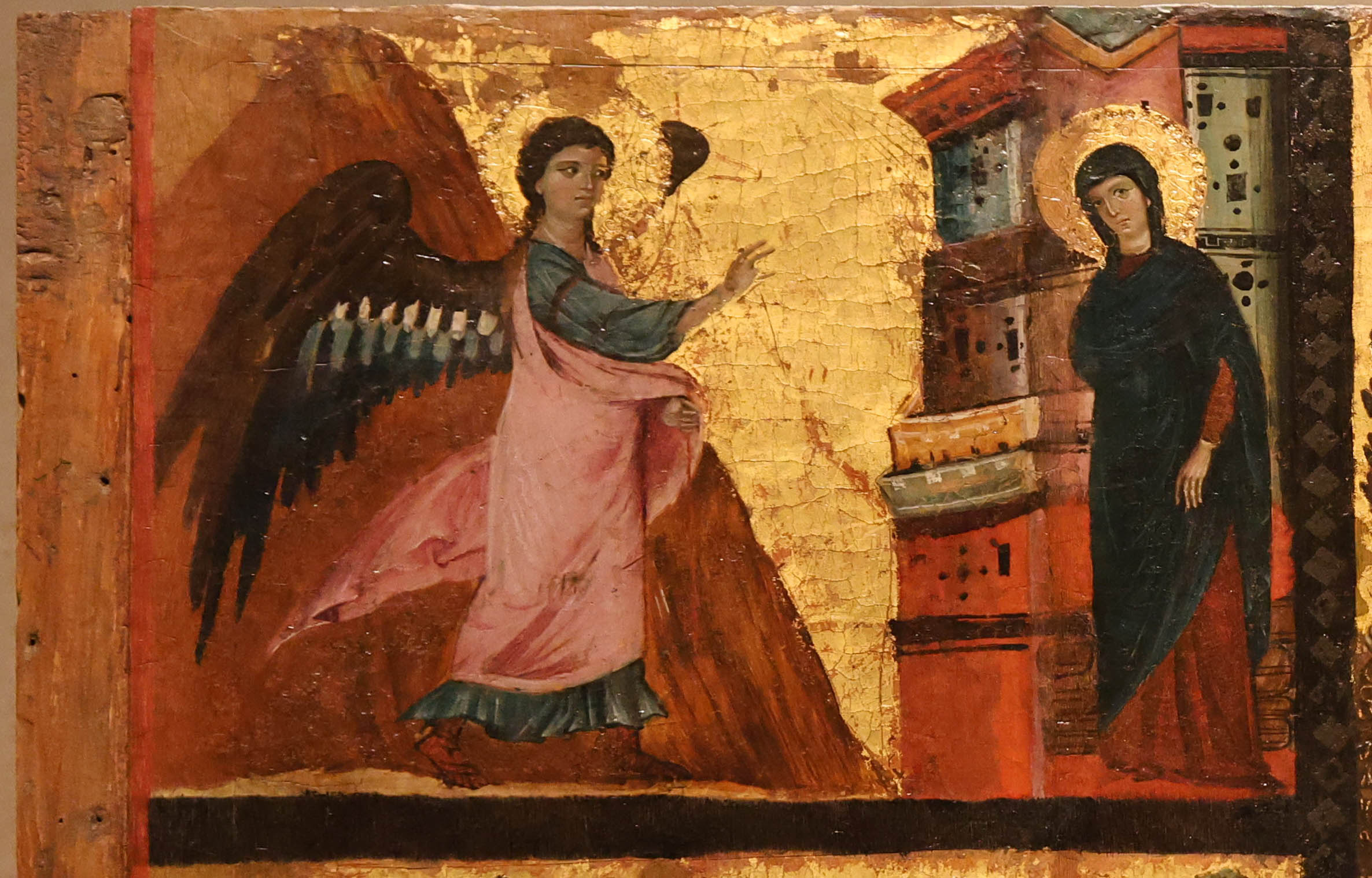 The Annunciation
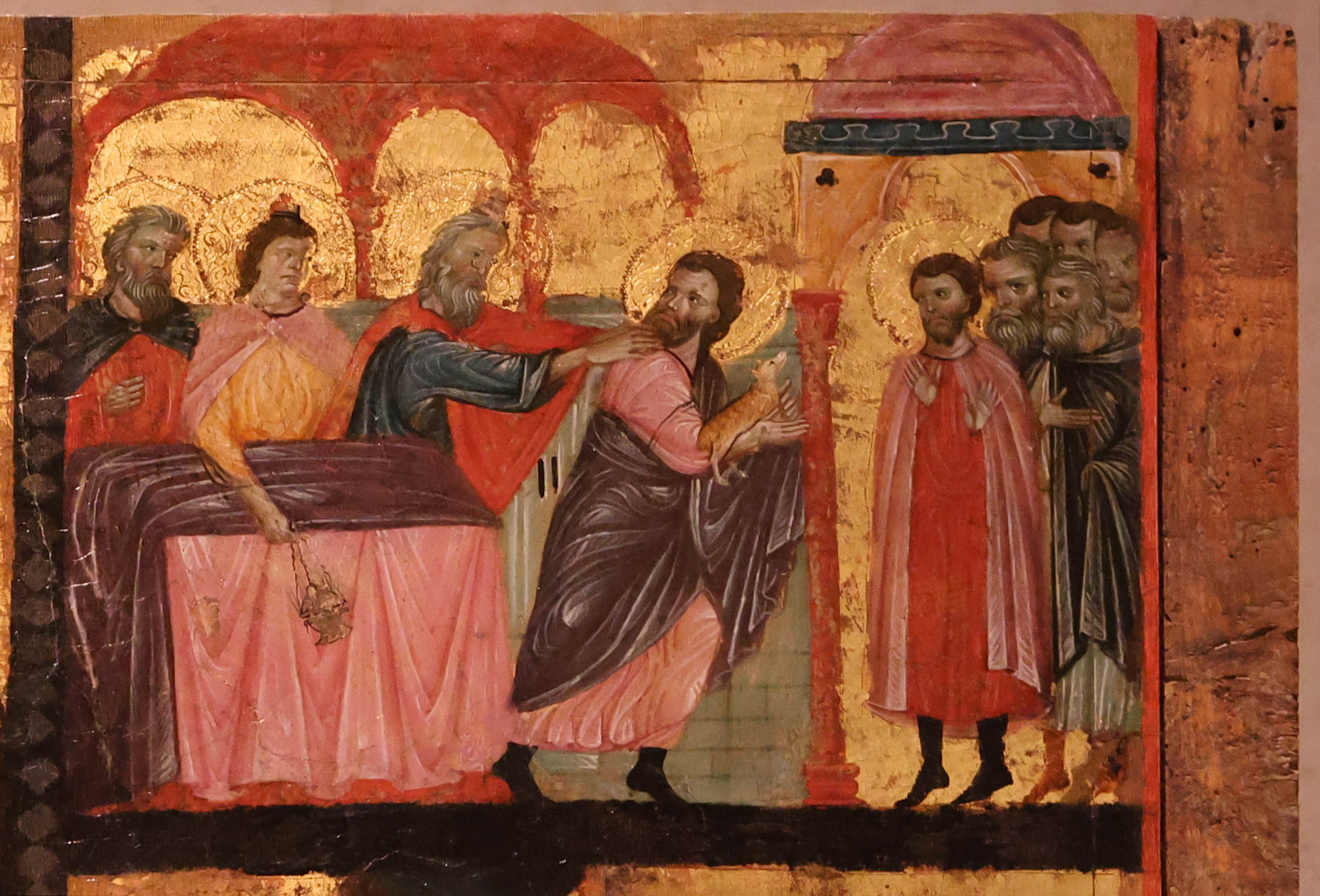 The priest refuses to accept Joachim's offering in the Temple and even drives him out, declaring that anyone in Israel without descendants is accursed and that his sacrifice is impure. To the right stand other Jews and scribes as witnesses. The painter gives the garments light and texture with a dense network of fine strokes in pure lead white.
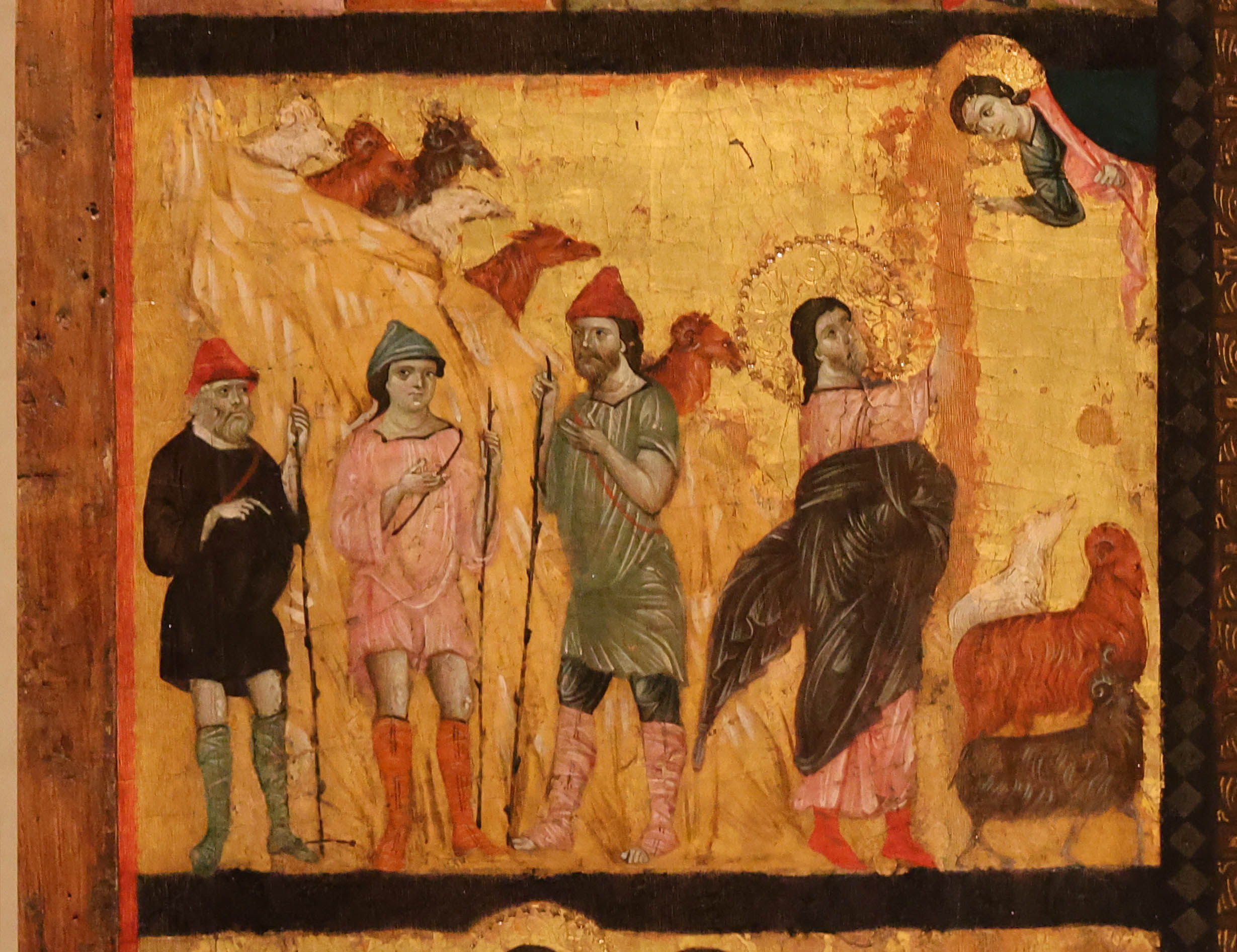 Joachim (on the right, dressed in dark green) flees to his shepherds, where God's angel reveals to him that he will soon have a daughter.
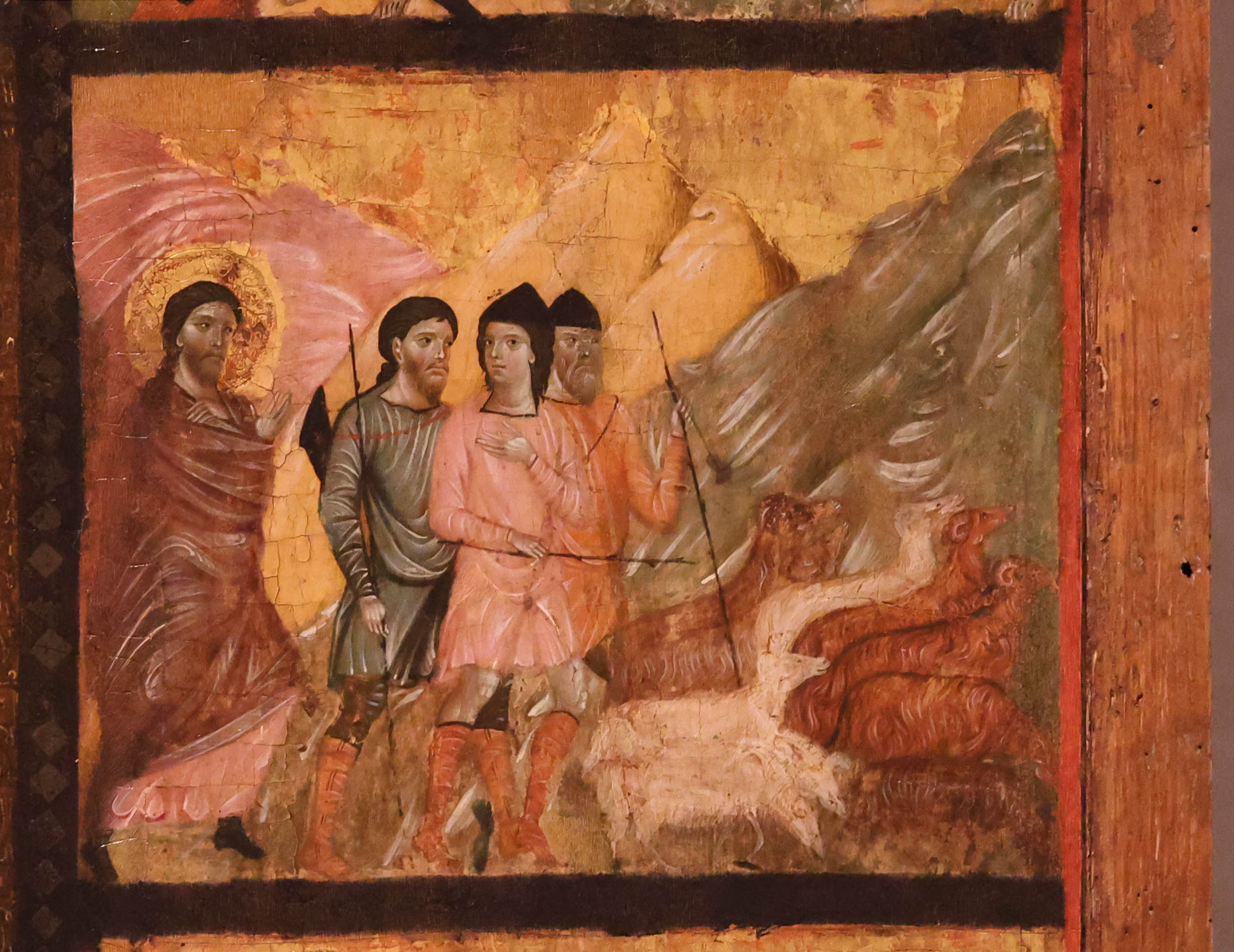 The angel's first appearance before Joachim and his shepherds.
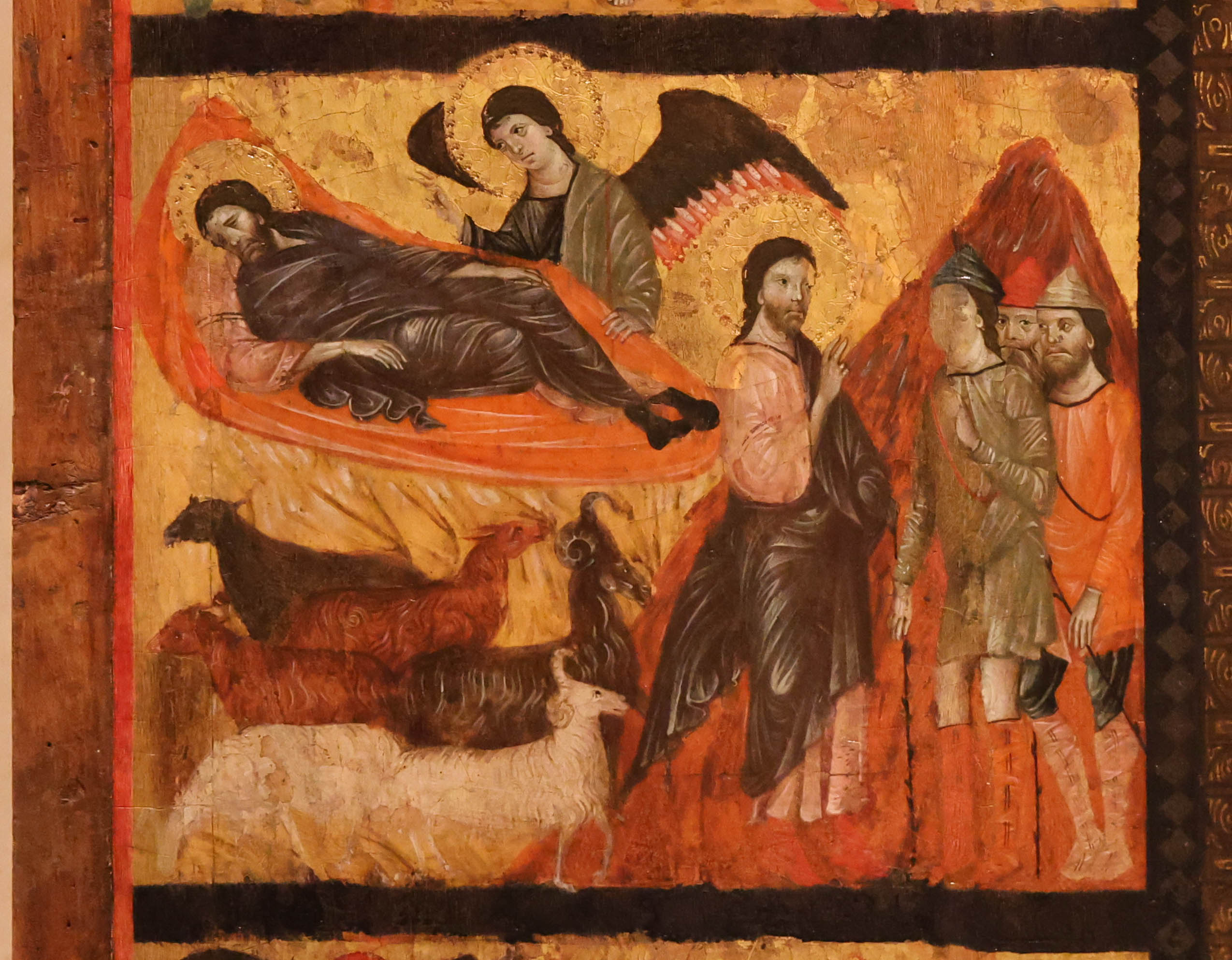 Joachim receives the good news from the angel in a dream; after he awakens, the angel repeats the same message to him.
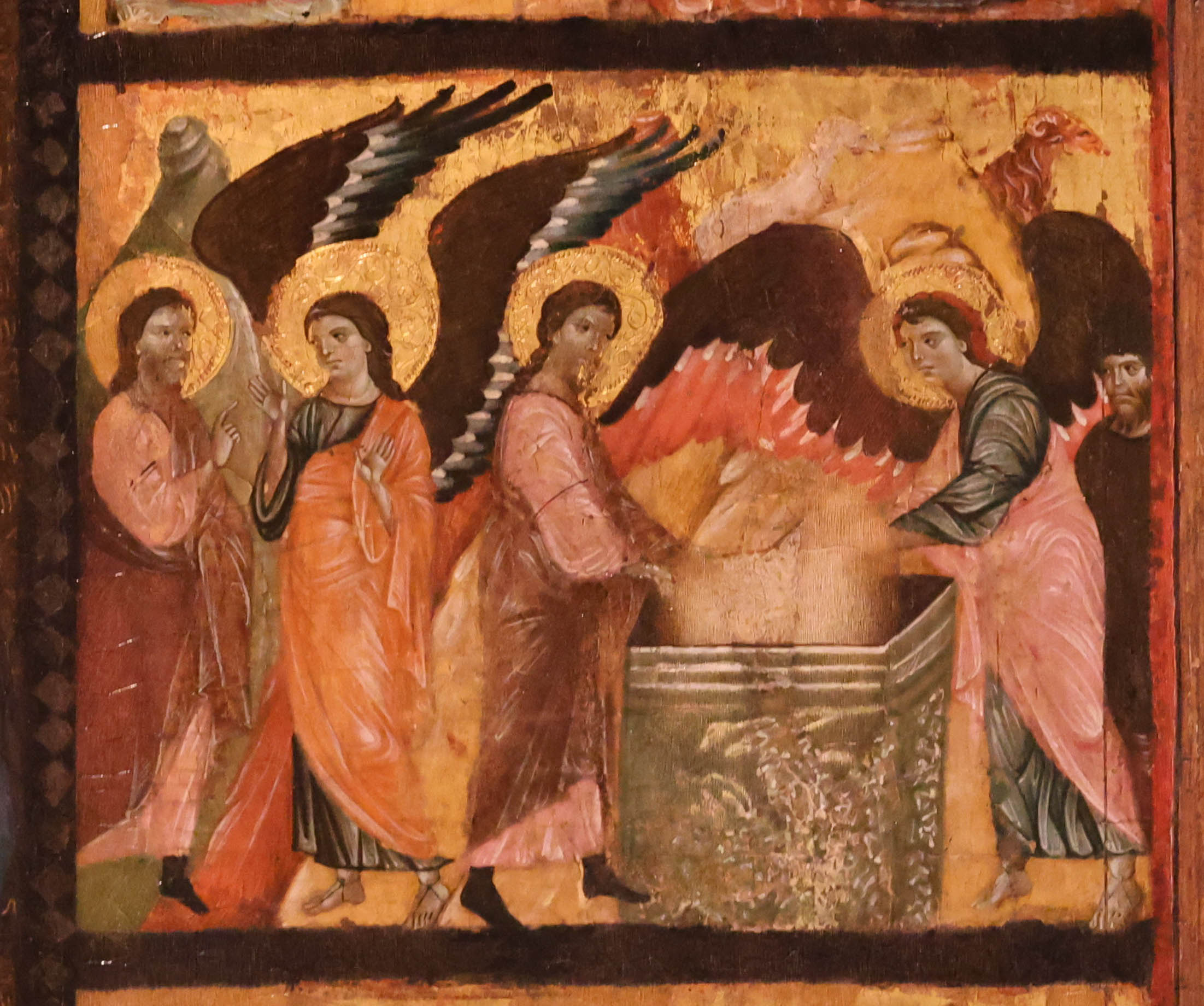 In gratitude for the good news, Joachim sacrifices ten lambs on an improvised altar, assisted by Christomorphic angels.
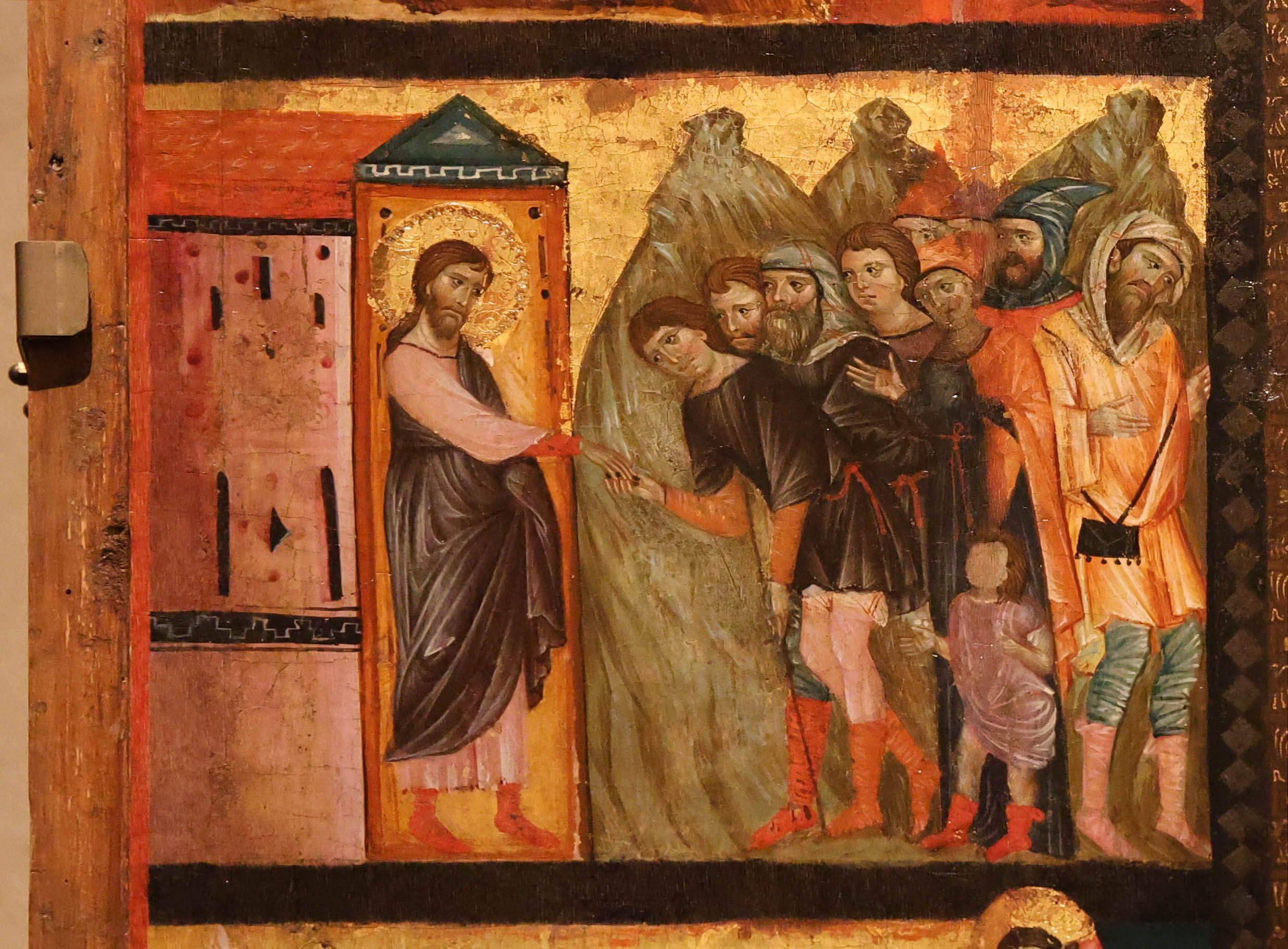 Joachim returns to the city accompanied by his shepherds. The angel awaits him at the city gate, and Joachim greets him humbly.
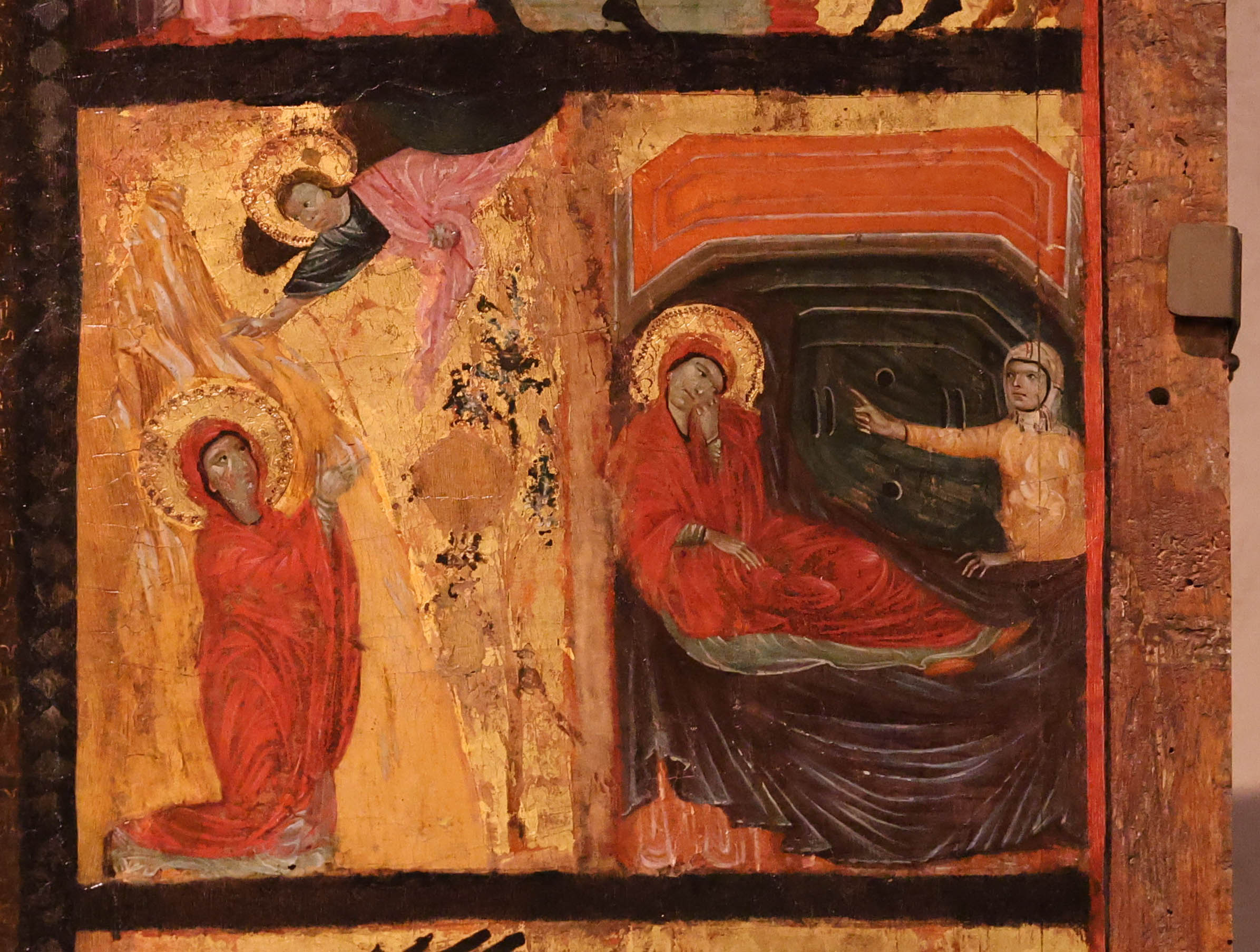 The angel announces to Anna in the garden, too, that she will give birth to a daughter. On the right, Anna sits pensively in her room, while her maidservant may be alerting her to the angel’s arrival.
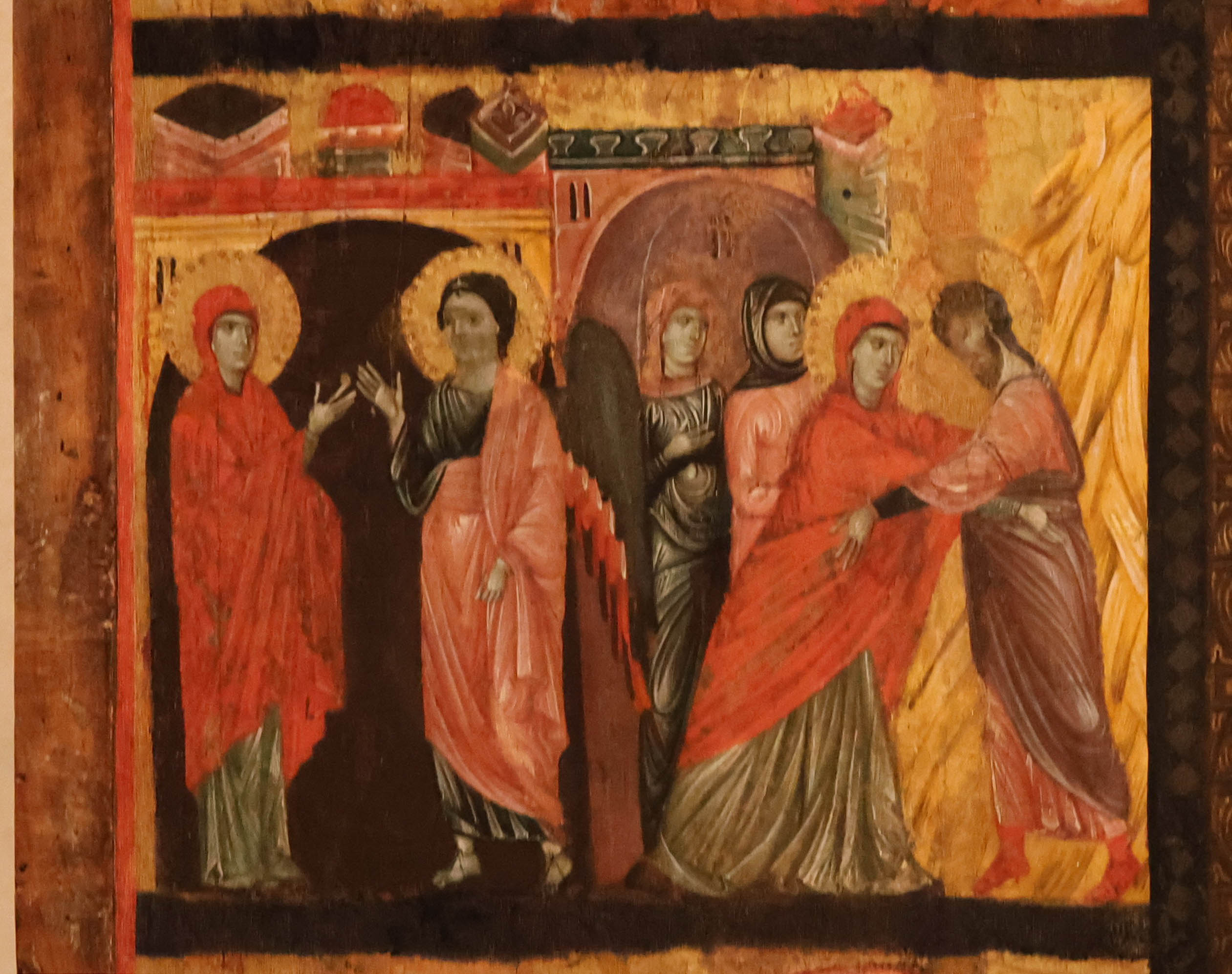 On the left, the angel tells Anna to go to the city gate to meet Joachim. On the right, Anna and Joachim embrace at the gate. Their kiss symbolizes the Immaculate Conception.
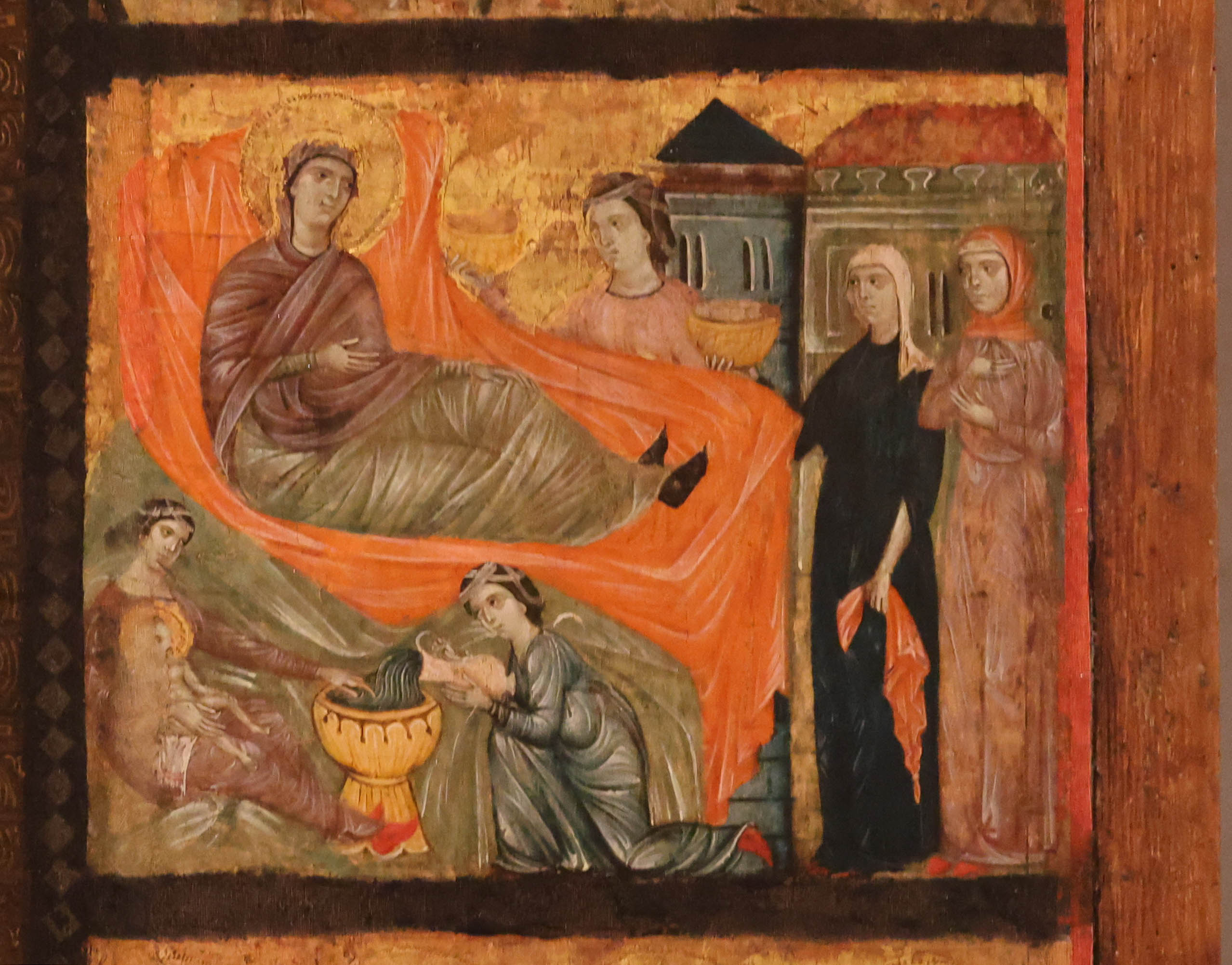 The Nativity of Mary. The composition, with the mother reclining and midwives bathing the newborn, echoes the traditional scenes of the Nativity of Jesus.
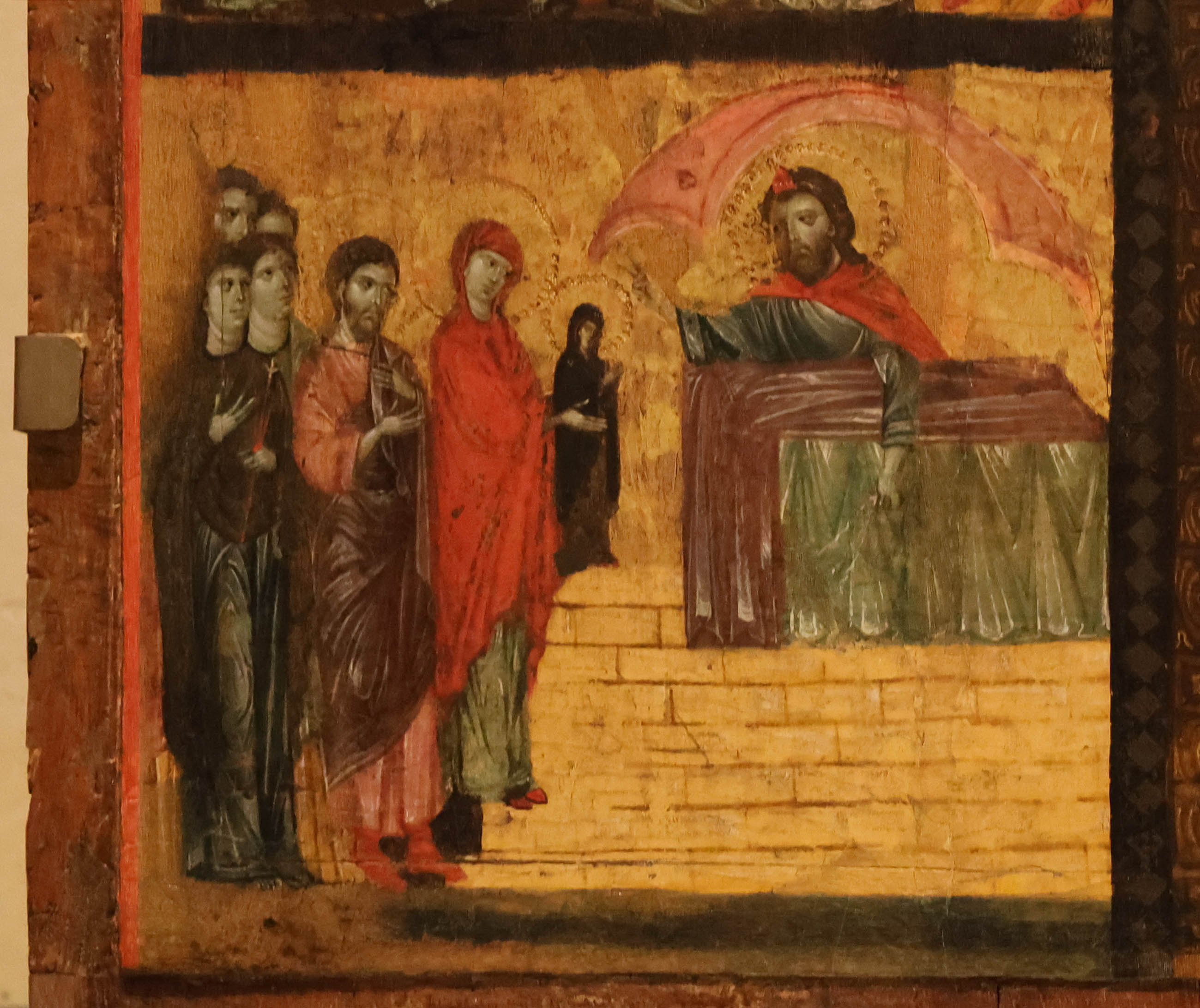 Mary’s parents bring their three-year-old daughter to the Temple. She climbs the steps on her own to approach the high priest, who is also depicted with Christ’s features.
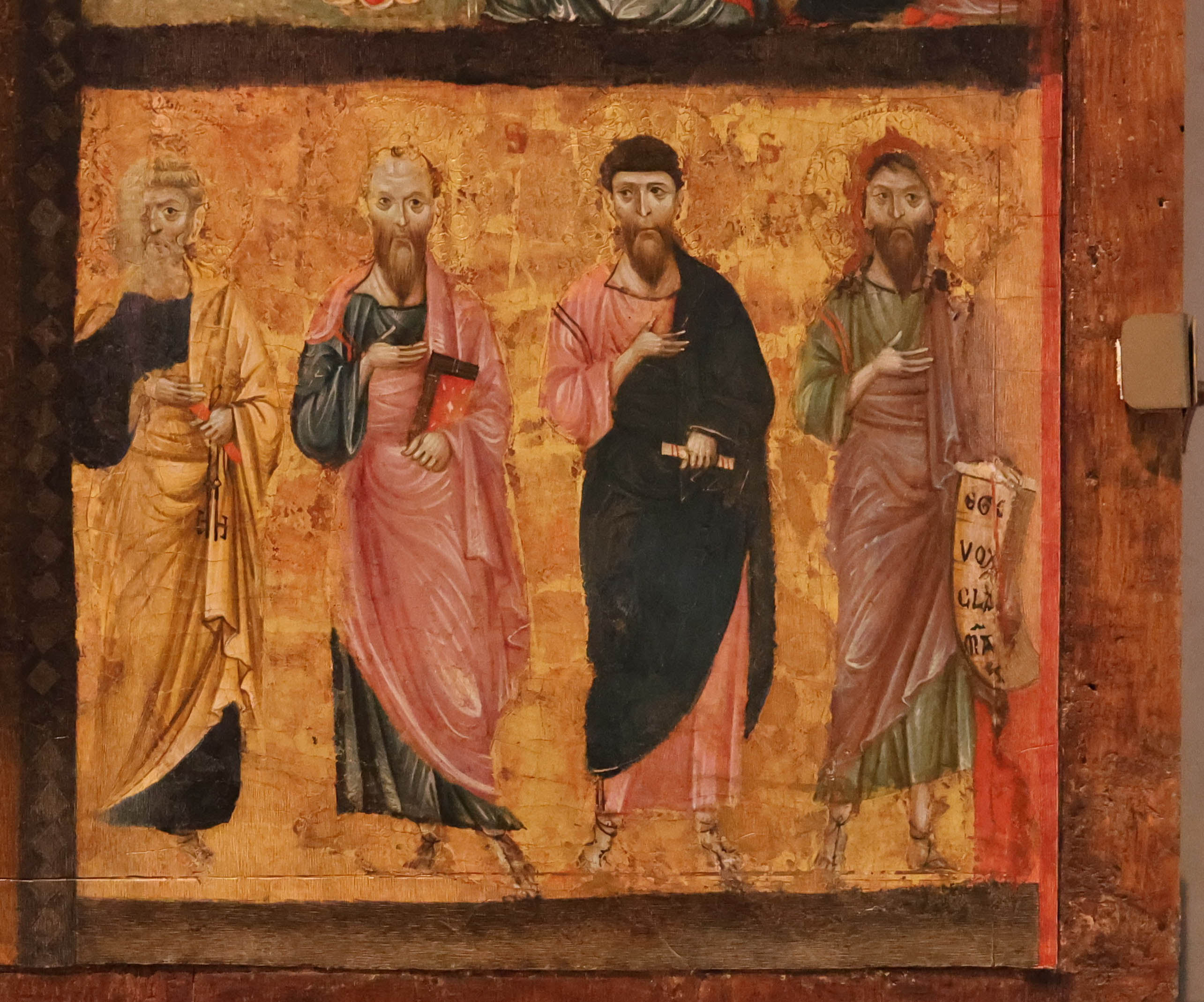 The final panel features four prominent saints: Peter, Paul, James (the author of the Protoevangelium), and John the Baptist (Christ’s cousin).
The significance of Saint Martin, shown at the foot of the throne sharing his cloak, is greatly enhanced by his presence in a story of such importance—as though he were an additional scene in the narrative—and by his place among this heavenly court.
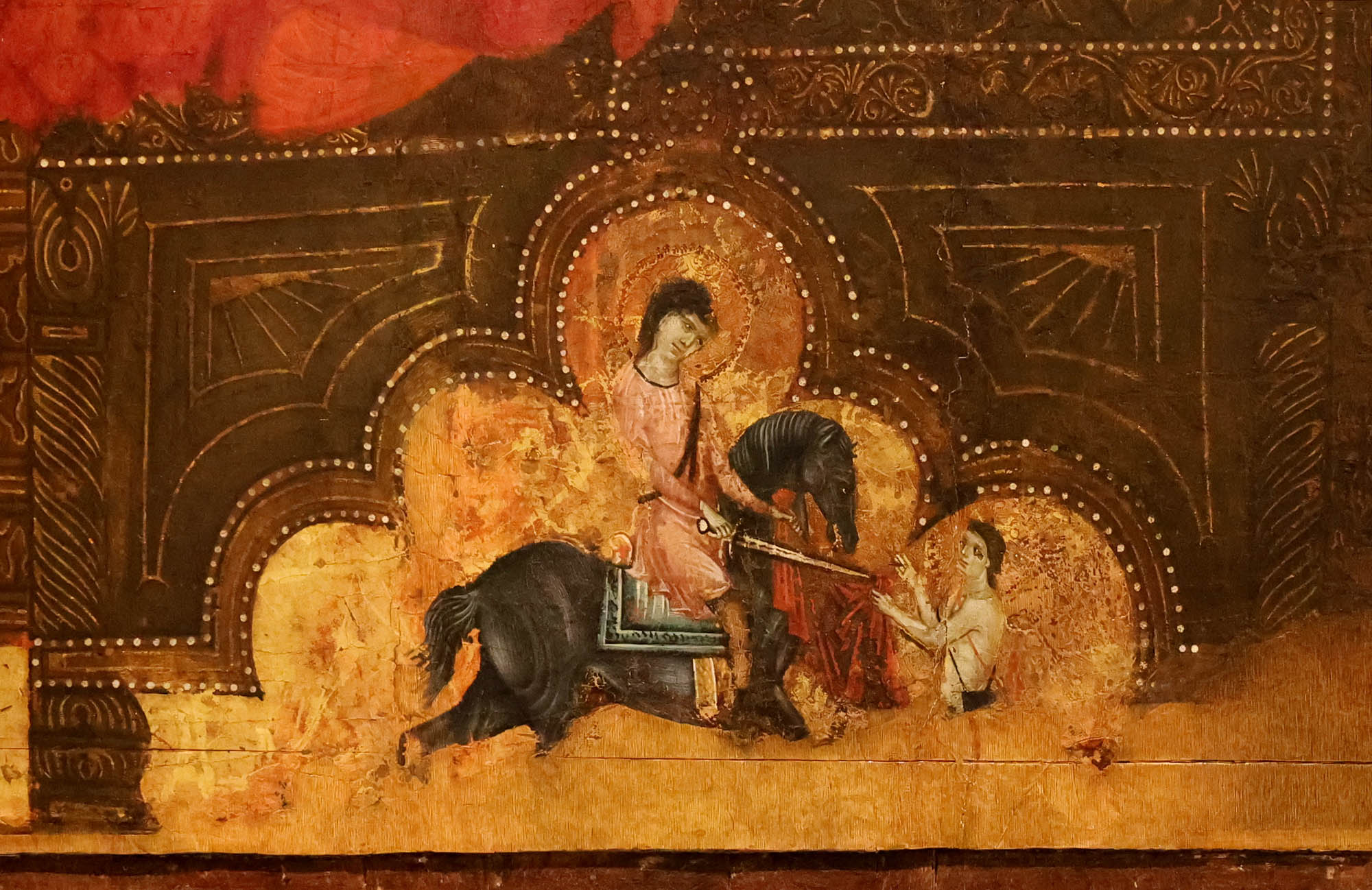
The lunette panel does not tell such a detailed story. Yet it has its own theological subtlety.
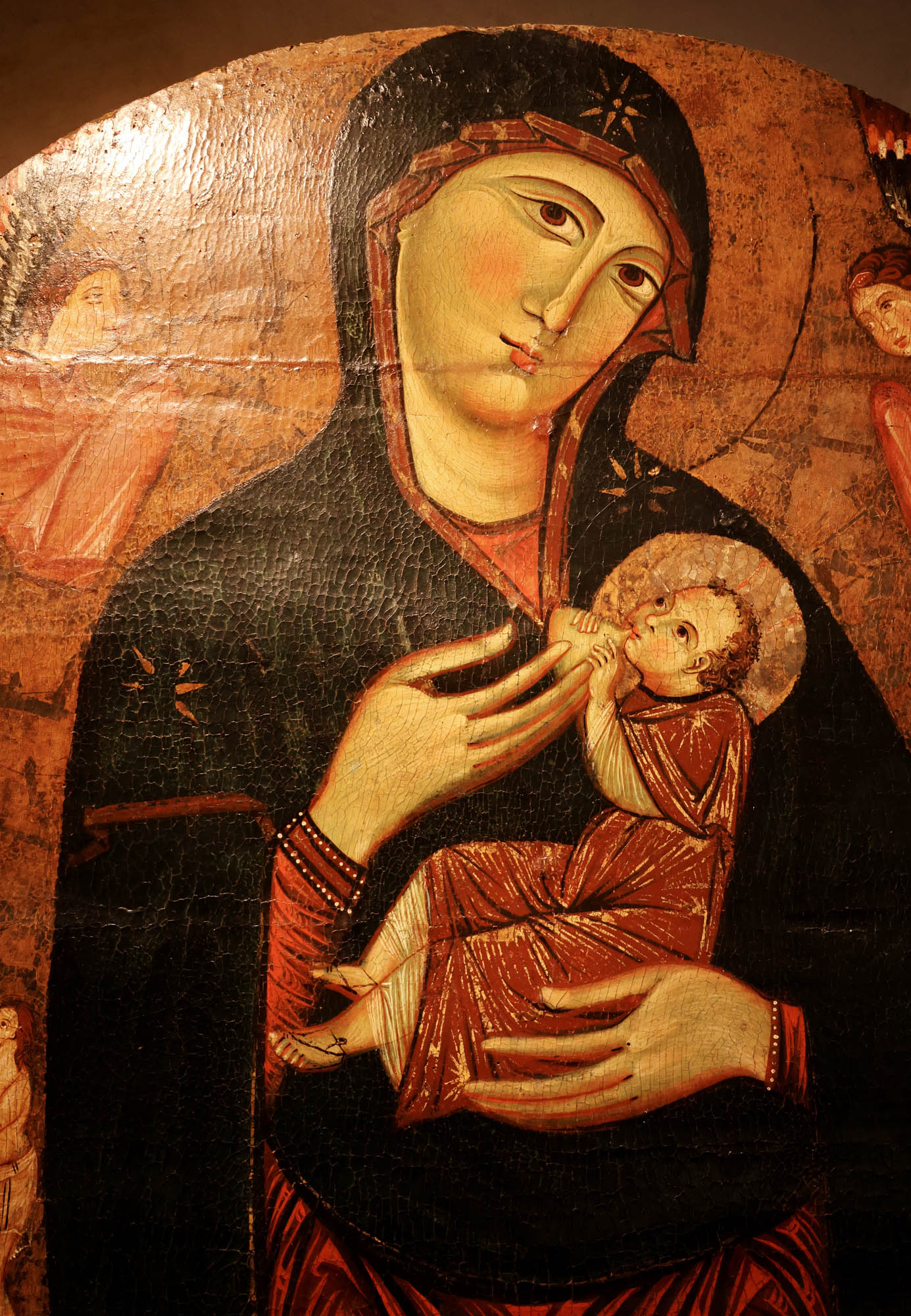
We tend to see the Nursing Madonna as an expression of the tender emotional bond between mother and child, and Renaissance and Baroque art did everything it could to encourage us to see it that way. Originally, however, this iconographic formula conveyed a theological teaching.
In the fifth century, Nestorius, Patriarch of Constantinople, taught that Christ’s divine and human natures remained separate. The Council of Ephesus in 431, which condemned Nestorius, declared instead that the two natures were united inseparably in Christ. Saint Cyril of Alexandria even explicitly invoked Mary nursing her child as proof that the Son of God had truly and fully become a human infant. The iconographic formula of the Galaktotrophousa (the Milk-Giving Mother of God) thus became an expression of the orthodox position.
This iconographic formula, which had spread throughout Eastern Christianity from the fifth century onward, reached the West in the thirteenth century through Pisa’s maritime trade connections. The painting by the Master of Saint Martin is its earliest known Western rendering. That the master—or whoever devised the iconographic programme—understood the formula’s original theological meaning is also demonstrated by the figure to Mary’s right: Saint John the Evangelist is writing in his book precisely the verse “In the beginning was the Word,” whose continuation reads, “And the Word was made flesh, and dwelt among us.”
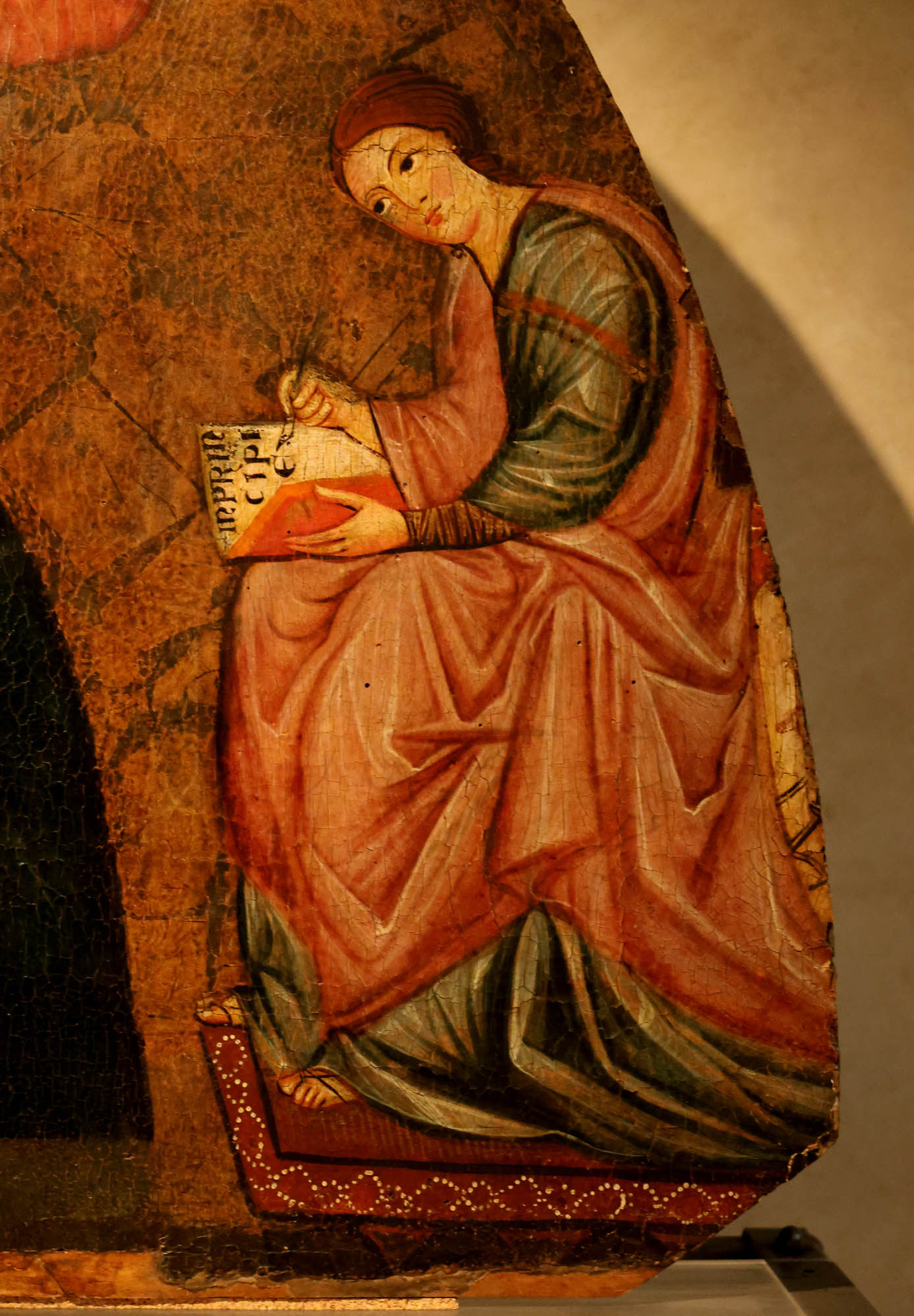
At the centre of the image are Mary and the divine Logos, who truly became incarnate as a human being. Yet the fact that Saint Martin appears alongside Saint John the Evangelist, the foremost witness to this mystery, as an equal member of the heavenly court must have been a tremendous honour for the parish that commissioned the painting. And for Saint Martin himself. And, let us admit it, perhaps a little for us too, his compatriots so many centuries later.


Add comment